Peter Carlman
Karlstad University
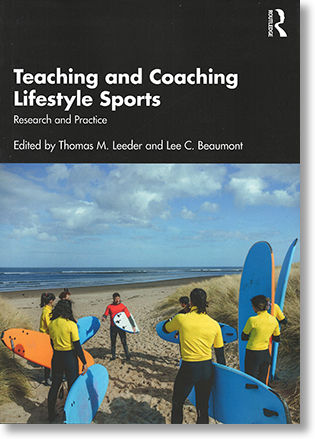
Teaching and Coaching Lifestyle Sports: Research and Practice
218 pages, paperback
Abingdon, Oxon: Routledge 2025
ISBN 978-1-03-258984-8
This edited collection by Thomas M. Leeder and Lee C. Beaumont addresses teaching and coaching within lifestyle sports and consists of 14 chapters, organised into two main thematic sections. The first focuses on lifestyle sports within the school subject of physical education, while the second addresses coaching in relation to these activities. These two sections are framed by an introductory and a concluding chapter.
The section on lifestyle sports in physical education highlights, among other things, the significance of these activities for young people as well as for the subject itself. It includes discussions on how experiences from activities such as mountain biking can be transferred from educational settings to extracurricular contexts, how freeriders in skiing learn, and how lifestyle sports can be understood in relation to broader issues such as childhood and neoliberalism. Furthermore, the section explores how lifestyle sports can be used to create more meaningful physical education, including how they may be integrated into the curriculum.
The second thematic section focuses on coaching and examines lifestyle sports in various contexts, such as surfing, BMX, and orienteering. It also addresses the professionalisation of lifestyle sports, particularly in relation to their inclusion in the Olympic Games. In addition, the section highlights how participation in lifestyle sports may have positive effects for individuals engaged in more traditional team sports. A central aspect explored here is how coaching practices relate to the often non-competitive ideals and more informal learning processes characteristic of lifestyle sports.
For example, discussions of informal learning processes, non-competitive ideals, and participant-driven practices within lifestyle sports offer valuable insights that could enrich how learning is understood and organised in school contexts.
The different parts of the book can be read independently, but it is in their interplay that the book becomes most compelling. When read as a whole, an overarching meta-narrative of lifestyle sports emerges, providing the reader with a deeper understanding of their inherent character. This, in turn, prompts reflections on what lifestyle sports are and what they can become in different contexts.
The division between physical education and coaching appears logical at a general and conceptual level. However, a closer reading reveals that this distinction is not as clearly dichotomous as it initially seems. The perspectives on learning developed in the coaching section appear at least as relevant for physical education, and in some cases more fully elaborated. For example, discussions of informal learning processes, non-competitive ideals, and participant-driven practices within lifestyle sports offer valuable insights that could enrich how learning is understood and organised in school contexts. These perspectives thus provide promising entry points for developing teaching practices, although they could have been further elaborated within the book.
Parts of the coaching section appear more explicitly focused on learning than some of the chapters on physical education. In the latter, the emphasis often lies on engagement and motivation, which are indeed central aspects of the subject. However, questions of what students are expected to learn and how this learning relates to the content of lifestyle sports receive less attention.
Another issue addressed in the book is that the definition of lifestyle sports is neither fixed nor easily determined. This is reflected in the wide range of activities included, where, for example, orienteering in a Swedish context is traditionally considered part of competitive sport rather than a lifestyle sport. This makes it challenging for practitioners who are not directly engaged in these activities to select relevant content for their own teaching.
One possible interpretation that emerges from the book is that lifestyle sports are better understood as an approach or orientation rather than as a set of specific activities. It is not primarily the activity itself that defines it, but rather the surrounding culture and the ways in which it is organised and practised. From this perspective, categorising particular activities as lifestyle sports may be misleading, as this depends heavily on context and practice. In relation to physical education, this suggests that what is transferable is less about specific activities and more about approaches to learning and participation.

At the same time, the book highlights an important argument for introducing students to new forms of movement practices beyond those that traditionally dominate the subject. This may help more students to feel included and enable them to find movement cultures in which they feel at home. However, the book could have further problematised these aspects. While lifestyle sports, with their strong links to identity and lifestyle, may attract different groups of students than traditional sports, there is also a risk that these identity-forming aspects may lead to exclusion. For some students, the cultural codes and norms surrounding these activities may be difficult to access, potentially creating new forms of marginalisation. This may in turn limit their transferability into long-term participation: while students may enjoy these activities in school, they may lack the resources or disposition required to engage in them outside school contexts. Here, the book implicitly points to an important didactic challenge that could have been explored further. Working with lifestyle sports in education thus involves not only introducing new activities, but also engaging with the cultural and social contexts in which they are embedded.
The book not only tells a story about sport, but also offers a broader perspective on society. By tracing how different sports emerge and develop, it highlights not only the history of sport but also wider social, cultural, and societal transformations, for example in the chapter on neoliberalism and childhood. This represents a particularly valuable contribution, especially in relation to physical education. By emphasising the societal dimensions of sport, the subject can be broadened beyond a sole focus on physical activity to include knowledge of how sport both shapes and is shaped by the society in which it exists. In this way, physical education can be strengthened as a knowledge-based subject, enabling students to develop a deeper understanding of the significance of movement culture in a wider societal context.
The book is primarily aimed at researchers. The chapters are written and structured as academic texts, and the format follows that of a traditional scholarly anthology. At the same time, it is also relevant for practitioners, such as teachers and coaches, who wish to develop their pedagogical leadership. As previously discussed, these groups can gain valuable insights, even in sections of the book that do not explicitly address their specific contexts.
As the book is not designed as a textbook, it is less suitable as introductory reading at undergraduate level. Instead, it functions as a more advanced resource. In this regard, it is particularly well suited as an entry point or overview for master’s students and doctoral candidates planning to develop research projects within the field of lifestyle sports.
At the same time, the book appears especially useful for teacher educators, who can draw on it to develop deeper knowledge of the field. This knowledge can then serve as a foundation for introducing and integrating perspectives on lifestyle sports in teacher education, thereby contributing to the development of future teachers’ understanding of the field.
Teaching and Coaching Lifestyle Sports clearly highlights an ongoing struggle over the definition of sport, what sport is and should be, as well as what knowledge and skills are considered relevant, how they should be learned, and why. In this sense, the book is not only about lifestyle sports as a phenomenon, but also contributes to a broader discussion of learning and coaching in sport. It thereby holds wider relevance within sport studies, as it addresses fundamental questions about knowledge and meaning in sport.
Copyright © Peter Carlman 2026