

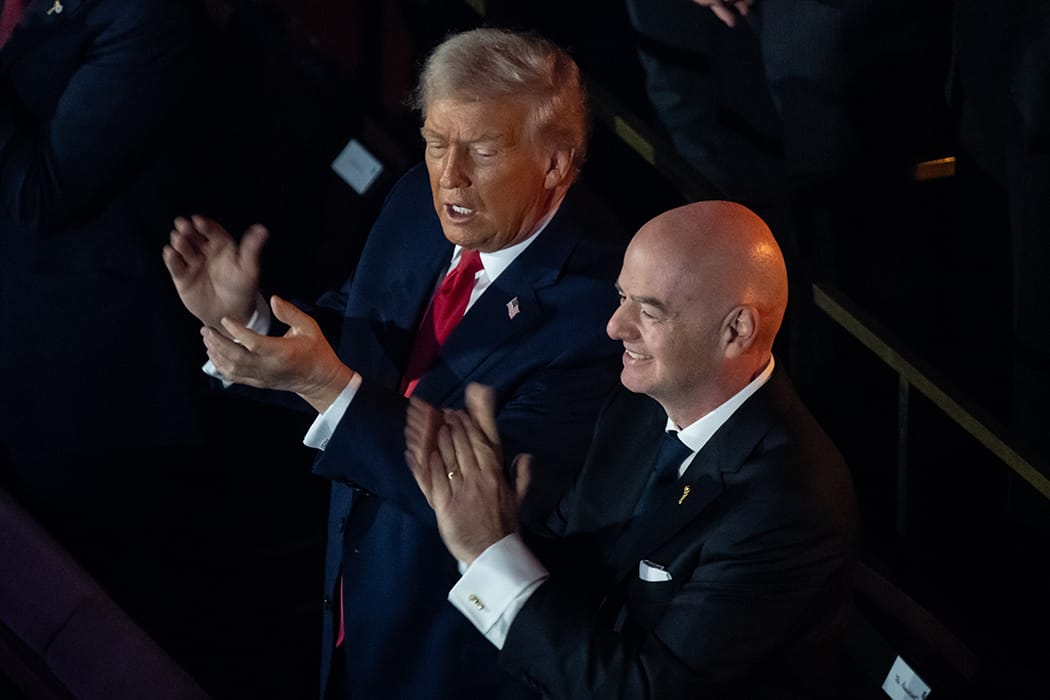
The 2026 FIFA men’s World Cup in the United States, Canada and Mexico is almost upon us.
This sporting spectacle – the largest ever World Cup, with 48 teams – will generate many memorable moments.
Mexico will get the tournament underway in its capital city on June 12, hosting South Africa.
Apart from the on-field action, much attention will be paid to the politics of the World Cup and to two major political players – US President Donald Trump and his FIFA counterpart Gianni Infantino.
But before a ball is kicked, an earlier media encounter is stubbornly lodged in the mind which sheds light on the cosy relationship between two presidents with much in common.
An increasingly close relationship
This is the bizarre sight of Trump receiving the International Federation of Association Football (FIFA)’s inaugural Peace Prize from Infantino in December 2025:
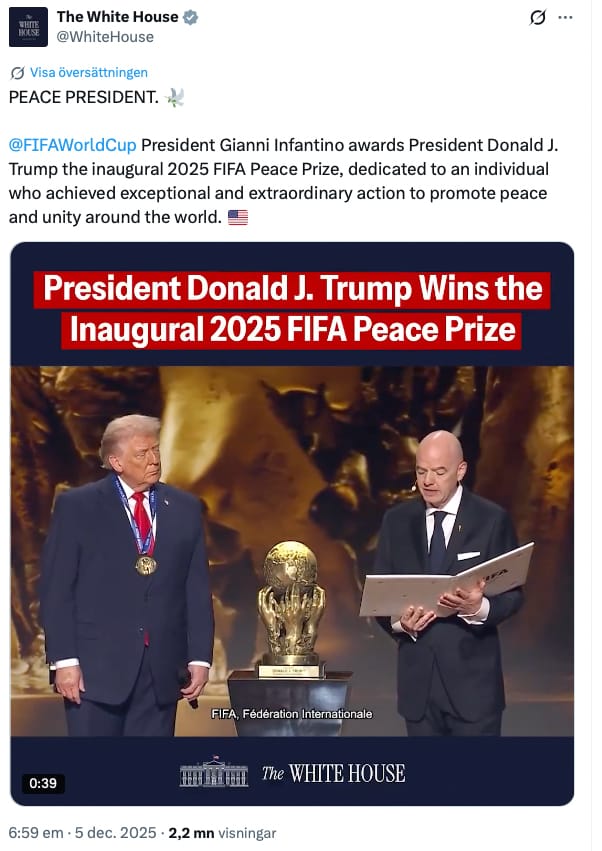
After Trump failed to receive his much-coveted and unashamedly demanded Nobel Peace Prize, Infantino jumped into the breach.
The two presidents make an odd couple in some respects.
Character assessments of Trump are, as he might put it, a dime a dozen. Outside his lovestruck MAGA support base, a survey of world opinion in his first presidency found him much disliked as the quintessential “ugly American”.
It has arguably become worse since, in view of his violent language and apparent narcissistic God complex.
By contrast, Infantino is a suave multilingual Swiss-Italian lawyer following in the footsteps of compatriot Joseph Sepp Blatter – his former, more flamboyant FIFA boss.
Blatter resigned shortly after re-election as FIFA president under pressure after the infamous dawn raid by FBI agents in Zurich during the 2015 FIFA Congress.
Seven high-ranking FIFA officials were arrested, and a further seven elsewhere, in a grand exposure of FIFA’s alleged corruption.
Just as Trump promised to “drain the swamp” of the US establishment, Infantino sold himself publicly as the cleanskin reform candidate ready to take on internal corruption and clean up FIFA.
But both Trump and Infantino have used the power of their presidencies to make major decisions with minimal consultation, while spreading considerable largesse around those who help keep them in their respective offices.
How the relationship blossomed
Infantino turned up the dial on the approach first adopted by world leaders – though now noticeably muted – of flattering and appeasing Trump.
Regularly attending the White House and other spaces around the world alongside Trump, in February 2026 Infantino committed FIFA to a strategic partnership with Trump’s United Nations-supplanting Board of Peace.
During the 2025 FIFA Club World Cup held in the US, Infantino watched with almost parental indulgence as Trump gatecrashed the on-field celebrations of winners Chelsea.
@skysports US President Donald Trump joined Chelsea on stage for the Club World Cup trophy lift 🔵🏆 #footballtiktok #cwc2025 #cwc #chelseafc #donaldtrump #cfc #premierleague
Infantino no doubt believes he must stick to his erratic primary host like glue for the World Cup to succeed.
It certainly has many potential flashpoints: Trump has declared co-host Canada should be incorporated as the 51st state of the US and insulted the other host, Mexico, as a land of criminals and rapists.
Trump’s administration has banned or imposed visa restrictions on fans from four participating nations and another 15 countries.
He previously threatened to move games from Democrat cities that he deems dangerous, and there are concerns about cost inflation for fans and the intimidating presence of US Immigration and Customs Enforcement (ICE) in and around stadiums.
These problems were compounded when, three months out from the World Cup, the US and Israel attacked Iran, prompting the Iranian team’s threatened withdrawal.
Apart from the resultant greater security threat to the tournament, already difficult and expensive international travel to the US became more so.
Infantino’s illiberal friends
Receding democracy in Trump’s America is, though, familiar terrain for Infantino.
Since Infantino’s election in February 2016, soon after Trump’s first inauguration, he has overseen men’s World Cups hosted by a succession of illiberal nations.
After the 2018 edition in Russia, President Vladimir Putin presented him with that country’s Order of Friendship medal after Infantino called it “the best World Cup ever”.
Infantino lived in Qatar in the lead-up to its 2022 tournament, cultivating his relationship with that country’s Emir, Tamim bin Hamad Al Thani. He fended off as hypocritical Western criticisms of the conditions and deaths of the migrant workers who built the stadiums.
In a notorious speech on the eve of the tournament that had echoes of Trumpian megalomania, Infantino likened his own experience of minority discrimination to that of people who are Qatari, Arabic, African, gay, disabled, or migrant workers.
Infantino then engineered the future hosting of the tournament in three confederations in 2030 – Europe, Africa and South America. This enabled an early return to the Middle East in 2034 in another illiberal nation, Saudi Arabia, where he has built a close relationship with its ruler Mohammed bin Salman.
In light of these developments, the Trump-Infantino alliance seems less remarkable.
It appears Infantino is dealing with Trump as just another king-like authoritarian leader from an affluent country keen to host FIFA’s most lucrative event.
Although often criticised as sportswashing, it is important not to underplay the naked economic interests at play.
Behind their mutual love of pomp, ceremony and personal awards, the tight embrace of Trump and Infantino is supercharged by soccer’s financial goalscoring record.
Both were elected with the promise of making other people richer. They have certainly done well for themselves, but the 2026 World Cup is likely to reveal a deeper ethical poverty at the heart of the world game.
This article is republished from The Conversation under a Creative Commons license. Read the original article.
Copyright © David Rowe 2026
Email: d.rowe@westernsydney.edu.au
Twitter: @rowe_david
Website: https://www.westernsydney.edu.au/ics/people/emeritus-professors/david-rowe
