Malcolm MacLean
University of Gibraltar/University of Wales Trinity St David
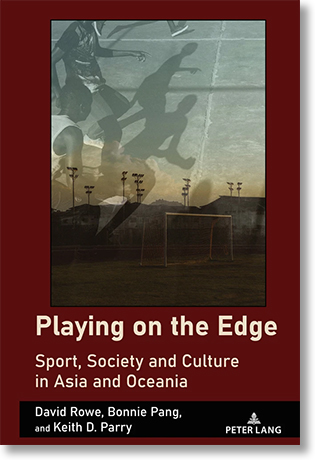
Playing on the Edge: Sport, Society and Culture in Asia and Oceania
207 pages, hardcover
Oxford, Oxon: Peter Lang Publishing 2026 (Sport in East and Southeast Asian Societies)
ISBN 978-1-4331-9355-2
One of the many welcome consequences of the post- and decolonial insurgency in the scholarly world has been the growing awareness and critical assessment of the geographical power dynamics of intellectual practice. As a result, in many discipline areas we are seeing a recognition of the partiality of perspectives grounded in the North Atlantic, Euro-(North) American nexus and with it the distinctiveness and significance of views from those regions, groups, and communities Othered and marginalised by that classed, racialized, and gendered geographical heartland. This well-crafted and multifaceted exploration of sport that both draws together an array of sites, forms, and aspects of bodily movement along with different but integrated authorial perspectives provides a vital critique of that dominant conceptualisation in sport studies.
In weaving together these studies, ranging from localised community explorations to trans- and international investigations of sport policy, economic and social significances, and sport cultures, Rowe, Pang, and Parry view sport as neither “irredeemably reactionary” nor glibly celebratory but as a dynamic, contested space and practice centred in that Euro-American framework. Instead, they have, in their words, “made metaphorical play with the concept of the edge in its full, polysemic glory” (p160). In doing so they provide a view from the edge(s) of sport that disrupts the conventional power dynamics of globalised sport cultures to show both the difference of and the challenge from the margins. In this sense, they have given us a powerful exploration of one possible path to rethink sport’s globalisation.
An alternative sense of margins, of being on the edge, can be seen in the assessment of South Asian–Australian cricket relations noting a common affinity through association with the Commonwealth and Empire that is disrupted by post-colonial tensions, especially between Australia and India.
The range of issues explored is diverse, from informal sport to the Gay Games, from Australian Rules football in China to India-Australia cricket relations, from football (as in soccer) diplomacy to esports. This diversity also recognises the fuzziness of the regional focus, in a space sometimes cast as Asia-Pacific, as Oceania, as Indo-Pacific, with the effect that while Australia sits at the centre of many of the cases explored, this is not a hermetically sealed Australia, but one that exists metaphorically and critically on the edge of Asia and Oceania. In this sense, and valuably, this allows the authors to look at its shifting relations with the Pacific and Asia, in a dialogue with its settler colony neighbour Aotearoa New Zealand, and as seen as a mistrusted local outpost and ally of the USA. The collection is then, as the authors note, the site of many edges, sporting, social, and geopolitical.
These multiple edges are held together both by a well-crafted collective voice and a clearly conceptualised introductory chapter that also provides a dual-conceptual base for the collection. The first base is a critical assessment of approaches to globalization including a timely and welcome critique noting that all too often globalization discourse becomes little more than a restatement of diffusionism without recognising the power dynamics involved or the significance of the local. This critique allows Rowe, Pang, and Parry to frame their discussions in an understanding of sport on the edge as a practice that is constantly and continuously remade.
The second critical strand casts population mobilities and sport as vital aspects of the New International Division of Cultural Labour (NICL), a notion Rowe and others have been developing over the last 25 years or so. This NICL is an approach that deserves more attention by sport sociologists and historians and is elaborated here. Woven throughout, although not to the same extent as these critical frames linking globalisation and labour, is a recurrent reflection on Australian sport diplomacy policies.
These themes are teased out in the book’s eight substantive chapters, four of which deal with inter-state relations within the region, albeit in an Australia-centric manner. The discussion of Australian Rules football links with China explores the contradictions and tensions of a major sport in a marginal state trying to effect market entry to a major state with which it has an ambiguous but largely hostile relationship. An alternative sense of margins, of being on the edge, can be seen in the assessment of South Asian–Australian cricket relations noting a common affinity through association with the Commonwealth and Empire that is disrupted by post-colonial tensions, especially between Australia and India.

This issue of post-colonial mobility is also seen in the discussion of Australia’s changing relationships with the Asian and Oceanic Football Confederations, highlighting the country’s position on the margins of both, its continuing but problematic relationship with the Pacific, and the effect of the differential standings of men’s and women’s teams. Football also plays an important part of the discussion of Australian sport in diplomatic efforts across the wider region that both develops the discussions of the NICL and makes a powerful case for diplomatic effects of grassroots sport development over state-run programmes as both lighter touch and less instrumentalist paths to soft power.
As disruptive as these approaches are to the Euro-American dominant framework, the centralisation of settler colonial Australia limits the extent of ideological disruption. This limitation, however, is offset in different ways by the other four chapters. The discussion of esport, with their strength in South Korea and the People’s Republic of China, shows this offsetting both in spatial terms and in respect of the ontology of sport. This regional dynamic locates East Asia as its centre further problematizes the notion of the edge, further compounded by the extent of commercialization involved and the uncertain place of esports on multi-sports events.
Similarly, the exploration of the Gay Games in Hong Kong shows a dualistic sense of Othering where LGBTQI+, other queer and gender non-conforming athletes are shown as marginalized in the Hong Kong sport system while hegemonic – ‘Western’ and ‘Global North’ – sexuality studies are shown as failing to recognise the specificities of queers of colour and especially ‘Global South’ experiences. The effect of this powerful discussion is to show the Hong Kong Gay Games as sitting on several edges: of the emerging ‘Asian Century’, of sport and sexuality in East Asia, and of the Gay Games as linked to whiteness, class privilege and racism.
The final two chapters continue this shift in perspective and add a change in scale. These richly informative discussions explore other kinds of edge, looking at informal sport in Sydney and Singapore taking in factors such as differential relationships with whiteness, patterns of pressure on green spaces, and the ways informal sport offsets the exclusionary character of organised sport. This discussion also opens up the place of migrant and other precarious populations’ engagements with sports participation, highlighting the value of informal sport and the paucity of academic inquiries in the area. Alongside this discussion and its suggestion of edges unstudied and populations unseen is an exploration of sport in three of Sydney’s so-called Sinoburbs that disrupts many of the presumptions about migrant and Chinese sport participation, while highlighting many of the banal exclusions in sport cultures.
In playing with the polysemous edge, Rowe, Pang and Parry have, in their words, considered “the ways in which an already unstable global sport order, with its separate and overlapping nationally defined sport fields, and its interpenetration and interdependency with the media field, is further destabilized by exogenous forces” (p 151). They have exposed the limitations of models that centralise Euro-(North) American ways of seeing and sense-making. The attention to esports with their disputes over ownership, technology, and intellectual property draws attention to the emerging and intensifying character of late late-capitalist sport, while the discussions of trans- and international sport flows highlight the emerging significance of East Asia and Oceania in the global sport ecosystem. These factors and the insights gained from the use of the notion of the New International Division of Cultural Labour combine to make this an essential addition to critical globalisation studies of sport, disrupting the power of the dominant frames of analysis.
Copyright © Malcolm MacLean 2026