 Marte Charlotte Dobbertin Gram is a PhD candidate at the Department of Sports Medicine, Norwegian School of Sport Sciences (NIH). On May 19, 2026, she defends her doctoral thesis, Overuse injuries, urinary incontinence and menstrual symptoms among Norwegian rhythmic gymnasts and dancers, at NIH, Auditorium Innsikt, 10:00+–16:00.
What is the PhD project about?
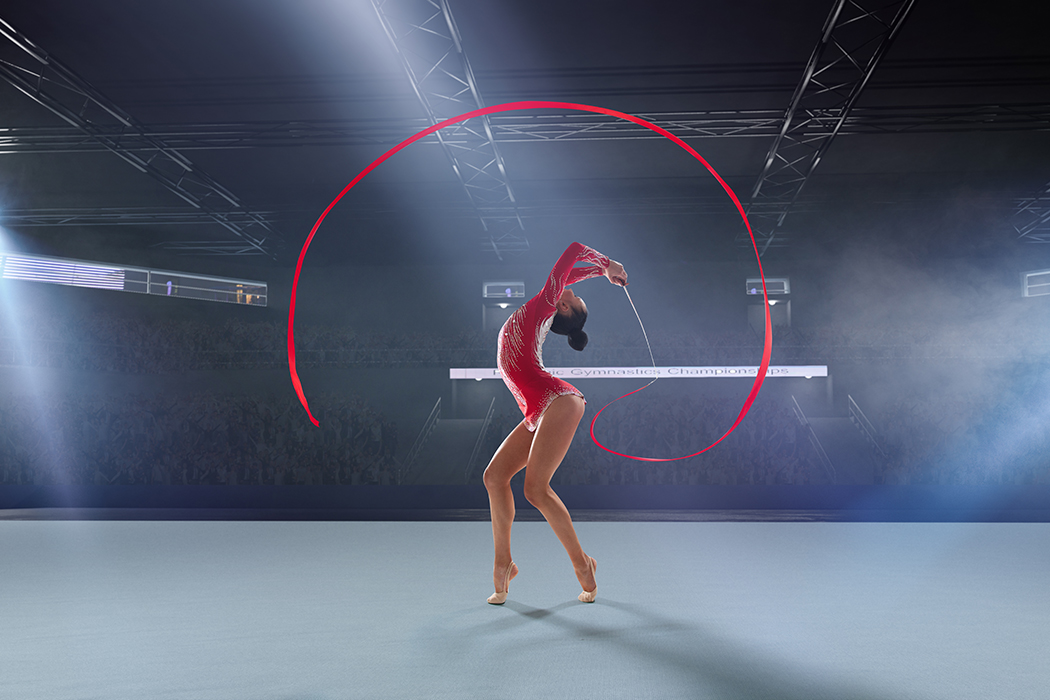
Rhythmic gymnastics (RG) is an aesthetic sport that combines the elegance of classical ballet and modern dance with the strength and explosiveness of artistic gymnastics. In competition, pre-choreographed routines are performed to music. The routines consist of a combination of body difficulty elements (leaps/jumps, balances, pivots/rotations) and elements performed with one of the five hand-held apparatuses: rope, hoop, ball, clubs, and ribbon. Body difficulty elements performed at a high level often require a combination of extreme strength and flexibility, particularly in the lower back and hips. To reach a high level, high training volume from an early age is required.
Research has shown that Norwegian rhythmic gymnasts have a high prevalence of overuse injuries in the knees, lower back, and hip/groin, and that urinary incontinence is common. Injury prevention initiatives focusing on the lower back have previously been implemented, while preventive efforts targeting the knees and hip/groin are lacking. It has also been identified a need for more knowledge on the prevention and treatment of urinary incontinence, as well as on how symptoms throughout the menstrual cycle affect training and performance—issues that this PhD project aimed to address.
What was done – and what was found?
The project consisted of four studies involving Norwegian rhythmic gymnasts and dancers. In the first study, reduced physical capacity in the knees, lower back, and hip/groin, which may potentially increase the risk of adverse loading and overuse injuries, was identified among Norwegian rhythmic gymnasts. In the following two studies, the effects of an RG-specific injury prevention program and systematic pelvic floor muscle training were tested over an eight-month period. The results showed that the specific injury prevention program alone did not reduce the prevalence of overuse injuries, and that systematic pelvic floor muscle training did not lead to clear improvements in urinary incontinence among Norwegian rhythmic gymnasts. In the final study, the majority of rhythmic gymnasts and dancers (88%) were found to experience menstrual cycle–related symptoms, particularly during the bleeding phase and in the days immediately preceding menstruation. Many reported having to adjust their training during these periods. Physical fitness and performance were perceived to be worst during the bleeding phase.
Why is this important?
There has been limited research on these topics within aesthetic sports, and the knowledge gained in this PhD project may be valuable for athletes, coaches, and medical support staff involved in aesthetic sports, to help promote good health while maintaining high-level performance.
The findings show that health challenges such as overuse injuries, urinary incontinence, and symptoms related to the menstrual cycle are widespread among young female athletes within aesthetic sports. However, overuse injuries and urinary incontinence appear to be difficult to prevent, and further research on comprehensive and targeted interventions is needed. The findings related to menstrual cycle–related symptoms revealed substantial individual variation, ranging from very negatively affected to not affected at all. This underscores the importance of individualized monitoring of the menstrual cycle to identify patterns and thereby allowing training programs to be adapted and performance optimized for each individual gymnast or dancer.
Results
- Paper I: High-level Norwegian rhythmic gymnasts lack both strength and flexibility to meet sport specific requirements and to be able to perform body elements with correct technique, thus possibly increasing the risk of adverse load and overuse of their bodies. An RCT is needed to study the effect of incorporating these findings into an injury prevention program within RG.
- Paper II: There was no difference in the monthly prevalence of overuse injuries or substantial overuse injuries in the targeted locations between the intervention and control group after eight months of conducting an RG-specific injury prevention program. The results suggest that a targeted injury prevention program alone during each warm-up/RG training session is not enough to prevent overuse injuries in the knees, lower back, hip/groin and calf/ankle/foot among competitive rhythmic gymnasts. Other injury preventive measures (e.g. load management and proper training planning) might be targeted in future studies.
- Paper III: There was negligible difference in change in bother or prevalence of urinary incontinence between the intervention and control group after eight months of conducting pelvic floor muscle training. The results suggest that one set of 8 to 12 near-maximum pelvic floor muscle contractions during each warm-up/RG training session is not enough to reduce the bother or prevalence of urinary incontinence among competitive rhythmic gymnasts. Supervised, individual training might be necessary for competitive rhythmic gymnasts, but more research is needed.
- Paper IV: Eighty-eight percent of the rhythmic gymnasts and dancers reported one or more symptoms during their menstrual cycle, causing 43% to alter training. The bleeding phase had significantly higher number of reported menstrual cycle symptoms compared to the other menstrual cycle phases. The worst self-perceived physical fitness and performance also occurred during the bleeding phase, with 71% perceiving physical fitness and 64% perceiving performance as negative.
Read the thesis here.
Committee
Chair
- Chair: Associate Professor Merete Møller, Department of Sports Medicine, NIH
Opponents
- Professor Evert Verhagen, Amsterdam UMC / VU University and UEFA, The Netherlands
- Professor Hilde Stendal Robinson, Faculty of Medicine, University of Oslo
Supervisors
- Main supervisor: Professor Emerita Kari Bø, Department of Sports Medicine, NIH
- Co-supervisor: Associate Professor Morten Wang Fagerland, Department of Sports Medicine, NIH, and OUS
Program