Joe Piggin
School of Sport, Exercise and Health Sciences, Loughborough University
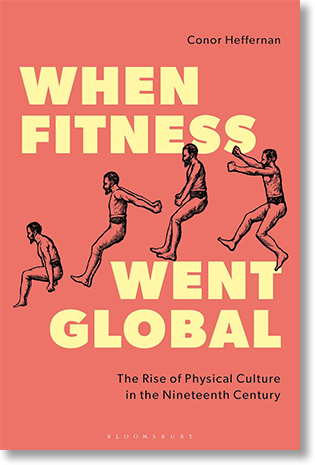
When Fitness Went Global: The Rise of Physical Culture in the Nineteenth Century
251 pages, paperback, ill
London: Bloomsbury 2026
ISBN 978-1-350-50077-8
Like Conor Heffernan, I am fascinated by fitness. Now, as I am in the midst of middle age, I often ponder questions such as:
- Where do our ideas come from about fitness?
- Why are we taught and marketed some fitness activities and not others?
- Is there some universal state of fitness that humans innately want to attain?
- Can fitness goals exploit us, for capitalism, religion, or other purposes?
- What are the costs and consequences of fitness quests?
And so it was a very pleasant surprise to be offered Conor Heffernan’s When Fitness Went Global: The Rise of Physical Culture in the nineteenth Century to review. Conor’s interest in fitness resonates with my own, and this weighty tome of more than 200 pages delves into the history of physical culture, examining everything from the magical to the mystical and the mundane in terms of how some human societies around the world have sought to control, regulate and manage physicality.
Early in the book, Conor sets out his central question about fitness, specifically in the 19th century: why did exercisers begin using the same movements and what impact did this have? This connects with my own research interests currently, related to the homogenisation of physical activity policy guidelines around the world, and the growing voices calling for “post-colonial” physical activity. And so it was heartening to read that from the outset, Conor states very clearly that his analysis of the global spread of fitness is not a celebration of it, because it is of course entangled with colonialism, oppression, exclusion and harm. Indeed, we may never know the full range and diversity of local forms of physical culture that have been either silenced or oppressed when overwhelmed by colonizers.
On modern yoga, for example, he demonstrates that there was no single person or institution that accounted for its growth in popularity. Rather, it was “multiple groups and institutions chaotically adopting the practice for their own means”.
Conor argues that in the 19th century, “fitness practices around the world began to cluster around a clear set of ideas, movements, products and body ideals”, and he aims to explain why this happened. He rightly points out that historical analyses tend to be national histories, and that he is instead focusing on a global outlook to understand the topic. It is still a weighty task to incorporate and articulate such a range of phenomena into a book:
- a global perspective,
- centuries spanned,
- a variety of cultures considered,
- an array of activities analysed,
- and the particularities of introspective exercisers working to become “fit”
Conor does make the decision to not focus so much on individuals’ introspections and more about the wider processes and actions that give rise to certain movement practices. Still, it is no easy task to incorporate and synthesize so many factors into a readable (and interesting) monograph. And yet Conor does this extremely well.
To set the scene for the main emphasis on the 19th century, Conor reaches back into earlier centuries. He connects exercise/s with a range of social spheres. Religion, medicine, the military, and (physical) education are all acknowledged as being deeply interested in fitness to achieve specific social aims.
Throughout the book, insights are offered which will probably shock the reader’s modern sensibilities about how fitness was thought of in Ancient, and more recent, history. These shocks are important, because they challenge the simplistic caricatures that we are too often presented with about what went into beliefs about fitness throughout history. I shall not ruin the shocks and surprises here, but suffice to say that these insights provide a more holistic understanding of fitness through history than is portrayed in today’s advertisements, inspirational memes, or even modern policy documents.
Conor’s writing style is thoughtful and enthusiastic … he writes of humanity’s “fleshy experiences”, and regarding people’s approach to energy use versus energy conservation, “we are a bundle of playful contradictions.” He also offers his own thoughts throughout the book about the reasons for including and excluding case studies. When discussing the governance issues in weight-lifting, the author notes “a more pressing issue was … the press”. It’s writing like this which makes historical analyses so much more readable.
Eugen Sandow, fitness extraordinaire
Conor writes that the factors to consider when thinking about what makes a global fitness product or practice are its adaptability philosophically, textually and commercially. He demonstrates this well in chapter 2. Using club swinging, yoga and judo as case studies, a variety of texts are woven together to show various political, cultural, and racial ideas being advanced through these activities. There is uncomfortable reading about eugenics and racial superiority ideas that informed the promotion of some types of activities throughout the 19th century. At the same time, Conor demonstrates that there are always ongoing contestations over the ideas that gain prominence. On modern yoga, for example, he demonstrates that there was no single person or institution that accounted for its growth in popularity. Rather, it was “multiple groups and institutions chaotically adopting the practice for their own means”.
Chapter 3 focuses on gymnastics, and it is likely most of us have memories of the routines and teachings that were imposed upon us as children in physical education classes. It is likely readers will connect these experiences and be able to make more sense of where these modern-day pedagogies came from and the rationalities that informed them. Chapter 4 focuses on the commercial side of physical culture and explores some of the characters who endeavoured to harness physical culture for their own profit or self-promotion, most prominent among them being Eugen Sandow. Just as the chapter on gymnastics will resonate with the reader, so too will this chapter. From ‘cross fit’ and ‘HYROX’ to the litany of national and international fitness celebrities, this chapter gives us an opportunity to reflect on ideas and images from the past and the present. Who are we listening to about fitness today? What interests do they have in us listening to them? Capitalism and fitness pursuits seem to be deeply entangled, and this chapter also highlight the disturbing racist elements that informed fitness promotion. Scholars and students should be alert to these aspects of fitness history. Conor shows us that fitness logic did not develop in wholesome or solely positive ways. Just as much as it helped people, so too it “othered”, oppressed and excluded people.
Chapter 5 highlights the conflicts of the local and the global by examining weight-lifting and lifting-stones and the difficult quest of standardising and growing a fitness practice. It is apparent that some activities do not garner widespread appeal, and the discussions of raising stones and heavy clubs are novel and insightful. The evocative sketches and photographs help with this.
Overall, this is an excellent exploration of the development, transformation, regulation and promotion of fitness over time, which has brought us to where we are today. It deserves to be read by researchers and students alike who want to know about the origins of the ideas they hold about health and fitness. But beyond the academic audience, I encourage it to be read by anyone who commits a large part (or even small part) of their identity to the pursuit of fitness. For all of us who are bombarded by ‘influencers’ and global corporations that promote fitness, When Fitness Went Global is an illuminating education into how and why we hold the ideas we do about fitness, and why we devote so much of our time and energy to it.
Copyright © Joe Piggin 2026