Karin Book
Associate Prof., Dept. of Sport Sciences, Malmö University
 Skateboarding is on the one hand a rebellious subculture, on the other hand an Olympic sport. It is a global, commercialized industry, and at the same time a grassroots movement. Skateboarding can be revitalizing for public places, but is also perceived by some as disturbing.
The City of Malmö has managed to navigate, and even capitalize, on this complexity. The recipe for success is spelled innovation and co-creation, where rights and roles have been reevaluated. These are processes that have grown from grassroots level and taken root in the corridors of power (Book, 2024; Book et al., 2020).
Challenges require new thinking
We are in a time when both sport and our cities are facing major challenges. The sports movement has seen a declining and more segregated sports participation over time, and increased competition from commercial and semi-organized training options, such as running groups organized through social media. Municipalities, in turn, see lower physical activity in large groups of the population and a need to upgrade areas and facilities for physical activity. At the same time, they are struggling with increasingly tight budgets, a lack of centrally located buildable land and demands for denser development (see e.g., Book, 2022; Book, 2025).
To deal with these challenges, a certain amount of innovation and increased collaboration across organizational and sectoral boundaries may be needed. The skate city of Malmö is an interesting and illustrative example. To do things in a new way, and put the skaters in the center, takes some courage. “Malmö is not a city, it is an attitude”, as the chairman of the technical committee, Andreas Schönström, put it when he inaugurated the much talked-about skate park LOVE Malmö 2024. Iain Borden, one of the most influential skateboard researchers, has described Malmö as the most progressive skateboard city in the world: “It has managed to embrace, integrate and manage skating in its urban fabric” (UCL, 2018).
Despite Malmö’s good reputation in the skateboarding world, last spring the chairman of the municipal board in Lidingö railed against tax money in Malmö being used to finance investments, including a publicly employed skate coordinator (Lidingö is a donor municipality in the Swedish tax equalization system, while Malmö is a recipient). And yes, this would have really invited criticism if the costs outweighed the benefits. But considering the social, organizational, sporting and economic values that have been created around skateboarding in Malmö, this is not the case. Let’s take a look at why.
Skateboard-friendly infrastructure
Perhaps the most important thing is that Malmö has a skateboard-friendly infrastructure with a variety of different so-called ‘skate spots.’ The city has several skate parks, both indoor and outdoor, of which Stapelbäddsparken is classified as one of Europe’s best. What is perhaps just as important, however, is the generally positive attitude towards skateboarding in public spaces. Malmö City often plans for skateboarding, with reinforced and skate-friendly surfaces and edges, furniture and so on. Some public skate spots are even considered iconic, also outside Sweden’s borders, such as ‘Svampen’ or LOVE Malmö which is partly a copy of the iconic LOVE Park in Philadelphia (Book, 2024).
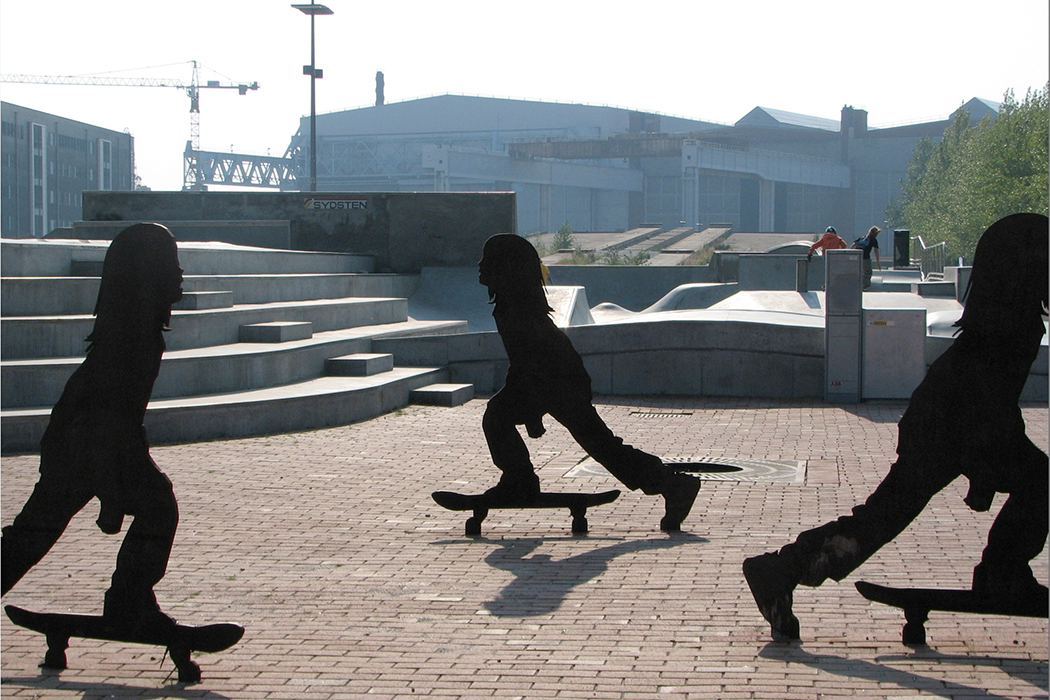
Malmö has also invested in skatable sculptures that can be moved around in the urban space. Another form of skate spots is all the ‘do-it-yourself’ (DIY) initiatives that local skateboarders have created themselves. Using public land in this way is not really allowed, but part of Malmö’s skating-friendliness consists of accepting this. The DIY site locationss are spread through social media and videos around the world and contribute to Malmö’s brand as perhaps the world’s most skating-friendly city. The contrast with many other cities (not least in other countries) is great, where skateboarding is often seen as disturbing and something that should be limited (Chiu & Giamarino, 2019).
Large and small events
The high level of infrastructure has enabled large-scale international events, such as the Quicksilver Bowlriders skateboard series, the Vans Park Series World Championship and the Vert Attack ramp competition, but also activities aimed at local skateboarders and a curious public who may be inspired to try the activity. The event concept Skate Malmö Street (SMS), which attracted both international and Swedish skateboarders, made skate visible in the city’s public spaces, highlighted female and non-binary skateboarding and contributed new, permanent skateboarding infrastructure in urban environments. Thus, the event left both a physical and a social legacy.
Another example is the Dork Zone, a strategy to introduce skateboarding in underrepresented neighbourhoods through various site development and planning methods, such as workshops that integrate skating and artistic creation. Further, the association Bryggeriet, in collaboration with the city of Malmö, offers try-out activities. Another promoting ingredient is undoubtedly the organic context.

Co-creation of a skateboard product
It was the establishment of the non-profit association Bryggeriet (brewery) in 1998 that laid the foundation for the development of the skateboard city. In addition to being involved in international events, Bryggeriet also developed community-oriented activities to maintain its credibility as a culture-bearing grassroots organization. In 2006, Bryggeriet High School opened, offering the opportunity to combine skateboarding with formal education. The school has been a platform for involvement in the development of Malmö’s skate scene, promoting skateboarders’ entrepreneurship.
Close cooperation in the construction of skate parks and recurring events has developed the relationship between the City of Malmö and the association Bryggeriet. In 2012, this was formalized under the brand and communication platform Skate Malmö. To further formalize the efforts, a full-time municipal position, called skateboard coordinator, was created in 2015 by the City of Malmö. The coordinator’s role within the municipality opened up opportunities to move activities from the skate parks to public places. Having an initiated person from the skateboarding world within the municipality’s administration has integrated grassroots perspectives into the city’s formal development, which has been very central to the success.
In summary, there are a number of stakeholders involved in the co-creation of the skateboard product Malmö: the non-profit organization Bryggeriet, the eponymous skateboard High School, the City of Malmö, and an active grassroots movement. In addition, Malmö’s strong brand as a skate city has attracted a number of companies focussing on skate-related products.

Exclusive and excluding activity?
Is all peace and joy then? Well, there are challenges that need to be taken into account. I would like to highlight two in particular.
The first concerns representation and uneven use of public resources. Skateboarding is often singled out as an exclusive and exclusionary activity, involving only a very limited part of the population – mainly privileged young white men (Beal et al., 2016). This is partly true, but today skateboarding includes an increasingly wide range of participants, in terms of both gender and ethnicity (Atencio & Beal, 2016)). Skate Malmö has worked hard to reach out to new practitioners and to make more people feel included. But as yet, the skate sport is neither equal nor fair. What is perhaps more important to take note of is that the municipality works to promote a diversity of activities in the public space – everything from different physical activities to opportunities to socialize, stay, observe, take part in a cultural event, and so on. The way skateboarding has grown from the grassroots upwards can be used as a source of inspiration and model for other sports, activities and solutions in the urban space.
The second challenge is related to the fact that Malmö seems to have entered a maturity phase regarding skateboard development. Certainly, new things happen all the time. The opening of the spectacular LOVE Malmö last summer, and the exhibition at the Malmö konsthall (Art Gallery) with artworks that the public was invited to skateboard on, are examples of this. The problem lies in the fact that these are professional ventures, controlled by people with formal power (albeit skating-skilled ones). Both skateboarding and sports and Malmö’s model for its development have become increasingly professionalized over the past decade. The development has been driven by well-established adults in the corridors of power and the distance to the grassroots is thus at risk of increasing. The more professionalized and complex the effort becomes, the more difficult it is to put responsibility and power back at the grassroots level.
Revitalize the grassroots
Those in power in the skateboard city of Malmö emphasize that there is a need to revitalize the grassroots. They all started at grassroots level, but then became part of Malmö as a skateboard product. In interviews for a research study, both the City of Malmö’s skate coordinator and the executive director of the association Bryggeriet reflect on the driving force at grassroots level today. When they started skating and getting involved, there was nothing. Now everything is served on a silver platter and it does not require so much commitment from the practitioners. In Malmö, the skaters don’t have to be rebels to take their place.
Maybe that friction is what is needed to cultivate commitment and creativity. Skate coordinator Gustav Svanborg-Edén reflects on the situation: “Fighting for your cause, getting involved, being involved in the planning, and feeling anticipation are important driving forces. These often disappear when a project or a site is finished. How can you create continued commitment? Perhaps by not providing ready-made infrastructure, but by enabling continued development, creating flexibility and setting new goals” (Book, 2024).
Lessons learned for other municipalities and sports
For other municipalities and other sports, there is a lot to learn from Malmö as a skateboarding city:
- Work at different levels, with different forms of places, activities and collaborations.
- Have the courage to do something different.
- Dare to invest.
- Combine large image-building efforts with lesser efforts.
- Have a permissive attitude.
- Let go of some control.
But the following lesson is also important: In order to develop and promote creativity and commitment, it is necessary that the stage is not too well prepared!
Copyright © Karin Book 2025
References
Atencio, M. and Beal, B. (2016), “The ‘legitimate’ skateboarder: politics of private–public skateboarding spaces”, Lombard, K. (Ed.), Skateboarding: subcultures, sites and shifts, Routledge, London, pp. 108–120.
Beal, B, Atencio, M., Wright, E.M., & McClain, Z. (2017). Skateboarding, community and urban politics: shifting practices and challenges. International Journal of Sport Policy and Politics, 9(1), 11–23.
Book, K. (2022). Dags att tänka nytt om platser för idrott och fysisk aktivitet – Utbud, tillgänglighet och flexibilitet. Dartsch, Norberg & Pihlblad (red.) Idrottsanläggningar – i dag och i morgon: Om behov, tillgänglighet och konkurrerande intressen. Rapport 2022:2, Centrum för idrottsforskning.
Book, K. (2022). Time to rethink places for sports and physical activity – Range, accessibility and flexibility. Dartsch, Norberg & Pihlblad (eds.) Sports facilities – today and tomorrow: On needs, accessibility and competing interests. Report 2022:2, Centre for Sports Research.
Book, K. (2024). No need to be rebellious: placemaking and value co-creation in the skateboarding City of Malmö. Sports Act. Living, 11 October 2024. Sec. The History, Culture and Sociology of Sports, Vol. 6. https://doi.org/10.3389/fspor.2024.1455642
Book, K. (2025). Recreation- and sport-led regeneration of urban water infrastructure. Sports Act. Living, 30 April 2025, Volume 6. https://doi.org/10.3389/fspor.2025.1558415
Book, K. & Svanborg Edén, G. (2020). Malmö – The Skateboarding City: A Multi-Level Approach for Developing and Marketing a City through User-Driven Partnerships. International Journal of Sports Marketing and Sponsorship, 22 No. 1, 164–178.
Chiu, C., & Giamarino, C. (2019). Creativity, conviviality, and civil society neoliberalising public space: Changing politics and discourses in skateboarder activism from New York City to Los Angeles. Journal of Sport and Social Issues, 43(6), 462–492.
UCL (2018). Stoked city. https://www.ucl.ac.uk/bartlett/ideas/bartlett-review/stoked-city