Daniel Svensson
Department of Sport Sciences, Malmö University
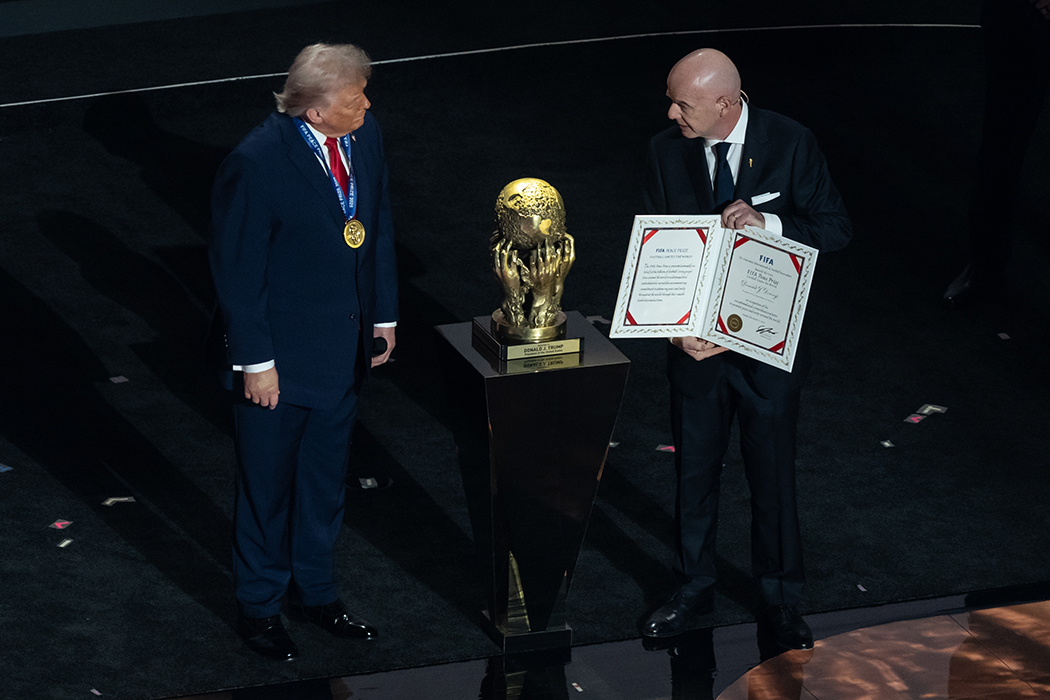
 “This is what we want from a leader: A leader that cares about the people. We want to live in a safe world, in a safe environment.” (BBC Sport). These were the words of Fifa president Gianni Infantino when the US president was awarded the newly established FIFA Peace Prize in early December 2025, which met with harsh criticism. A few months later, with the US attack on Iran dominating the news, the award appears to be the coup de grâce for the idea of sport as apolitical.
The idea that sport should be a free zone where political differences can be put aside has been part of international sports exchange ever since Pierre de Coubertin revived the Olympic Games in the late 1800s. Sweden has also been one of the most ardent defenders of such a line. During World War II, when our neighboring countries were occupied by Nazis, some Swedish sports leaders thought it was perfectly reasonable to continue the “apolitical” sports exchange with Nazi Germany. Something that did not go down well with Norwegian and Danish sports leaders. In retrospect, the Swedish attitude appears to be naïve at best, and cynical at worst.
Democratic structure
Today, the fundamental values of sport are once again under severe pressure. Swedish association sports, like sports in many of the world’s democratic states, are based on fundamental human rights and transparency. In theory, the member-controlled Swedish football association is part of a democratic structure with Fifa as the leading organization. However, democracy within Fifa has been undermined, as pointed out by the Swiss Mark Pieth, who is an expert on sports governance. Despite attempts to reform Fifa, the development has gone in the wrong direction. The World Cup is given to countries that are not democratic, and dubious peace prizes are instituted in direct contradiction to the organization’s values and statutes.
We are constantly seeing new examples of how sport is an arena for political expressions of various kinds. The decision to allow Russian athletes into the Paralympics is one of them, which has rightly created a great debate. The latest was the news from Swedish Television that 150 elite athletes had signed skier Björn Sandström’s petition for an end to fossil fuel sponsorship in skiing. Political? Yes, undeniably. But is it more political than sports deepening their dependence on fossil fuel companies’ money in a time of accelerating climate change? International elite sport faces major challenges when it comes to living up to its social and environmental commitments, not least as performance and economy tend to trump other values.
The credibility of Swedish sport is closely linked to gender equality and democratic education. Our sports organizations therefore have a responsibility to take a clear stand against anti-democratic and anti-intellectual tendencies in international sport, even if this leads to a temporary reduction in influence. Otto Drakenberg’s actions within the International Fencing Federation should be held up as exemplary.
Work is now underway within the Swedish Football Association, driven by the Swedish grassroots football club Mariehem SK, to develop a clear policy with guidelines for how Swedish football should behave when a country that violates human rights is proposed or chosen as the host country for international championships. It is an important step, but it is not expected to become a reality until after the 2026 World Cup.
If Fifa cannot be fundamentally reformed, it is time to seriously consider leaving the organization completely and, together with other democratic countries, build up new forms for international sports exchange. In anticipation of such sweeping changes, Sweden should use the World Cup participation this summer to highlight democratic values. When developments within Fifa and other organizations undermine the values that sport is supposed to contribute to, silence also becomes political.
Copyright © Daniel Svensson 2026
(Originally published in Swedish in Göteborgs-Posten, 2026-04-07, https://www.gp.se/debatt/om-inte-fifa-reformeras-i-demokratisk-riktning-bor-sverige-overvaga-att-lamna.53d51888-eaf6-417b-8729-2f7a02bdaef1)