Angela Stănescu
Sport Research Institute, Universitat Autònoma de Barcelona
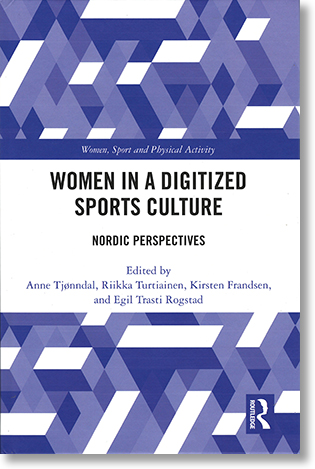
Women in a Digitized Sports Culture: Nordic Perspectives
246 pages, hardcover, ill
Abingdon, Oxon: Routledge 2025 (Women, Sport and Physical Activity)
ISBN 978-1-032-86444-0
Women in a Digitized Sports Culture: Nordic Perspectives, edited by Anne Tjønndal, Riikka Turtiainen, Kirsten Frandsen, and Egil Trasti Rogstad is a book situated at the intersection of gender, sports, media and technology. It provides an understanding of women’s lived experiences in a sports culture that is transformed by innovative digital technologies such as mediatization instruments, coaching and referee systems based on artificial intelligence, or esports spaces. The Nordic perspective is first of all reflected by the academic spaces of the editors and contributors to this volume. All the authors are researchers from ten universities from Denmark, Finland, Norway and Sweden, engaging an international and interdisciplinary team.
However, the Nordic perspective doesn’t only spatially situate the research projects and the contributors, but it also reflects a conceptual framework. All Nordic countries, Denmark, Finland, Iceland, Norway and Sweden, have been for a long time benchmarks in gender equality, digital innovation and population welfare. The editors and contributors are critically questioning the assumption that gender equality policies translate into equal digital sporting environments. This volume highlights that “in times where neoliberal trends and globalization puts the model under pressure” (p. 6), reaching gender equality is an ongoing project as the systemic inequalities and traditional barriers are reflected even at the intersection of sport, digitization and gender. As explained by the editors, “the Nordic countries are among the most digitized countries in the world and the highest ranked in terms of gender equality globally” (p. 217).
Considering the highly current relevance of the topics addressed by this book, it is important to highlight that this project encouraged meaningful academic conversations between researchers drawing from various disciplines like sport sciences, cultural studies, media or gender studies, but also between junior and senior researchers. Cross-referencing among chapters underscores the collaborative and interdisciplinarity dimensions of the volume.
From a postfeminist perspective, digital technologies can be understood as ambivalent spaces: they may reinforce sexism and other discriminatory structures while simultaneously enabling new forms of solidarity, activism, and resistance.
One of the book’s major contributions lies in the usage of the Nordic perspective as a conceptual framework for studying the intersection between gender, sports and digitization. The included studies demonstrate how the sports culture even in progressive societies recognized with top positions in global scales of gender equality and digitization remain shaped by hegemonic masculinities and institutional exclusion.
Digitization produces significant changes in sports, and this transformation affects women’s experiences at all levels of sports. As several contributors emphasize, longstanding gender inequalities persist within digital cultures. Such discrimination is evident not only in social media environments but also in the professional experiences of women working in sports as athletes, coaches, managers, referees or journalists. From a postfeminist perspective, digital technologies can be understood as ambivalent spaces: they may reinforce sexism and other discriminatory structures while simultaneously enabling new forms of solidarity, activism, and resistance (Antunovic, 2022).
If gender equality is explained and questioned only in terms of increased participation of female athletes, we are missing out on understanding the real barriers, and experiences of all female agents in the sports culture. In the Nordic context proposed by this book, the premises are that digitization processes produce not only positive changes but also cause setbacks for women in sports. This perspective is one of the book’s greatest strengths as it emphasizes the socially constructed nature of digital sports culture and the transfer of systemic gender inequalities in this environment.
The book is organized in four parts that explore the theoretical framework, experiences of athletes and fans in digital spaces, and institutional inequalities that impact technology and digitization in sport. The fourth part presents the editor’s conclusions, future directions and the most important highlights drawn from this book’s chapters.
The theoretical framework of this volume is explored in the first part structured in three chapters. This part is clearly setting the reader’s expectation and understanding of the context and approach used by the editors. From the first chapter, the editors explain the conceptual framework of Nordic perspectives and detail the interdisciplinary and phenomenon-oriented approach to the examination of gender and digitization in sports culture. The “phenomenon oriented” approach encouraged interdisciplinarity and collaboration between researchers specialized in various fields of study: sports media, sport sciences, sociology or gender studies. An interesting particularity of this book, which enriched the discussion considerably, is the extended focus of professional experiences of women in sports beyond the participation as athletes, but also as activism agents, fans, referees, or coaches. This book focus is directed towards digital tools and platforms that “are reshaping women’s opportunities, careers, practices, and participation, with potential implications for daily life and broader societal norms” (p. 7-8).

To deeply explain and analyze women’s experiences in a digitized sports culture, Lucy Piggott, Verena Lenneis and Daniel Alsarve introduce the readers to the intersectionality theory and how it influenced the approach used in some of the studies included in this volume. For the authors the usage of intersectionality is essential “to develop a greater understanding on how digital spaces can become more inclusive” (p. 25). Gender inequalities are not linear, and women experience these inequalities in different forms in various digitized sports spaces. This understanding contributes meaningfully to the volume. The inclusion of diverse female experiences beyond athletic participation alone is particularly valuable. Certain cases were notably insightful and unexpected, for example the discussion about Tumblr used as a platform for activism.
Mediatization understood as the concept that produces structural transformations to sports cultures is described in detail in the third chapter of the first part. Mediatization theory explains the “influence of media on social and cultural change” (p. 40). Media and communication technologies actively influence societal behaviour. In sports this is reflected in fan engagements through digital platforms, opportunities for athletes to create their own online brands through self-representations in social media, etc.
Several chapters of this book employ the mediatization theory to explain how digital media influence women’s experiences in sports. From activism of fans on unexpected social platforms or on social media, to the usage of Strava as a platform for self-representation by elite cyclists, or the usage of Video Assistant Referee system in football games broadcast by television, new media technologies offer new opportunities, but also increase the pressure for individuals and organizations. Sports media is an environment that is predominantly masculine, and these traditional structures transitioned into the digitized sports media environments although scholars and other agents initially expected a digital space more liberated from inequalities.
Although it might be perceived as dense, the theoretical framework detailed in the first part of the volume provides a structured and clear framework for the understanding of the following empirical studies. It also provides the theoretical grounding necessary to understand the interdisciplinary scope of the volume. Personally, I was particularly impressed and intellectually stimulated by the coherent theoretical foundation that contextualized further studies included in the volume.
The second part of the volume centers on narratives of athletes and fans in digital spaces, and it is organized in four chapters. Each chapter presents an empirical study addressing women’s voices and experiences in various communication technology spaces. Riikka Turtiainen employs an ethnographic approach of immersion to explore women’s football fandom on the microblogging platform Tumblr. Chapter 5 analyses how Nordic women footballers use social media, particularly Instagram, to promote gender equality and other issues pertaining to social media activism. Incorporating influencer theory and micro-celebrity, the next chapter analyzes how Maymi Asgari, a Danish-Iranian freestyle footballer, is using TikTok to build her personal story and challenge stereotyping in a highly male-dominated football culture. In the last chapter of this part, Rogstad and Røsten analyze how gender influences the self-representations of elite cyclists on the fitness tracking and social network platform Strava, aiming to explain how these representations establish athlete’s market value.
Mediatization theory is highly connected to the empirical studies presented in this part. In times when communication in digital spaces, particularly social media, influences and shapes athlete’s careers, sponsorship opportunities, and fan engagement, the questions raised in these studies under the gender framework become relevant. It is specifically important to understand which voices are marginalized at the intersection of communication, technology, sport and gender and think critically about the benefits of digitization of media.
Whether they want to understand gender inequalities, digitization in sports culture, or mediatization of sports, this book represents an important foundation both through the analytical framework proposed and the empirical rigor employed.
Focusing on institutional inequalities, part three examines the “systemic and structural implications of digitization on gender equality in sports” (p. 9). In contrast to neoliberal feminism approaches that place the burden of achieving equality on individual choices and actions, the four chapters in this part explore the structural dimensions of gender inequalities embedded in digital sports cultures. Chapter 8 discusses structural inequalities in esports, a space that has yet to deliver on its promises of diversity, inclusion, and gender equity. Anne Tjønndal highlights in the next chapter how the usage of artificial intelligence in coaching is not gender-neutral, and how the intersection of politics and technologies in sports reinforces gender disparities. Chapter 10 scrutinizes the difficulties experienced by women referees with the introduction of novel technologies like VAR. Finally, Chapter 11 draws on the concept of “inspirational labour” to analyze the ways in which women sports professionals – journalists, coaches and athletes – articulate and negotiate their agency in an evolving media environment.
In the final part, Chapter 12, the editors of the volume, Anne Tjønndal, Riikka Turtiainen, Kirsten Frandsen, and Egil Trasti Rogstad synthesize the key findings and main themes emerging from the contributions included in this volume. While digitization creates new opportunities for representation, activism, and professional development of women in sports, the editors emphasize that inequalities persist across digital spaces. Including the Nordic context of highly digitized countries where gender equality occupies leading positions should be critically analyzed and not viewed as a “paradise of equality” (p. 217), particularly in the male-dominated environment of sport.
Methodologically, the studies included in the volume demonstrate empirical rigor and critical reflection. There is a strong coherence between the theoretical framework presented in the first part and the empirical studies advanced. The research contributions are grounded in recent case studies and within interesting and sometimes unexpected digital spaces. Exploring the usage of Strava as a social networking platform, or conceptualizing gendered dimensions of data privacy when discussing the usage of artificial intelligence in coaching represent only a couple of examples of innovative approaches presented in this volume. It has been particularly interesting for me to discover the research approaches to digitized sports spaces proposed.
Overall, Women in a digitized sports culture: Nordic Perspectives is an important academic contribution to sports and media scholarships, suitable for researchers and students who want better to understand gender inequalities in sports. The interdisciplinarity of this volume makes it interesting for scholars from various fields of study. Whether they want to understand gender inequalities, digitization in sports culture, or mediatization of sports, this book represents an important foundation both through the analytical framework proposed and the empirical rigor employed.
This book provides an enjoyable and rewarding reading. For me, this volume has been a highly insightful read prompting reflection over my own research work. For researchers interested in gender studies, media studies, sports and digitization, this book is relevant and intellectually stimulating.
Copyright © Angela Stănescu 2026
Reference
Antunovic, D. (2022). Social media, digital technology and sport media. In J. Sanderson (Ed.), Sport, Social Media, and Digital Technology: Sociological Approaches (Vol.15, pp. 9-27). Emerald Publishing Limited