Kutte Jönsson
Dept. of Sport Sciences, Malmö University
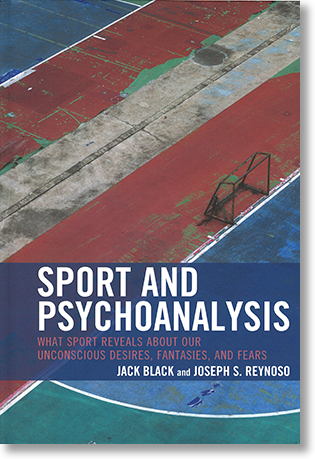
Sport and Psychoanalysis: What Sport Reveals about Our Unconscious Desires, Fantasies, and Fears
274 pages, hardcover
Lanham, MD: Lexington Books 2024 (Psychoanalytic Studies: Clinical, Social, and Cultural Contexts)
ISBN 978-1-66693-842-5
The British sports philosopher Graham McFee once asked, ‘Why doesn’t sports psychology consider Freud?’ This was also the title of an article he published in the 2005 anthology Philosophy and the Sciences of Exercise, Health and Sport.
It’s a good question. Over the past twenty years or so, I have met many sports psychologists, all of whom seem to neglect and actively reject Freudian perspectives and psychoanalysis altogether. To them, Freud is just another “old guy” whose theories have become obsolete. And to be honest, some of his theories have not stood the test of time. But that is probably true of every old theory or theorist. That does not mean, however, that they have all become irrelevant or that they cannot offer valuable insights into the human experience. Freud is not an exception.
Since Freud, many psychoanalytic theories have been developed, but it is as if Freud himself stands in the way of other psychoanalytic theorists, at least sometimes. However, simply dismissing psychoanalysis as a theoretical tool for a deeper understanding of sports, for example, would be a mistake. It is not enough for sports psychologists to claim that Freudian theories are not “science” (whatever that means). If that were the case, it would exclude most philosophers, from Socrates, Plato and Aristotle to Kant, Mill and many others, from being relevant in any way. However, I believe that many still think they all have something to say about our time and what it means to be human these days. This does not mean that everything they said, argued or claimed as truth is relevant to us today, but it is nonetheless sufficiently relevant for us to study them, “talk” to them (and talk back to them) and work with their ideas. Therefore, rejecting Freudian theories simply on the basis of their assumed “anti-scientific” nature is an example of anti-intellectualism.
As the American psychoanalyst James Hansell explained in a 2010 article, “Sports exemplify basic Freudian concepts, such as unconscious motivation, unconscious conflict and compromise, and the centrality of sexual, aggressive, narcissistic and attachment themes throughout the human life cycle”.
Generally, sports psychologists tend to be instrumentalists. This is significant. They are far more interested in finding rapid solutions to specific issues than psychoanalysts are. For this reason, they do not consider the theories of Freud or other psychoanalysts. Nor do they consider what these theories may offer. However, as McFee puts it, “Freud’s work offers ways of viewing the mind, the person, and action that are more plausible than those currently espoused by sports psychology. This is especially important when we consider methodologies, as Freud’s ideas can help combat a dominant scientism.”
What McFee is aiming for here can be described as an existential perspective on the human psyche, including in relation to sports-related issues. Yes, particularly with regard to sports. As the American psychoanalyst James Hansell explained in a 2010 article, “Sports exemplify basic Freudian concepts, such as unconscious motivation, unconscious conflict and compromise, and the centrality of sexual, aggressive, narcissistic and attachment themes throughout the human life cycle”.
In recent years, there has been a growing interest in psychoanalytic perspectives within the field of sports studies. Two key figures in this development are Jack Black, an English associate professor of culture, media and sport at Sheffield Hallam University, and Joseph S. Reynoso, an American clinical psychoanalyst from New York City. Their work combining psychoanalysis and sport has already made an impact in academia, as evidenced by special issues in academic journals. It seems that there is a demand for psychoanalytic views.
One example is the 2024 anthology Sport and Psychoanalysis: What Sport Reveals About Our Unconscious Desires, Fantasies and Fears. This anthology is part of the book series Psychoanalytic Studies, which aims to publish works that explore the implications of the individual’s position in clinical, social, cultural, historical and ideological contexts. This anthology on sports and psychoanalysis fits that description very well, of course. The editors have collected twelve texts that scrutinize sports from different perspectives. It is a rich compilation.

The anthology is organized into five themes and covers most of the essential aspects. The themes of the athletic body, coaching, fandom, identity and play offer a deeper understanding of sports. All the writers contribute interesting psychoanalytic insights that are rarely seen in other sports papers. Together, they demonstrate how the human psyche is expressed in sport. For example, the athletic body is not only a body that acts in certain ways for athletic purposes; it is also a container of dreams, fantasies and sensations that impact athletic actions. Furthermore, the body is a symbol that can be interpreted in terms of symptoms to reveal deeper meanings.
Or, consider the various roles in the world of sport, such as the relationship between athletes and coaches. A coach can be an authority figure – someone every athlete needs to relate to. What does this mean, and what could it mean? Psychoanalysis may reveal a number of paradoxes here, such as the paradox of deceiving others while being involved in self-deception.
We all know about athletes and coaches, but what about fans? Fans invest a lot in sports, both financially and, more importantly, emotionally. So, how can we understand that? We may be dealing with another Freudian concept here: transference-countertransference. In this case, the fans are mirrored by the “objects” they like or even love. Perhaps they even become something else through the fandom, becoming attached to something that runs deeper than initially expected. This may be a question of identity. We enter sports with our own personal histories and unconscious motivational patterns, which are then shaped by the sports we engage in. And all this for games we play or watch from the sidelines. However, sporting practices are not just sporting practices.
Now, one might question that position by turning to the unproven Freud quotation, “Sometimes a cigar is just a cigar”, and saying, “Let sports be.” Let’s just have some fun with it. Let sports just be sports. However, even such statements may have deeper implications than we initially realize. To those of you who perhaps claim that (me included): What are you escaping? What don’t you want to investigate further? What are you afraid of? Perhaps it is better to let people talk, as if it were a collective talking cure. I think so, and the anthology Sport and Psychoanalysis is a good place to start.
Copyright © Kutte Jönsson 2026