Scott Fleming
Lincoln Bishop University, UK
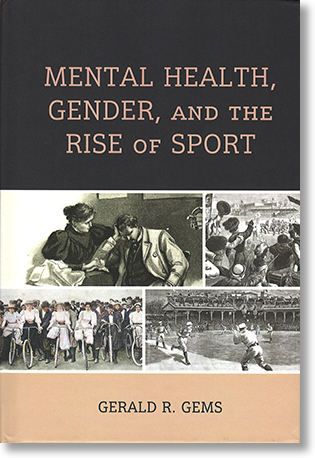
Mental Health, Gender, and the Rise of Sport
213 pages, hardcover
Lanham, MD: Lexington Books 2024 (Sport, Identity, and Culture)
ISBN 978-1-66695-506-4
I thoroughly enjoyed reading the latest book from Gerald R. Gems, a lively and thought-provoking piece of scholarship. Rigorously researched and engagingly written, it is an interesting and informative interdisciplinary analysis that draws on social history, sociology, social psychology, and psychiatry (in decreasing order of influence), and addresses the relationship between sport and a public health epidemic in the USA during the second half of the nineteenth century. Neurasthenia, “a mysterious nervous disorder with symptoms that ranged from lassitude to hysteria” (p. 1), became widely diagnosed following the American Civil War and persisted into the early twentieth century. American sport was in a phase of development at the same time and as sport increased, neurasthenia decreased. This link provides the ‘golden thread’ for the book.
Awarded the International Routledge Award for Scholarship in 2016, Gems is a prolific author with over 200 outputs (including 30 books), mostly concerned with the history and sociology of sport in the USA. He was therefore well placed (perhaps uniquely) to write Mental health, gender and the rise of sport – the twelfth monograph of the Sport, Identity, and Culture series. Gender is foregrounded explicitly in the title but as with some of his other work (e.g., Gems et al., 2023), the themes of ‘race’, class and religion are prominent too.
Interestingly (for me at least), the name that features most frequently throughout the book is Theodore Roosevelt, the 26th President, who was an outspoken advocate for physicality and domesticity with all the concomitant gender roles that were implied.
The book is divided into ten chapters, each citing a wide range of illustrative source material. In addition to the Introduction and Conclusion, three chapters are devoted to providing societal context, a background to neurasthenia, and the emergence of organised sport. Four chapters then deal specifically with case study sports, before the penultimate chapter addresses the therapeutic contribution of sport. All chapters are enriched by scholarly insights and brought to life with rich archive material. It is a little unusual also to comment on the bibliography, but its 424 items constitute an admirable and wide-ranging database for social history scholars and students interested in American sport, public health and gender studies.
The hitherto unexplored association between neurasthenia and sport is identified in the Introduction through a brief and selective summary of epidemics in the USA dating back to the likely arrival of measles and smallpox with Christopher Columbus in 1492. The nascent feminist movement of the late Victorian period is also sign-posted.
Drawing on Gramsci, Marx, Engels and Veblen, Chapter 1 (Modernization – A society in flux) provides a conceptually informed overview of the transformative impact of industrialisation on American society, including urbanisation, mechanisation, improved transport infrastructure, technological change and an emerging middle class. By the second half of the nineteenth century, tense industrial relations had led to violent unrest, and immigration (especially from Ireland and Germany) created overcrowding with all the associated social problems and public health challenges. As Gems concludes: “the turmoil thus engendered provided fertile ground for the emergence of the psychological trauma of neurasthenia” (p. 24).
Chapter 2 (Neurasthenia – A national epidemic) sheds light on the prevailing attitudes towards the condition dominated by institutional sexism within the medical profession which reflected the dominant values of male hegemony. There were also religious and class-related prejudices alongside a feminisation of culture that threatened virile masculinity. Interestingly (for me at least), the name that features most frequently throughout the book is Theodore Roosevelt, the 26th President, who was an outspoken advocate for physicality and domesticity with all the concomitant gender roles that were implied.
The functions of sport during this period are tackled first in Chapter 3 (The rise of sport – The expression of physical vitality) which acts as a preface for the four case study chapters that follow. Pugilism, horseracing, pedestrianism, aquatic sports (i.e. rowing, swimming, yachting and steamboat races), mountaineering and several ‘leisure sports’ (i.e., archery, cricket, croquet, golf, ice skating, tennis) are all introduced with an acknowledgement of Bourdieusian habitus, and there is some evidence of pioneering women challenging stereotypes about fragility as well as class-related differentiation in sports participation amongst men.
Chapters 4, 6 and 7 (Baseball – Creating the national game; Boxing – Reasserting masculinity; and Football – A surrogate form of warfare) cover relatively familiar territory about the development of key sports. The description of the brutality and barbarity of boxing and football is typically forthright (see also Gems, 2000), and together these chapters highlight the importance of fandom, gambling, civic pride (especially for immigrants), and the cult of heroic masculinity through athleticism. They also expose the ‘double burden’ of gender and racial discrimination for Black women and challenge the dominant beliefs of the period about White racial superiority.
Chapter 5 (Cycling – Upsetting gender norms) is different. A professional sport for men and women, freedom of movement for cycling required departure from the conventional women’s fashion of the mid nineteenth century, and recreational cycling gave women emancipation and independence. There were objections to women cyclists from male politicians and clergy. Medical opinion about the benefits of cycling was divided, but some neurologists who treated inactive women suffering from lithemic neurasthenia (i.e., with excessive uric acid in the blood) prescribed cycling as therapy.
At the start of chapter 8 (Sport as therapy – Stress relief) Gems notes that “Neurasthenia affected Americans across ethnic, racial, religious, and social lines throughout the nineteenth and early twentieth centuries” (p. 145). Sport, exercise and physical activity were increasingly prescribed for their therapeutic benefits, but they also became a focus for a pernicious form of racialised discourse which included pseudo-scientific examinations of sports performance linked to so-called ‘races’.
The Conclusion, which is informed by Durkheim’s account of religion and Csikszentmihalyi’s flow, serves as a synthesis of some of the key themes from the preceding chapters – notably, the capacity of sport to ease individual and collective anxiety in stressful circumstances, to provide a vehicle for the expression of ethnic identity, to showcase sports fandom linked to invented traditions, to symbolise conflict and warfare, and (as the title of this review asserts, p. 178) to heal psychosomatic conditions.
Overall, it is a good read. But don’t take my word for it, see also Snyder (2026) and Zimmerman (2026).
Copyright © Scott Fleming 2026
References
Gems, G. R. (2000). For pride, profit, and patriarchy – Football and the incorporation of American cultural values. Scarecrow Press.
Gems, G. R., Borish, L. J., & Pfister, G. (2023). Sports in American history – From colonization to globalization (3rdedition). Human Kinetics.
Snyder, B. (2026). Book review: ‘Mental health, gender and the rise of sport’. Journal of Sport History, 53(1), 200–202. https://doi.org/10.5406/21558450.53.1.19
Zimmerman, J. (2026). Book review: ‘Mental health, gender and the rise of sport’. The American Journal of American History, 112(4), 805–806. https://doi.org/10.1093/jahist/jaag071