Jules Woolf
University of Illinois Urbana-Champaign
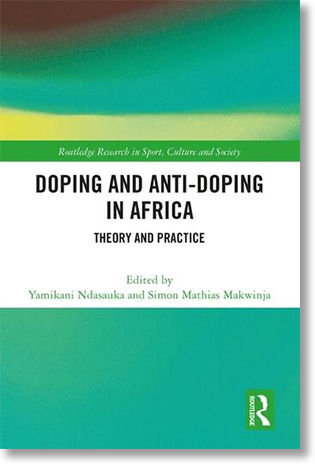
Doping and Anti-Doping in Africa: Theory and Practice
194 pages, paperback
Abingdon, Oxon: Routledge 2025 (Routledge Research in Sport, Culture and Society)
ISBN 978-1-03-244165-8
It is, perhaps, somewhat ironic that the origins of the term “doping” are often attributed to a substance ingested by South African Zulu warriors prior to combat, and yet, there has been little scholarly engagement with the African experience in the study of doping. Instead, Western perspectives have dominated, with limited effort to examine the African context or integrate African worldviews into the crafting of anti-doping policy. Yamikani Ndasauka and Simon Mathias Makwinja address this shortfall in their edited volume, Doping and Anti-Doping in Africa: Theory and Practice. Their book brings together nearly twenty African scholars and practitioners who provide commentary and insight into the African experience. Moreover, the book offers alternative perspectives on doping and its prevention, generating insights that are not only relevant to African contexts but also applicable to anti-doping efforts globally.
The book is organized into two parts. The first, African Thought and Doping, comprises five chapters that explore African beliefs, values, and popular representations of doping in sport. The second, African Practice and Doping, includes seven chapters focused on applied contexts, followed by a concluding chapter that offers a summary and directions for future research. Most chapters begin with an introduction to doping, which enhances their accessibility as standalone contributions for readers new to the topic. However, for those with more experience, this format can feel somewhat repetitive. Despite this, the chapters provide meaningful contributions to the literature, and taken together, are best understood through three overarching themes that structure the remainder of this review.
The first theme, and perhaps most controversial, concerns Juju or “spiritual doping”. It may be tempting to discount ideas surrounding witchcraft as mere superstition and unbecoming for social scientists to contemplate and debate. However, a careful reading of Chapters 6, 8, 10, and 12 provides a more nuanced account that begs our attention. The concept of Juju is not uniform across African countries but can broadly be described as the use of traditional medicines and ritual practices, which are thought to invoke good luck and protection through the spiritual, ancestral, or supernatural realm.
Whether Juju practices improve performance and provide an unfair advantage is a distinctively harder question to answer. Secrecy surrounds these practices, and uncovering the method used reportedly neutralizes their effectiveness.
The authors argue that, regardless of our skepticism, these practices are widespread and beliefs about their effectiveness have survived for generations. They operate on a deep psychological and cultural level and are part of young athletes’ socialization. We learn that Juju is a concern among sport teams (particularly football) who attempt to uncover and counteract the efforts of their opponents, sometimes enlisting the services of witchdoctors. Ignoring the lived reality and beliefs of a population is counterproductive, especially when they are so widespread. As Namusanya explains in Chapter 12, acknowledging the practice creates the opportunity to address it.
Importantly, many of the rituals described involve the use of substances that theoretically could result in a doping violation. Substances that include herbs, tree bark, roots, and animal tissues (e.g., testes) may be ingested or rubbed on the body, enabling transdermal absorption. Some of these plants are used in pharmaceutical drugs, while substances, such as Mchape, may act as masking agents. Others, like Catha edulis, contain pseudoephedrine. Indeed, Juju rituals are described as making athletes run faster and more fatigue-resistant, suggesting stimulant involvement.
Whether Juju practices improve performance and provide an unfair advantage is a distinctively harder question to answer. Secrecy surrounds these practices, and uncovering the method used reportedly neutralizes their effectiveness. Post hoc explanations are, therefore, provided to explain success or failure, all of which means Juju cannot be empirically tested. Moreover, Juju appears to take myriad forms and include different substances, talismans, and methods of administration, complicating replication. Taken together, this makes it difficult to accept Juju as a genuine doping practice.
The authors acknowledge these limitations but emphasize that Juju may still meet two criteria for inclusion on the prohibited list. First, some substances pose potential health risks, and second, Juju violates the spirit of sport by seeking an unfair advantage. If accepted, this raises the question of whether Juju should be regulated. However, the claim that any unfair advantage stems primarily from the confidence gained through such rituals is less convincing. Accepting this proposition would amount to policing faith, which is neither practical nor enforceable.
A further reason the authors advance for taking Juju seriously is its more insidious, unintended consequence. Belief in the effectiveness and perhaps necessity of Juju results in effort and resources being diverted away from athlete development. As described in the book, athletes may invest less time in training and skill development, while administrators allocate funds that could support athlete welfare toward the services of witchdoctors. On this basis, the authors contend that addressing Juju practices is justified on multiple grounds, and they call for WADA and national anti-doping organizations to develop a clear position.

Despite these arguments, how such practices should be addressed remains unresolved. Education is proposed as a solution, though its effectiveness is often questioned. Organizations such as WADA would also need to consider potential backlash and reputational risks if engagement with Juju were perceived as legitimizing irrational beliefs. Conversely, if WADA did prohibit Juju, this could be interpreted as neo-colonial interference. As such, the issue is more complex than it may first appear and provides opportunities for future research on topics such as the prevalence and perceptions of Juju.
While the discussion of Juju highlights cultural belief, a second, more policy-oriented contribution of the book is its critique of WADA’s Whereabouts policy. Two arguments are presented in Chapter 13. First, African athletes reside in a communitarian society, where the community takes precedence over the individual. Commitment to the community means that athletes do not control their schedule, making it unrealistic to expect them to keep their Whereabouts updated.
A second, more novel argument, is that African athletes subscribe to a unique conception of time. Unlike Western perspectives that divide time into past, present, and future, African conceptions are described as emphasizing only the past and present, rendering future-oriented requirements such as Whereabouts reporting incompatible with this worldview. While this raises an interesting line of inquiry, it also prompts questions about how athletes engage in inherently future-oriented practices, such as periodization and Olympic-cycle preparation. As such, both arguments are ultimately unconvincing, and the recommendations remain underdeveloped, perhaps reflecting the limited attention this topic receives within a single chapter. The book’s final major contribution, however, lies in its broader focus on the communal nature of African life.
This contribution is developed through engagement with African philosophical traditions as a foundation for doping prevention, particularly in Chapters 2, 4, and 5. Central to this discussion is the pan-African concept of Ubuntu, along with related, regional-specific concepts of Umunthu and Hunhu. These frameworks emphasize relationality and humanness. A person is defined by their existence in relation to others, requiring the establishment of respectful relations within the community. It stands in contrast to more individualist and self-interested conceptions of personhood. Within this worldview, doping, when framed as an individual act, becomes fundamentally incompatible.
These philosophical frameworks are presented as a basis for developing effective anti-doping strategies, not only for African athletes but more broadly. Interestingly, Mbewe (Chapter 5) further argues that doping is largely a Western import, emerging alongside the transformation of sport, from a colonial tool of social control to a source of national pride, and the pressures that followed. The migration of African athletes to more developed training environments is also identified as a pathway through which doping practices are introduced and transmitted. From this perspective, doping is understood as another consequence of Western imperialism and colonization.
While the authors provide a detailed account of these philosophies, less attention is given to how such values are transmitted and internalized. Although rituals and rites of passage are mentioned, the processes through which individuals adopt and sustain these values remain underdeveloped. This raises the risk that concepts such as Ubuntu become reduced to appealing but superficial slogans, lacking the specificity needed for policy implementation. It also risks a simplified assumption that promoting communal values alone can address doping. While such approaches may influence individual behavior, they do little to address organized or systematic doping, including state-sponsored efforts.
In conclusion, Doping and Anti-Doping in Africa provides a timely and important contribution to the literature. By covering African perspectives, the volume offers alternative ways of conceptualizing doping and its prevention. Although some arguments are more fully developed than others, the book opens important avenues for future research and invites scholars and policymakers to engage more fully with the cultural, philosophical, and social contexts in which doping occurs. In doing so, it makes a compelling case for taking African perspectives seriously in both the study of doping and the development of anti-doping policy.
Copyright © Jules Woolf 2026