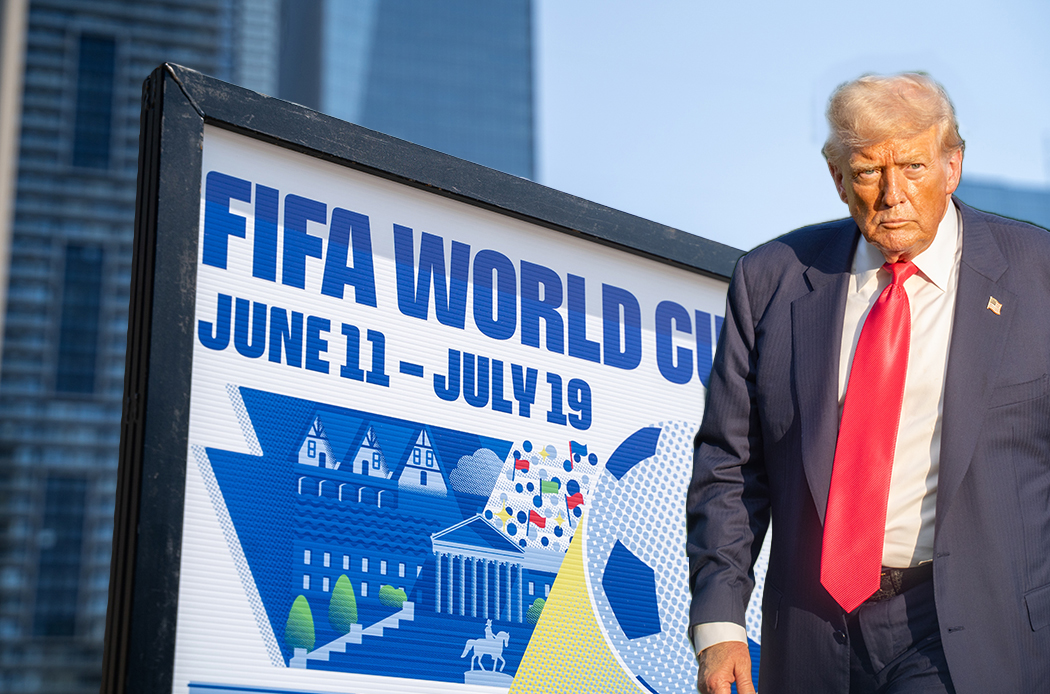
The Centre for Culture, Sport and Events at the University of the West of Scotland is pleased to announce our next FREE ONLINE SEMINAR, which will take place on the 20th of ApMayril at 5pm CEST. The theme for this seminar is “The 2026 World Cup: Human Rights, Sportswashing, & Authoritarian”, featuring Drs Jules Boykoff and Callum McCloskey. Register here: https://www.eventbrite.co.uk/e/the-2026-world-cup-human-rights-sportswashing-authoritarianism-tickets-1987809305142?aff=oddtdtcreator&_gl=1*7azjlw*_up*MQ..*_ga*OTA1MjExNjk3LjE3Nzc0NTgwNjQ.*_ga_TQVES5V6SH*czE3Nzc0NTgwNjMkbzEkZzAkdDE3Nzc0NTgwNjMkajYwJGwwJGgw
Speakers
 Professor Jules Boykoff is the author of Red Card: The 2026 World Cup, Sportswashing, and the FIFA Greed Machine (OR Books, 2026) and Kicking (Duke University Press, 2026), a memoir about his former life as a professional footballer and his current life as a critical academic of sport. He has written six books on the politics of the Olympics, and teaches political science at Pacific University.’
Dr Boykoff will explore how sportswashing helps us make sense of the World Cup in the twenty-first century, whether staged in Russia, Qatar, or the United States. In this seminar, I adopt a historical perspective to shed light on our current political moment and the cascading crises of sports mega-events in the US under President Donald Trump. Sportswashing—the concept at the analytical heart of this talk—is when political leaders use sports to appear important or legitimate on the world stage while stoking nationalism and deflecting attention from chronic social problems and human-rights woes at home. Sportswashers use sports to try to burnish personal and national prestige, and to advance their economic and political success. There is a tendency among academics and journalists to only apply sportswashing to authoritarian settings, but I’ll argue that Trump is engaging in sportswashing as the US prepares to host the 2026 FIFA World Cup (and the 2028 Summer Olympics in Los Angeles). Along the way, I’ll examine how authoritarian and democratic regimes alike have, with varying degrees of success, attempted to capture the FIFA World Cup and reformat this massively popular event to their political advantage. But sportswashing entails a gamble, as the proves reveals cracks and fissures that, when covered by the media, create opportunities for pushback from activists and people of principle.
 Dr Callum McCloskey recently completed a PhD (pending final corrections) examining how human rights commitments are implemented in the 2026 FIFA Men’s World Cup. Based at the Centre for Culture, Sport and Events at the University of the West of Scotland, they lecture across events, sociology, politics, and sport, while working in football coaching alongside their academic career. They are also currently a research assistant on projects related to sport and events, including Sports for the Planet, which maps sustainability across major events over the past 30 years, the Commonwealth Games 2026 Legacy Network, and a UEFA-funded project exploring female volunteer opportunities.
Dr McCloskey’s presentation will examine how human rights commitments made during the bidding process for the 2026 FIFA World Cup (FWC2026) are being translated into governance structures and delivery practices. Following a series of reforms introduced by FIFA since 2014, the tournament has been positioned as a more rights-aware mega-event. However, questions remain as to whether these commitments are being meaningfully embedded, or whether they function primarily as symbolic responses to external pressure. Through the lens of institutional and stakeholder theory, the study explores how key actors – including FIFA, host cities, national governments, and civil society organisations – interact within a complex, multi-level governance system. Drawing on qualitative methods, including observation, document analysis, and stakeholder interviews, it examines how these dynamics shape the implementation of human rights commitments. The findings highlight ongoing tensions between global commitments and local implementation, uneven progress across host contexts, and the influence of advocacy coalitions in shaping accountability. Overall, the presentation argues that while human rights have become more visible within mega-event governance, their institutionalisation remains partial, contested, and shaped by existing power dynamics.
Sandro Carnicelli
Professor of Tourism and Leisure Studies
Co-Director – Centre for Culture, Sport and Events
School of Business and Creative Industries
High Street, Paisley, PA12BE
Email: sandro.carnicelli@uws.ac.uk