Jan Andre Lee Ludvigsen
Liverpool John Moores University, UK
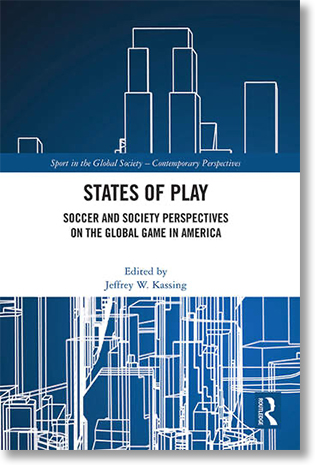
States of Play: Soccer and Society Perspectives on the Global Game in America
330 pages, hardcover
Abingdon, Oxon: Routledge 2026 (Sport in the Global Society – Contemporary Perspectives)
ISBN 978-1-041-26600-6
As sociologist Maurice Roche (2003) suggests, sport mega-events, very much aided by their extensive media coverage, should be approached as temporal markers, or referent points, in contemporary societies. In a similar manner to annual national public event calendars, mega-events, Roche writes, ‘are profoundly important time-structuring and history-marking institution[s]’ (p. 102), which impose a certain rhythm onto social calendars. Fittingly, at the time of writing, this summer’s FIFA 2026 World Cup in men’s soccer (football) – co-hosted by the US, Canada and Mexico – is two months away. Yet the build-up, or countdown (see BBC, 2026) is well underway and the event itself, commencing on 11 June 2026, figures as the reference point.
While the volume of journalistic and academic analyses of, and commentary on, this summer’s World Cup will increase over the next weeks, the well-timed publication of States of Play: Soccer and Society Perspectives on the Global Game in America helps us both historically contextualise this summer’s tournament and understand the social, political and cultural status of soccer in the US, which hosts the majority of World Cup fixtures during the 2026 edition.
As an edited collection, States of Play is indeed set, or framed, against the backdrop of this summer’s tournament. It aims to provide ‘a valuable time capsule to revisit prior to the arrival of the 2026 Men’s World Cup’ (p. 10). It must be noted, however, that the book’s individual chapters, except for the introduction, are originally articles that have featured in different volumes and issues (between 2003–2022) of the journal Soccer & Society. The collection is edited and curated by Jeffrey W. Kassing, whose opening chapter explains the text’s rationale, and delineates themes, or ‘trajectories’, under which the chapters are organised.
Collins’ Chapter One (from 2006) is particularly insightful, as it addresses why US soccer is regularly considered to have ‘failed’ to establish itself as a popular spectator sport.
The book’s baseline, Kassing writes, is that soccer in the US often receives less coverage and has a more peripheral or marginalised status in comparison to other sports:
[…] coverage of the global game in the United States often considers its relative standing among more popular, American-derived pursuits like American (grid-iron) football, baseball, and basketball and in light of its failure to ignite interest as it has elsewhere in the world (p. 1).
Notwithstanding, as Kassing observes, over the course of Soccer & Society’s history, the US context has still been well-represented: overall, 59 articles were identified by the editor, addressing, in some form, soccer in the US. Of these 59 articles, 20 were purposively sampled by the editor (p. 2), and included in the final collection, which intends to:
[O]ffer readers a sense of the historic successes and failures, persistent challenges, and potential promise of soccer in the United States as the nation prepares to cohost the 2026 men’s FIFA World Cup […] Interestingly, the United States will ascend to elite status when the World Cup kicks off – joining Italy, France, Germany, Brazil, and Mexico as the only nations to have hosted the men’s tournament final more than once (p. 1).
This, as Kassing emphasises, is all the more remarkable given that soccer, as mentioned, is not the predominant sport in the US and given the fact that the US, in 1994, was the first nation to stage a World Cup without a major domestic professional league. In 2025, the US was, of course, also the host of the expanded 2025 FIFA Club World Cup, highlighting the momentum behind this attempt to revisit, or reconsider, the status of soccer in the US.
The 20 chapters are organised according to five main trajectories, including exceptionalities (the relationship between US soccer and exceptionality), femininities (focused on the position of women’s soccer), challenges (to the development of soccer), gateways (relating to fandom and exposure to soccer), and finally, pockets (case/context-specific examples of soccer as rooted in local communities).
Because the collection consists of 20 chapters (plus Kassing’s introduction), it remains impossible to review each chapter here. Yet, within the exceptionalities part of the book, Collins’ Chapter One (from 2006) is particularly insightful, as it addresses why US soccer is regularly considered to have ‘failed’ to establish itself as a popular spectator sport. Especially when US soccer, at the time, was undergoing important commercial transformations, with an influx of new star players, soccer-specific stadiums, increased sponsorship revenues and salaries, but still failed to ‘capture the popular imagination of America’ (p. 24). Collins highlights how soccer, often dubbed as a ‘global game’, lacks the national frame that is more embedded in baseball, basketball and football. Indeed, similar discussions of the (media) construction of soccer as ‘un-American’ is offered by Schwartz in Chapter Three.

Given that the soccer’s popularity lags behind other spectator sports, the book’s gateways section is also particularly interesting, because it deals with soccer audiences and entries into fandom. For example, Chapter Thirteen, by Gerke (from 2019) examines the dynamics of soccer fandom. Interestingly, Gerke observes how many soccer fans were introduced into the sport via the national team and international soccer mega-events, such as the 1994 World Cup, rather than through the more ‘traditional’ route, which would be via local soccer clubs. As ‘soccer manages to enter the mainstream culture for a few weeks every four years in form of the World Cup’ (p. 206), Gerke shows us how mega-events – as alluded to in this review’s opener – are critical, temporal points or moments that can be the catalyst for more organised fan cultures that, in turn, translate into more active support for soccer clubs:
Although a segment of younger generations of club supporters today more strongly identifies with their local soccer club, the National Teams are still a major point of reference for most organized supporters and a force that regularly unites – despite all the contradictions this implies – organized supporters from around the country (p. 212).
Gerke’s chapter is particularly pertinent at the current juncture where important questions could be asked about how, or whether, the 2026 World Cup may attract a new generation of soccer fans, and furthermore, how fan cultures, practices, and rituals fluctuate between club and country. Given the high-ticket prices and high demand (The Guardian, 2026), younger fan generations’ mode of soccer consumption, also, remains an open question in the new era of short form reels and YouTube watchalongs.
It is an interesting, welcome and well-timed text that will be of interest to scholars working on the cultural, historical and social dimensions of soccer.
The collection’s final section locates pockets where soccer has been successfully embedded in local communities. This includes chapters exploring the nexus between soccer, migrant communities, and place in New England (Chapter Seventeen), California (Chapter Eighteen and Nineteen), and New Jersey (Chapter Twenty). Central across these chapters is the historical and contemporary role of soccer in everyday life and as a cultural activity. For example, Van Rheenen’s chapter (first published in 2009) provides a fascinating account of the Greek-American Athletic Club which competed in the San Francisco Soccer Football League (SFSFL); a competition founded already in 1902. The story of the Greek-American AC, and SFSFL, it is argued, challenge the widespread notion that US soccer’s potential is ‘unfulfilled’. The author, instead, offers the view that:
… San Francisco soccer fields have indeed afforded space for communities to assemble around a common goal. Thus, rather than tale of promise unfulfilled, the San Francisco Football Soccer League, and American soccer in general, has provided an open terrain for new ethnicities to play and compete for cultural space in an emerging nation (p. 298).
Given that the book, with the exception of the introduction, draws upon already-published work, a brief concluding chapter could have been potentially insightful, with some departure points, and emerging research agendas vis-à-vis the 2026 World Cup and soccer, more broadly. Though, this is merely a minor point.
The conclusion of this year’s World Cup, at MetLife Stadium, New Jersey, on 19 July, will no doubt be followed by new analyses and commentary on soccer in the US. In these writings, accounting for historical conditions and factors will remain crucial and it is here that States of Play will serve as a valuable resource (or time capsule). While the contribution of States of Play’s individual chapters, naturally, must be read in light of when they were originally published, the collection works well as a whole. It is an interesting, welcome and well-timed text that will be of interest to scholars working on the cultural, historical and social dimensions of soccer. As intended, the collection illuminates both the challenges and potential of soccer in the US by signposting the reader towards the key trajectories in the literature.
To end this review, then, it could be noted that, whereas the countdown to the World Cup is typically characterised by attempts to predict the future – ‘who will win?’, ‘who gets the Golden Boot?’, ‘which team will surprise us?’ – States of Play’s chapters remind us of the importance of looking back.
Copyright © Jan Andre Lee Ludvigsen 2026
References
BBC (2026) Messi, McTominay, Kane or Estevao – who to watch with 100 days to World Cup. Available at: https://www.bbc.co.uk/sport/football/articles/ckg1xpddn29o
Roche, M. (2003) Mega-events, time and modernity: on time structures in global society. Time & Society, 12(1), 99-126.
The Guardian (2026) Fifa raises top ticket price for World Cup final to $10,990, up from $1,600 in 2022. Available at: https://www.theguardian.com/football/2026/apr/02/fifa-ticket-prices-world-cup-2026-final.