Hans Bolling
PhD in History, Independent scholar
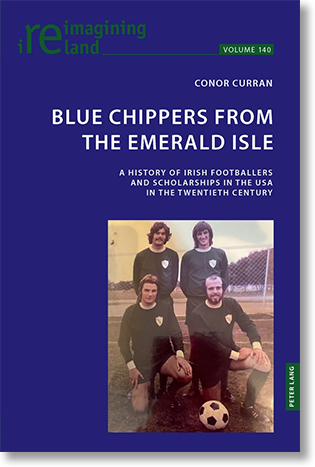
Blue Chippers from the Emerald Isle: A history of Irish footballers and scholarships in the USA in the twentieth century
299 pages, paperback, ill
Oxford, Oxon: Peter Lang Publishing 2025 (Reimagining Ireland)
ISBN 978-1-80374-739-2
In June 1969, the 1965 Government Commission on Sport concluded its work. Its views and proposals were summarized in a report titled Idrott åt alla [Sport for all]. It has rightly gone down in history as a milestone in the history of the Swedish sports movement. The report can be summarized as a paean to sport as a free popular movement and a socially beneficial activity. It contained proposals for reforms across the entire sport sector, including increased support to give young people aspiring to elite levels the opportunity to receive a good education while they strived to achieve results in their sport. The conditions for combining a career in sport with a civil career have also been a fairly popular area of research in sport science over a long period of time. A Swedish classic is Olle Halldén’s Stjärnidrottsmannens anpassningsproblem efter idrottskarriärens slut [The star athlete’s difficulties adjusting to life after retirement] from 1963 and he has been followed by a large number of researchers.
I was reminded of the classic government report on sport when I read Conor Curran’s book Blue Chippers from the Emerald Isle. A history of Irish footballers and scholarships in the USA in the twentieth century, which has its origins in the author’s master’s degree in Higher Education at Trinity College Dublin, in 2020. Blue Chippers from the Emerald Isleis as the subtitle clearly indicates a book about young and relatively successful Irish footballers who chose to pursue a career at North American universities, mostly males but in the later years also females. With a soccer scholarship they were given the opportunity to engage in high performance sport while pursuing a programme of study at a third level institution. According to the author, the book ‘offers a unique analysis of the migration of Irish soccer players and their experiences of soccer scholarship programmes in US universities within a particular historical context’.
Football seems to have begun to gain acceptance within the Irish education system at around the same time that the English FA lifted its ban on women playing football on pitches of the members of the association.
Before reading Conor Curran’s book my knowledge of foreign athletes on sport scholarships in the US was largely limited to Swedish athletes who studied at stateside universities, mainly track and field athletes, swimmers and golfers, who managed to combine their studies in the USA with their sporting careers, which helped them reach the elite-level in their sports – athletes such as Christer Garpenborg, Peter Billing and Kajsa Bergqvist, Gunnar Larsson, Pär Arvidsson and Bengt Baron, Annika Sörenstam, Linn Grant and Ludvig Åberg – or in some tragic cases taught them the ‘benefits’ of using anabolic steroids.
That foreign students not always were welcome in college sports is evident from when the two Swedish shot-putters Hans ‘Honta’ Höglund and Hans ‘Plutten’ Almström helped lead University of Texas El Paso to victory in the NCAA Championships in 1975. It prompted the coach of University of California Los Angeles, Jim Busch, to launch a fierce attack on less well-resourced universities that recruited foreign track and field athletes in order to compete: ‘No one is allowed to compete for UCLA without being a qualified student. I know that one of the Swedish shot putters has little more than a primary school education. He is not qualified for university studies. But El Paso needed a shot putter and sneaked him in.’[1]
The structure of Blue Chippers from the Emerald Isle is straightforward, as with almost all historical studies today, an introductory chapter followed by six thematic chapters arranged in chronological order and it all ends with conclusions. In the first empirical chapter, “Soccer in Irish schools”, the development of association football within schools in Ireland are assessed. We learn that while football was popular in schools before the partition of Ireland in 1921 the game was opposed by the new rulers in Free State Ireland, whilst an active policy of ‘Gaelicisation’ was pursued. This meant that sports like hurling and Gaelic football were promoted at the expense of what the Gaelic Athletic Association designated as “foreign and absurd” sports. Football seems to have begun to gain acceptance within the Irish education system at around the same time that the English FA lifted its ban on women playing football on pitches of the members of the association.

The second chapter, “The development of US soccer scholarships”, looks at the development of the intercollegiate sport system, above all with regard to football, and how sport scholarships were established and have developed in the USA. In the third chapter Curran looks at the time when football players were first recruited from Ireland to the USA on scholarships. He demonstrates how networks and pathway were created in the last third of the twentieth century. Chapter four, “The playing season”, the playing careers and achievements of some of the Irish players are assessed. That is followed by a chapter that looks at the socialization and acculturation into the university system in the USA of the Irish players.
In the last empirical chapter aptly named “Post scholarship careers” it is made clear that accepting a football scholarship in the USA was not an astute career choice if your aim was to forge a career in (male) professional football. However, a degree from a US university was helpful in gaining work outside football.
In view of the above, Curran’s book raises many thoughts and questions but unfortunately does not provide many interesting answers for a non-Irish reader. When I finished reading Blue Chippers from the Emerald Isle I could not help but feel that it would have been a more interesting book if Curran had chosen not to focus so much on a football and sport history context, but had instead chosen to situate his study clearly within an educational and career history framework. As mentioned in the beginning, the difficulties of combining elite sport and education have been highlighted for more than half a century. There would likely have been more to explore and discover if he had aligned himself stronger with this field of research, thereby gaining a broader context within which to operate. It is a field of research that has generated a great body of work to engage with and contribute to. We are dealing with young people who use their talents in one area to gain an advantage in another, which is a very interesting phenomenon for an historian to take on, to my mind a much more interesting topic than a description ‘of the migration of Irish soccer players and their experiences of soccer scholarship programmes in US universities’. Unfortunately, I am not qualified to offer advice on how the author should have approached the study to achieve that, but must content myself with the reviewer’s right to offer advice that is not only unsolicited but also unsubstantiated.
Copyright © Hans Bolling 2026
[1] Svenska Dagbladet, 19 June, 1975.