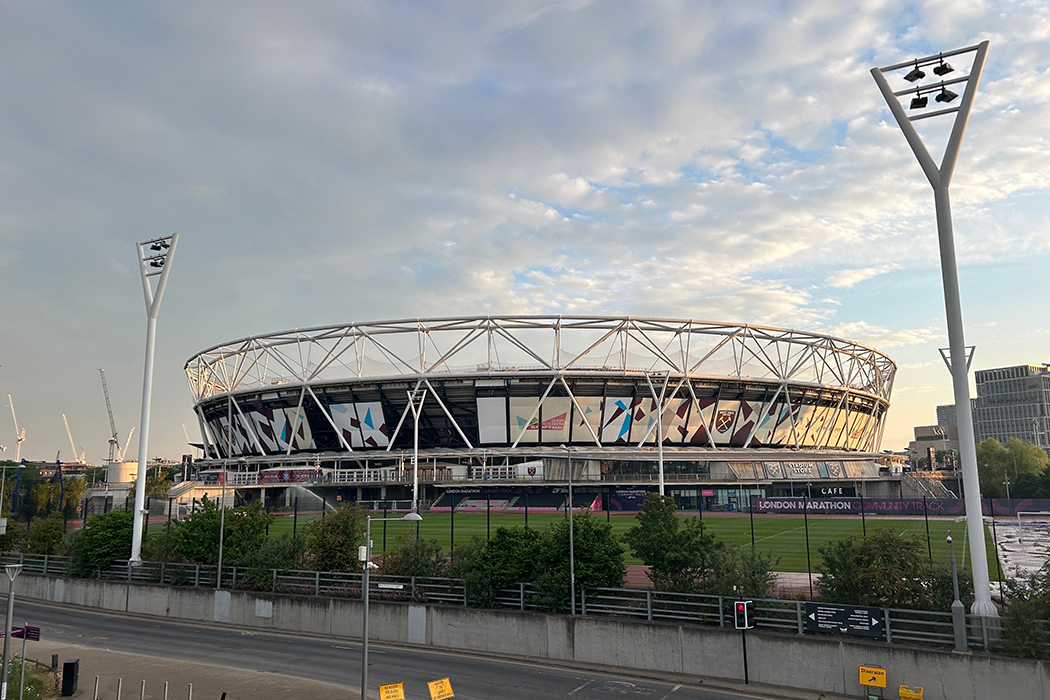
The Olympic Stadium as Home: Architecture, Memory and Belongings a live online event organised by the Olympic Studies Research Centre (OSRC) at the University of East London. On behalf of the OSRC, we are pleased to announce the second in our series of Live Online Events. In collaboration with the London Festival of Architecture, we share details of our event focusing on the theme of Olympic Architecture.
For this event, we are pleased to announce three esteemed speakers:
Geraint John
Geraint John will be talking on Olympic Stadia incorporating his work for the book Theatre of Dreams and the London 2012 Olympic Stadium, taking a past, present and future approach incorporating a discussion of proposals for Olympic stadia for the future Summer Olympics in Los Angeles and then Brisbane.
Geraint John authored the book Olympic Stadia Theatres of Dreams in 2019 (with Dave Parker) and is a prominent architect known for his contributions to the field, particularly in the design of sports stadiums and public buildings. Geraint John also became the first Briton to be awarded a medal for outstanding service to the Olympic Movement. John is a senior adviser at sports architecture specialist Populous since 1996. He worked on designs for three Olympic stadia during his career, including Sydney 2000, London 2012 and the Sochi Winter Olympics in 2014.
Professor John R. Gold and Margaret Gold
John and Margaret Gold have kindly agreed to present on the subject of “Olympic arenas and post-games transformation: narrative, memory, belonging and London 2012.”
Summer Olympic Games have been used strategically by many host cities to transform their built environment and meet their urban agendas. In the case of London 2012, it was a project designed to transform a large area of East London that had been the target for piecemeal development programmes over decades. It was a top-down project, which at the time seemed the only way to generate the sums required for the scale of investment required to transform the Lea Valley. They look at the narratives involved, the importance of embedding memory in the scheme (from the IOC perspective as well as the local perspective) and the opportunities for belonging which the project provides 16 years on.
Professor John Gold is Honorary Senior Research Fellow in the Bartlett School of Architecture, University College London, and Professor Emeritus at Oxford Brookes University, Oxford, UK. A historical geographer with strong urban interests, he has written and broadcast widely about architectural modernism and the history and contemporary role of city festivals. These interests are expressed in more than 200 publications, most notably being the author or editor of 25 books. These include Olympic Cities: city agendas, planning, and the world’s games, 1896-2020 (Routledge, four editions: 2007, 2011, 2016 and 2024), the four-volume collection The Making of Olympic Cities (Routledge, 2012), and Festival Cities: culture, planning and urban life (Routledge, 2020), which were co-written with Margaret Gold.
Margaret Gold is Honorary Research Fellow at London Metropolitan University, London, UK, and Joint Editor (with John Gold) of Planning Perspectives: an international journal of history, planning and the environment. Her research interests focus on cultural events including festivals, megaevents, heritage interpretation, and culture-based urban regeneration. Her nine books include Cities of Culture: staging international festivals and the urban agenda, 1851-2000 (Ashgate, 2005), Olympic Cities: city agendas, planning, and the world’s games, 1896-2020 (Routledge, four editions: 2007, 2011, 2016 and 2024), the four-volume collection The Making of Olympic Cities (Routledge, 2012); and Festival Cities: culture, planning, and urban life (Routledge, 2020).
This is the second event to be organised by the recently established Olympic Studies Research Centre (OSRC) at the University of East London (UEL). Situated in the heart of the Olympic Borough of Newham in East London, the OSRC brings together multi-disciplinary research and teaching and to develop engagement and outreach activities. The UEL Library is also host to the British Olympic Association (Team GB) Archive which documents the history of the British Olympic Team, and engagement in the Olympic movement, from 1906 through to the present day.
This will be a free online event hosted through Microsoft Teams. Reserve a spot at Eventbrite: https://www.eventbrite.co.uk/e/the-olympic-stadium-as-home-architecture-memory-and-belonging-tickets-1984619856415?aff=erelexpmlt. A link will be sent out to participants prior to the event. The webinar will consist of presentations by Geraint John and the Golds, followed by an open Q&A session.
The Event will be recorded, and we hope to make this accessible after the event. If you have any questions, please contact Paul Dudman, UEL Archivist, on p.v.dudman@uel.ac.uk, or tel: +44 (0) 20 8223 7676.