Lina von Petersdorff
Human Rights Studies, Lund University
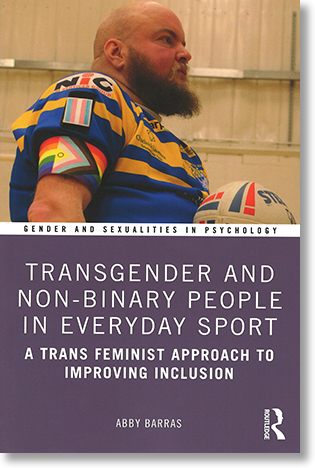
Transgender and Non-Binary People in Everyday Sport: A Trans Feminist Approach to Improving Inclusion
200 pages, paperback
Abingdon, Oxon: Routledge 2025 (Gender and Sexualities in Psychology)
ISBN 978-1-032-46617-0
In recent years, transgender athletes in competitive sport has been a hot topic, discussed extensively on social media and in academic publications. What has often been neglected, however, is the perspective of transgender athletes themselves, as well as the field of everyday sport. While it makes sense that gender plays an even greater role in competitive sport, many more people are involved in amateur and recreational sport. Abby Barras’ book attempts to fill this gap by giving a voice to transgender athletes.
Barras begins by giving a personalized introduction of the 18 participants she interviewed in her study (p. x-xii). This makes their lived experiences very approachable. She introduces the theme of the book by discussing the social construction of modern sport and reviewing previous research on transgender and non-binary people in sport, including an account of the relevant regulations. She argues from a trans feminist perspective and considers possible ethical issues. Chapters four, five and six discuss the lived experiences of participants with a focus on three different narratives: sporting bodies, sporting spaces and sporting communities. Finally, she gives recommendations.
Barras’ book is a great read for anyone interested in the topic of transgender and non-binary people in sport. She explains the relevant historical and societal events and arguments understandably and makes a comprehensible case as to why transgender and non-binary people should be included in sport, at least on an amateur level. She opens up a new perspective in the discussion by giving a voice to athletes. Barras’ opinions and arguments are what guides the whole book. This makes a lot of sense when it comes to the presentation of her data. In the first few chapters, however, a few minor points are missing/wrong.
Allegedly, male body parts were detected during examinations and after that Ratjen was forced by the Nazi regime in Germany to live as a man called Heinrich.
On page 32 Barras claims that trans athletes existed in Olympic records and gives the example of high jumper Dora Ratjen. Ratjen, however, was not a trans person. They were assigned female at birth and competed in the women’s category, but after they won the European championships in 1938 and set a world record, their gender was doubted. Allegedly, male body parts were detected during examinations and after that Ratjen was forced by the Nazi regime in Germany to live as a man called Heinrich (Krämer 2020). Additionally, Barras leaves out the whole discussion on competitive sport, which in itself makes sense as her book is one of the few works focusing on everyday sport. A paragraph on the fine line between everyday and competitive sport, however, would have been helpful to understand where she sees her argumentation in that regard. While the book “recognizes the need for separate women’s and men’s categories in elite sports” (p. 51), it does not become clear how sub-elite sport should be handled. It could be quite complicated to include trans and non-binary people in everyday sport but exclude them as soon as they want to be competitive.
Barras makes some important points that have been missing from the discussion so far. She points out “that given some trans men take testosterone, it is curious that the Olympic community does not consider they may have an advantage over genetic men.” (p. 35) She also calls out a fellow researcher (Cathy Devine), which is a bold but important move. Devine has published numerous pieces on the debate and is a name that always comes up. She was asked to give legal advice to British Rowing. It is only fair that anyone interested in the issue should know that she has no qualifications to do so and how transgender exclusive policies are created (p. 53).
Barras uses a trans feminist approach to better illuminate the lived experiences of trans people in sport. She explains that trans feminism questions anatomy as a criterion for social organization (p. 81) and “encourages looking beyond the common or popularized sporting narratives, privileging the voices of the athletes themselves.” (p. 85) It therefore has the potential to support working “towards greater inclusion for trans people in everyday sport.” (p. 83) She bases her position on this approach, as she argues for an inclusion of trans and non-binary people in sport. It is helpful that she explicitly explains her own approach and her positionality as a researcher: “Equally important is acknowledging my discomfort with being an outsider researcher whilst attempting to produce research which is representative of the participants.” (p. 78) It is noteworthy that a lot of researchers in the field, especially those arguing from a trans-exclusive angle, do not acknowledge this. They rather lose sight of the harm their research could do and focus on a trans-exclusive feminist argumentation. However, in this field positionality and ethical considerations play an important role. Additionally, she is very careful and thorough in explaining important terms like “passing”.
In the second half of the book, Barras discusses the content of her interviews, including some interesting insights. She highlights that the lived experiences of her participants are very different, that gender is a continuum, and identities are complex (p. 98f.). However, participants shared similar experiences, for example over half of them experienced feelings of gender dysphoria, which were heightened through sport (p. 93). A compelling finding is that three trans women found, to their own surprise, that they had no physiological advantage. Rather, they felt that transitioning in general and taking hormones put them at a disadvantage due to factors such as longer recovery times (p. 110) and health implications of surgeries (p. 114). Some participants also talked about barriers for trans women when joining a women’s team as they felt they should not try too hard to avoid being seen as having an unfair competitive advantage (p. 111).
Barras also thematizes the aspect of changing rooms, a topic that was significant in the interviews, but is often addressed only briefly. Many participants had concerns about discrimination and violence in changing rooms. She argues that “framing trans people as deviant sexual predators who should not be allowed to use cis people’s changing rooms and bathrooms bears striking resemblance to previous moral panics, most notably the one against gay men in the 1980s.” (p. 127). When discussing the idea of trans-only sporting spaces, Barras recognizes that there is not a lot of competition and none of her participants expressed a wish to radically change the structure of the binary sporting system, rather “their very presence in sports settings meant they were involved in redefining gender from within” (p. 143). She also discusses the importance of sporting communities to be inclusive, as they have the power to give meaning to a person’s identity. This can be done through training staff, more research, gender neutral changing rooms, relaxing clothing policies and offering trans-only sessions (p. 162f.).
To conclude, Barras points out a few important aspects and highlights her own viewpoint:
- “Trans men/trans masculine experiences are often overlooked.” (p. 169)
- “Sporting practices are historically produced, socially constructed and culturally defined to serve the interests and needs of powerful groups of society.” (p. 173)
- “Above everything, for me, sport is a human right, something which should always start from a place of inclusion.” (p. 174)
- “The misuse of girls and women’s sports to promote discrimination against trans-gender individuals needs to stop, and we can only do this through collaboration and dismantling those systems which oppress us all.” (p. 174)
Abby Barras’ book is a worthwhile read as it provides a close look at the opinions, ideas and feelings of transgender people involved in everyday sport. Anyone working in the field, whatever their position, should take this perspective into consideration.
Copyright © Lina von Petersdorff 2025
Reference
Krämer, Dennis (2020) Intersexualität im Sport. Bielefeld: transcript Verlag.