Mads Skauge
Nord University, Bodø, Norway
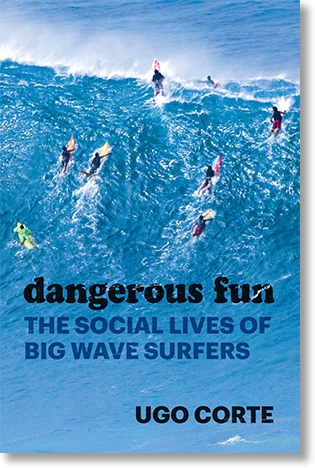
Dangerous Fun: The Social Lives of Big Wave Surfers
270 pages, paperback
Chicago, IL.: University of Chicago Press 2022
ISBN 978-0-226-82045-3
Dangerous Fun: The Social Lives of Big Wave Surfers, by Ugo Corte, is a celebrated book. It won the 2023 Charles Horton Cooley Award from the Society for the Study of Symbolic Interaction and has been reviewed in journals like American Journal of Sociology, Contemporary Sociology, Social Forces, Symbolic Interaction, Cultural Sociologyand The Journal of Religion. However, none of these reviews have approached the book from a sociology of sport perspective, which is my starting point.
It is estimated that there are about 20 million surfers worldwide. Corte visits the Mecca of surfing – Hawaii and especially The North Shore of O’ahu, which according to William Finnegan is the Vatican of surfing. While the Hawaiian Islands are known as the birthplace of surfing, the North Shore of O’ahu is renowned for having the highest concentration of world-class surf spots on the globe. Corte is not interested in just any type of surfer; he orients his fieldwork towards those surfers who seek the biggest waves, the ‘big wave surfers’, whom Corte estimates to number around 200 worldwide. Corte wants to understand this subculture within the subculture of surfing: the participants’ mentality, meaning construction, social cohesion, trajectories, solidarity and self-understanding.
Corte provides an ethnographic insight into the social lives of surfers: who they are, how they relate to surfing and attach identity to it, their motivations and ambitions. But just as interesting is the sociological explanation for this. The theoretical argument has its starting point in ritual chain reactions or interaction ritual chains (as Randall Collins calls them, inspired by Durkheim and Goffman). A successful interaction ritual requires a group of at least two individuals in the same physical space having a mutual focus of attention and a mutual awareness of this attention that creates a barrier to outsiders, so that the individuals feel safe expressing themselves in what Mead would call ‘impulsive expressions’. If pumped up to a certain level, their shared mood intensifies so that they become attuned to one another. The individuals become locked into a similar rhythm and start mirroring one another.
To gain status within the group or as a group, respect and approbation from peers and rivals are needed, and these acknowledgments in risk sports are heavily built upon risk-taking initiatives in which the group members inspire one another to engage in.
This may, at its best, lead to collective effervescence, an intense feeling of community and collective exhilaration that one individual cannot achieve alone because it is based on an intensification of shared experience, which in turn produces emotional energy as an individual outcome of a collective ritual. John Parker and colleagues describe it as “reciprocal synchronization and mirroring of voice and movement among co-located social actors”. Corte describes it as follows: “Each individual enters each social encounter with a certain amount of emotional energy and walks away from it with more, less or roughly the same amount. In this line the term ‘chains’ implies that individuals enter new situations with a residue from previous encounters” (p. 45).
Such interaction rituals might – especially in small, tight, face-to-face interactions, what Michael Farrell calls collaborative circles – influence the risks we take through what Stephen Lyng calls edgework (activities in which people consciously move along the border between control and loss of control, with a potentially dangerous outcome), and the amount and kind of fun we may or may not have. This is where Corte links Collins’ theory of rituals with the sociology of fun, addiction and risk. Effervescence is addictive: If you have experienced it, you want to experience it again, to an increasingly intense degree. Consequently, if the enthusiastic effervescence ritual is a result of ‘dangerous fun’ in risky activities such as big wave surfing, one’s risk-taking typically increases with time. In turn, this represents a transformation within the individual. “Rather than a theory of interaction rituals à la Collins, I formulate a theory of self-transformation” (p. 72).
But the self-transformation is dependent upon the group. We are socialized through groups, and often we do not respond to an anonymous audience (cf. Goffman), Corte argues, but rather, as contended by Gary Alan Fine, to other members of the small group we know. Each sequence of action is built on previous actions and sequences, not least on fateful moments(Giddens), ‘turning points’ holding high emotional energy and which lead to transformative change in one’s identity. And our behaviour is learned partly by reading the response it generates in others, especially in significant others within the ‘tribe’ (Maffesoli).
The fundamental question of the book is how incremental risk-taking is achieved interactionally among big wave surfers. To answer these questions, Corte has collected different types of data over several years, a fieldwork consisting of recorded observations in the form of field notes, photographs, videos and 79 interviews with different big wave surfers who occupy various positions within this social world, including lifeguards.

In Chapter 2, Corte explores interaction rituals in big wave surfing as follows: Fun moments are successful encounters generating emotional energy among participants. How does this work? Well, two key factors are mentorship and peer influence. Group belonging is both cause and effect of social identity formation: The groups we belong to shape how we see ourselves, just as how we see ourselves shapes the groups we gravitate toward. Within these groups there might be mentors, novices and friends, and even rivals, but all of them qualify as significant others.
One mentor described by Corte is Phil, an old and experienced surfer. He feeds the group with energy. When faced with questions of self-doubt, he reframes the situation and makes sure that his team members do not become overwhelmed by fear, but instead focus on the steps they have already accomplished. The mentor functions as a group leader and a ‘specialised other’ which less experienced group members rely on to try to make sense of a critical situation. The leader thus functions as a ‘sacred object’ or at least the mutual focus of attention within the group which others gather to draw energy from by mirroring his and, eventually, one another’s rhythm.
This emotional energy can develop cohesion (Chapter 3) and incremental risk-taking (Chapter 5). Through reciprocal influence surfers stimulate one another into taking bigger risks. To gain status within the group or as a group, respect and approbation from peers and rivals are needed, and these acknowledgments in risk sports are heavily built upon risk-taking initiatives in which the group members inspire one another to engage in. This dynamic that pushes group members to match and exceed each other’s performance, partly in anxiety about whether they are worthy of inclusion, is what Farrell calls escalating reciprocity. This concept can explain how collective judgements contribute to individual risk-taking, in this case attempting to ride exceptionally large waves. This is a productive dynamic: “If members of a group manage to set up and maintain this kind of dynamic, then the group’s productivity and creativity far exceed what any member could produce alone” (p. 151).
For a sociologist of sport, Chapter 6 is perhaps the most interesting. Here, Corte discusses the gradual transformation of a ritual towards a sport, what sociologists of sport would call sportisation (Elias). Corte notes that surfing made its Olympic debut at the Tokyo 2020 Summer Games (held in 2021). As a result of more competition, sponsors and money within surfing, a wider range of approaches to surfing is made possible. For some, surfing is recreation. For others, it may be a career path and a living. Although this is not a key point in Corte’s analysis, this evolution may cause intercultural conflicts in the form of resistance and ambivalence within the subculture.
I would like to point out four directions for further ‘waves’ of research inspired by Corte. First, how the increasing popularity of so-called ‘risk sports’ can be understood as a response to a ‘quest for excitement’ (Elias) and big emotions in an increasingly civilized social world (at least in some parts of the world). Second, how participants within these subcultures tend to take increasingly bigger risks because of social dynamics. Third, analyses of how participants relate to, for example, surfing as both an organized sport and a lifestyle, or what Belinda Wheaton calls lifestyle sport. Fourth, this book should inspire sociologists of sport, and other sociologists, to use collective effervescence and group dynamics to explore interaction rituals in a wide range of (sports) activities, both among athletes and not least among spectators at major events.
This is a theoretically sound book of interest to all micro-interactionists, sociologists of culture and sociologists of sport, almost independent of empirical interests. Corte’s analysis opens ways of incorporating concepts from various social theories of interaction in an inspiring way. Finally, it may offer food for thought for the sociology of sport community that an ‘outsider’ can write one of the best books of relevance to the sociology of sport in recent years. But that says more about Corte’s brilliance than about any shortcomings of the sociology of sport.
Copyright © Mads Skauge 2026