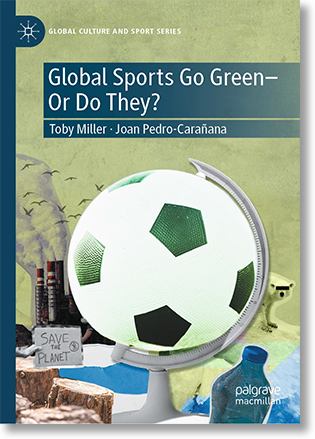
Global Sports Go Green—Or Do They?
471 pages, hardcover, ill
Cham, CH: Palgrave Macmillan 2026 (Global Culture and Sport)
ISBN 978-3-032-14206-1
As the 2026 FIFA World Cup looms with its record number of 48 participating countries contesting matches at 16 venues across three nations with immense physical distance between the nominated venues, this is surely an ideal time to confront the environmental impact of mega sporting events. Furthermore, it provides a prime opportunity to illustrate how sporting federations and the local organisers of such events engage in greenwashing to legitimise the logistics and the benefit of such global gatherings.
Toby Miller and Joan Pedro-Carañana in their timely new work provide a multi-faceted and very detailed study that goes well beyond the traditional examination and celebration of the uniting function of sporting mega events. This regularly concentrates on the largely misplaced economic well-being and growth that these gatherings are projected as offering to the residents of the hosting and bidding cities and their respective hinterlands. Rather, the authors have opted to focus on the increasing essential scrutiny required of the ecological and environmental responsibility of mega event hosts and potential bidders in terms of the impact of their arrangements on ecosystems, communities and athletes, in addition to investigating the gap between greenwashing rhetoric, material realities and grassroots resistance. Sports, as the authors remind us, constitute the nineth biggest global industry valued at $2.65 trillion (Anani 2024) and thus merits the level of critical attention it now receives under the heading of sport ecology.
Greenwashing, the ugly cousin of sportswashing is the practice of misleading consumers about environmental efforts through deceptive marketing and communication that all too often is pro-business in outlook, and counter to public resistance. When organizations engage in greenwashing activities, accidentally or intentionally, they mislead stakeholders into thinking they prioritize climate action, delaying critically needed environmental changes and lacking in a true environmental conscience which can also be disguised as part of their corporate social responsibility policy programmes,as the authors state in each of their case studies.
Chapters focusing on the FIFA World Cup and the Summer Olympics are well trodden, though an updating of the former in a possible later edition of this valuable volume would be useful in commenting on the excesses of this year’s competition with respect to climate politics, geopolitics and personal human suffering.
The text rightly contextualises its critical discussion from the perspective that sport and the natural environment share a bidirectional relationship. On the one hand, it not only provides prerequisites for practicing (or watching) sports, but it may also influence athletes’ performance alter supporters’ attendance intentions, or shape organizational strategy in times of climate change. Alternatively, sports exert significant impacts on the environment, for instance, via greenhouse gas emissions or by extensive energy consumption, waste generation, or water use during international sports events such as the Olympic Games.
This volume, comprising seven chapters, focuses on the theme that the authors term “Carbon Violence” of sport, categorically stating that although not in the class of extraction and manufacturing, the slow violence of carbon sport cannot be perceived to be ecologically sustaining with its residues of blood, grief, injury (to humans and animals) and memory. In seeking to prove their case the aothors have chosen to base their extended analysis around the FIFA World Cup, the summer Olympics, the America’s Cup and Formula One racing. In each case, the competition is both directly and indirectly environmentally damaging as a consequence of the events themselves and the promotion of unsustainable industries favouring commercial over environmental concerns.
Commencing with a fascinating historical and philosophical overview of the emergence and growth of sport with references extending from Marcus Aurelius to Orwell and its consequent potential for making substantial sums of money which are unevenly distributed across classes and geographical frontiers as proven in extensive time-series analysis (Ivanov and Ashyrov 2024) the parameters of the study are clearly established. Chapters focusing on the FIFA World Cup and the Summer Olympics are well trodden, though an updating of the former in a possible later edition of this valuable volume would be useful in commenting on the excesses of this year’s competition with respect to climate politics, geopolitics and personal human suffering.
With strong justification the authors confront F1, although this is the shortest chapter in the volume, with much of the emphasis on the subjugation of nature to technological advancement. However, in so doing it remains well nigh impossible to attribute much progress to the sport becoming seriously more environmentally conscious when it worships, speed engine size, engine power and aerodynamic efficiency, while focusing so little on the dependence of the earth’s physical resources. The efforts of some of the drivers to raise issues may be worthy, but is also scarred by inconsistency in their actions. Sponsors find the sport so alluring as it remains a constant and virtually year round feature in the international sporting calendar, with the only changing variables being the introduction of new venues and increasing streamed footage.
The most stimulating and challenging chapters are those in the second half of the volume which focus on the America’s Cup and on refusing and resisting carbon sports. The former merits attention as the costs to the host are often not widely known to the general public, nor the scale of the travelling entourage accompanying those sailing the boats. The America’s Cup unlike the other mega events observed is a corporate competition between private yacht clubs of the rich world originating in 1851 and constituting the first modern international sporting event and a showcase of maritime supremacy.
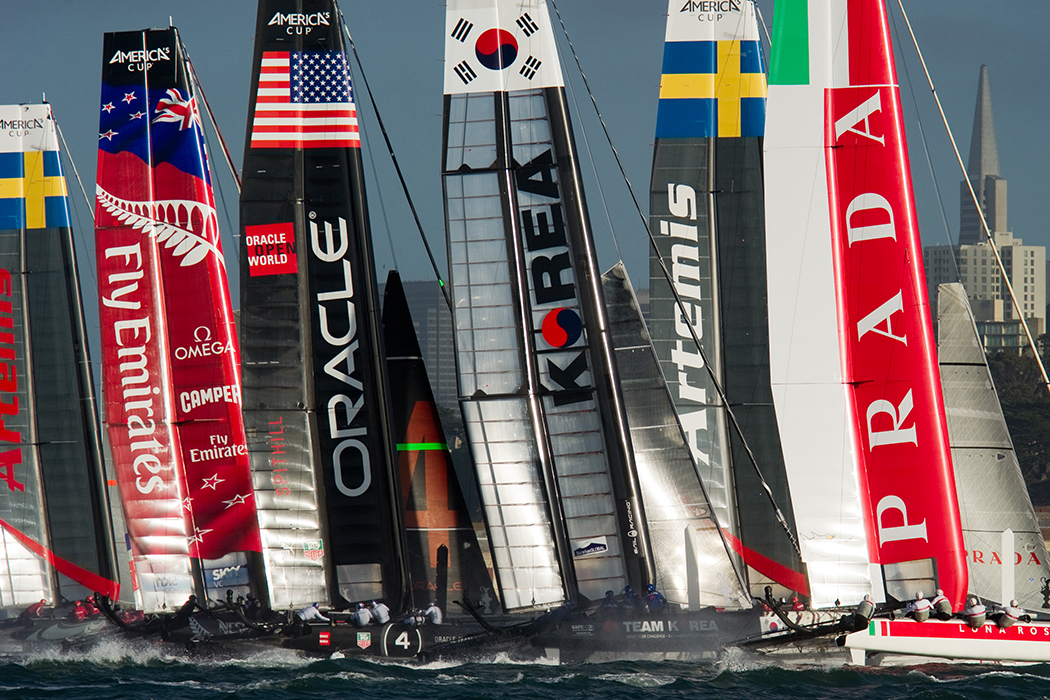
Since 1983 the winner of the contest to challenge the holder of the trophy has received a prize named after the sponsor who handed over most cash and have in effect underwritten the event with many of these awarded having been notorious carbon emitters, most notably Emirates Airlines. The billionaires competing for the Cup in terms of financing national challenges have also lobbied hard to acquire public funding, and many cities, most notably Valencia and Barcelona in recent times, have had their municipal authorities seduced by boosters promising economic growth and urban consolidation which in the case of the latter resulted in substantial municipal debt. To many the America’s Cup has become F1 on the water and no longer a regular regatta, but a higher octane event very much connected to notions of city gentrifying development plans.
Although the efforts to deny environmental damage generated by sport, in which the authors suggest the virulent denial of climate crisis is far less than in other industries, the text offers a model of analysis that seeks to confront the executive dominion over the world’s carbon sporting fixtures and how non-governmental organizations arguing for direct action, public interest collectives (critics and scholars), grassroots groups and sporting participants deal with their own degree of complicity as spectators and athletes. In response terms however, more could have been said about the evidence of good practice as demonstrated by Forest Green Rovers (the only pro football team certified for carbon neutrality by the UN), the installation of 6,200 solar roof panels by FC Freiburg, whilst the Johann Cruijff stadium in the Netherlands and the Galatasaray Stadium in Istanbul have undertaken similar actions.
As an overview of the progress or otherwise of global sports taking on a meaningful green agenda, it would have been potentially valuable to have some discussion of cricket (the authors offer a limited justification for excluding the Indian Premier League from their analysis), tennis and golf. In each case the respective sport has global appeal and has different critical financial backers, yet the cost in environmental terms in each instance has multiplied most notably in South Asia, one of the geographical areas most prone to environmental disaster, though cricket offers a lifeline to many seeking an escape from poverty. However, one of the chief backers of cricket remains Aramco, a major global greenhouse gas emitter and a key backer of both men’s and women’s cricket, much to the chagrin of many followers of the game.
For anyone seeking to grapple with and understand the complexity of sport ecology (McCullough, Orr, & Kellison 2020) which the authors seek to clarify, this is a very brave, valuable and readable piece of writing that should appeal to a wide readership extending beyond the spheres of academia and journalism. The references used are both grounded in theory and exceedingly varied and contemporary, whilst the text reminds the reader that the bulk of serious analyses of these issues has been undertaken via an Anglo dominant literature that shows insufficient engagement with the negative impact of environmental thinking. This is a matter of some importance with the global south now far keener and capable of hosting mega-events be they football, athletics, sailing, cricket, tennis, motor racing or even seriously bidding for winter and summer Olympics.
Ultimately, however, as the authors remind us in their concluding comment, it remains up to all of us to grasp the “noxious nettle” and bring an end to the slow violence of carbon sports. This remains a challenge that we cannot afford to shy away from regardless of whatever capacity we remain attached to and delight in sport.
Copyright © Russell Holden 2026