Steph Doehler
The Open University, UK
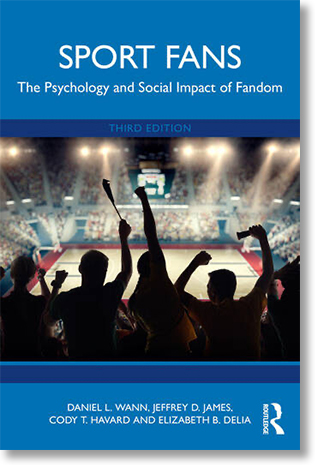
Sport Fans: The Psychology and Social Impact of Fandom (3rd Edition)
366 pages, paperback
Abingdon, Oxon: Routledge 2025
ISBN 978-1-032-5886-5
Sports Fans: The Psychology and Social Impact of Fandom presents itself as an updated third edition examining the psychological foundations and societal consequences of sport fandom. Authored by four established scholars in the field, the book promises expanded coverage, including increased attention to fandom surrounding women’s sport and women sport fans. It delivers a comprehensive synthesis of psychological research on how and why individuals form attachments to teams and athletes. Yet, while the volume is undoubtedly authoritative within its disciplinary lens, certain claims, particularly around gender, warrant closer scrutiny.
By way of positionality, I approach this book not as a sport psychologist but as a sociologist with an interest in fandom and its cultural implications. I have not read the previous editions and therefore cannot comment on how this version builds upon them. My reading is thus shaped by an attentiveness to broader structural and cultural questions that sometimes sit beyond a strictly psychological framework.
The book is structured in three main parts: how and why individuals become fans; the emotional and aggressive dimensions of fandom; and the consequences of fandom for individuals and society. Rather than progressing chapter by chapter, it is more useful to understand the book as a sustained engagement with attachment, motivation, emotion, and identity through a psychological lens.
While women are incorporated into examples and occasional discussions, there is little sustained engagement with the gendered conditions under which fandom operates. The structural realities of sexism, marginalisation, and hostility faced by many women fans, particularly in digital spaces, are not meaningfully explored.
Across its discussion of topics such as motives, emotional responses, aggression, and rivalry, the book demonstrates impressive command of the literature. The synthesis of research is extensive and meticulously referenced. The chapter on fan motivation, for example, draws together a vast body of work and critically examines the measurement scales that dominate the field. Similarly, the exploration of emotional reactions reminds readers of the intensity and breadth of feelings that sport evokes, from joy and pride to anger and despair. These sections reinforce the book’s core strength: its ability to consolidate decades of psychological scholarship into a coherent and accessible narrative.
However, the disciplinary focus is also where some limitations become visible. The authors state that this edition expands coverage of fandom relating to women’s sport and women sport fans. Yet such coverage remains comparatively limited and, at times, cursory. While women are incorporated into examples and occasional discussions, there is little sustained engagement with the gendered conditions under which fandom operates. The structural realities of sexism, marginalisation, and hostility faced by many women fans, particularly in digital spaces, are not meaningfully explored. Given the book’s explicit claim of increased coverage, this absence is noticeable and prompts an unavoidable question: how minimal must such engagement have been in earlier editions?
More broadly, other dimensions of inequality receive limited sustained attention. Although the book recognises diversity among fans, it stops short of deeply analysing how race, sexuality, class, or geography shape fan experience. The geographical scope is particularly constrained. While occasional cross-national references are included, the globalisation of fandom, including the growth of overseas NFL supporters or the expansion of Premier League followings across Asia, remains largely peripheral. In an era where sport consumption is profoundly transnational, this feels like fertile ground for future development.

The text does successfully integrate both US college sport and professional sport, reflecting the centrality of collegiate athletics within American sport culture. For readers outside the United States, however, the prominence of the college system may resonate less strongly. While this focus is understandable, more expansive comparative perspectives could have enhanced the book’s international relevance.
Stylistically, the prose is readable and generally accessible. The inclusion of occasional personal reflections from the authors is a welcome touch, adding a sense of intellectual investment rarely visible in academic texts. At the same time, chapters are substantial, often exceeding twenty pages, and their density can make the book less suited to brief, selective reading. The thoroughness is admirable, yet the cumulative length occasionally risks losing momentum.
Despite these critiques, the book succeeds in what it primarily sets out to do: provide an authoritative psychological account of sport fandom. It convincingly demonstrates that fandom is not a trivial pastime but a meaningful and often consequential aspect of individual and collective life. Its examination of emotional investment, behavioural outcomes, and societal implications underscores the depth of attachment sport can generate.
Ultimately, Sports Fans: The Psychology and Social Impact of Fandom will serve as a valuable resource for scholars and students seeking a comprehensive overview of psychological approaches to fandom. It consolidates an extensive body of research into a coherent framework and will likely remain a core text within sport psychology curricula. However, readers seeking sustained engagement with gendered power relations, global dynamics, or broader sociocultural critique may find its scope narrower than its framing suggests. A future edition that more fully integrates these perspectives would further strengthen what is already a substantial scholarly contribution.
Copyright © Steph Doehler 2026