Daniele Canini & Anne Tjønndal
RESPONSE – Research Group for Sport and Society,
Faculty of Social Sciences, Nord University, Norway
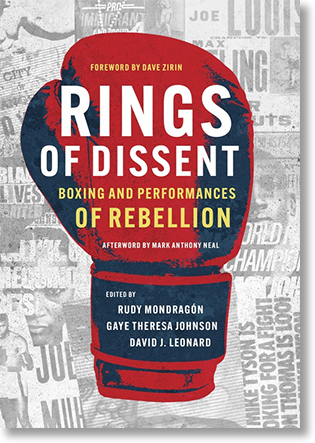
Rings of Dissent: Boxing and Performances of Rebellion
256 pages, paperback
Urbana and Chicago, IL: University of Illinois Press 2025 (Sport and Society)
ISBN 978-0-252-08898
The book Ring of Dissent: Boxing and Performances of Rebellion, edited by Rudy Mondragón, Gaye Theresa Johnson and David J. Leonard, aims to identify the power structures and practices of agency that have always been present in boxing, focusing on episodes involving mainly marginalised boxers with lesser-known stories. As the authors themselves point out, the book focuses on boxing culture in the US, tracing its history back to the early 20th century. In certain parts of the book, the authors’ US-centric perspective means that a good knowledge of American history is required to fully grasp the nuances. These characteristics are evident from the very first chapter, entitled “Passing and Prize fighting: Ralph Dupas’s Fight to Be White” written by Louis Moore. Here, the Dupas case is clearly introduced, described and put into context, but it assumes some prior knowledge of the segregation bill in the US. However, the book is published by University of Illinois Press, so one can assume it is also primarily written for an American audience.
While the book includes some interesting stories and perspectives on race and racism in American professional boxing, it is difficult to determine which readers it is intended for. The book includes some historical case studies and some more recent ones. Some chapters are written as analytical and scientific analyses, while others are not. For instance, Chapters 2, 4, 8, 10 and 12 each contain a transcribed interview with no analytical or scientific content. In some of these interview chapters, it is not entirely clear why the individuals were selected for inclusion in the book, as some interviewees appear to have only limited knowledge of boxing despite being asked to discuss the sport. This leads to some general observations that any enthusiast of any sport might make. Emblematic is the exchange in Chapter 4 between David J. Leonard and Jessica Luther, where the interviewer points out “You noted that you don’t watch boxing” and the interviewee answers “[…] I don’t have a sense of how you watch boxing”. Specifically, the interview with Kali Reis (Chapter 2) would gain considerably in analytical depth if paired with Chapter 3. Pairing these two chapters would allow the reader to move between lived experience and critical analysis, reinforcing the arguments developed across both. Speaking more generally, these chapters would take on a different significance if used to reinforce or offer a different perspective on the issues addressed in the book. In our view, the rationale for including the complete interview transcripts in the volume is not clear, as it is difficult to determine how they substantively enhance the book’s overall contribution.
While we appreciate that books, monographs as well as anthologies, are academic outputs that allow for more creative writing than journal articles, some coherence and streamlining in how the individual chapters are presented would have been helpful in this case.
Chapter 5, entitled “Down but Not Out: Mexican Prizefighters and Struggles against US Immigration during the 1930s”, deals with a topic similar to that covered in the chapter on Ralph Dupas. As for Chapter 5, José M. Alamillo tells the story of two professional boxers, providing a detailed analysis of the historical context which, even here, is far removed from the present day, despite the fact that these are themes that recur periodically even today. In some passages, the chapter becomes overly descriptive, and the conclusion feels somewhat banal. Chapter 6 “The Great Off-White Hope” follows the same line: here too, there is no analytical section, only the narrative. In both chapters, however, we appreciate the telling of unusual stories that have not been recounted in many other books, offering the reader a broader perspective on the topics discussed.
Of all the chapters, Chapter 7 “‘Yo Soy José De Avenal’: The Deployment of Expressive Culture in Disruptive Ring Entrances” by Rudy Mondragón, stands out as one of the most academically oriented. We appreciated the structure, tone and ideas presented, and we believe there could be many interesting analyses on the subject of ring walks in professional boxing. The case about Trump is the first attempt to bring the arguments into a more contemporary context, which we consider an important contribution. Another highlight in the book is the discussion on the differences between boxing gyms and boxing studios in Chapter 9 written by Priscilla Leiva. The introduction engages in an analysis of these differences, but then the focus shift heavily to the stories of two specific gyms in Los Angeles, which makes the second half of the chapter somewhat descriptive and anecdotal.
An interesting aspect of the book relates to chapters 11, 12 and 13, which all spotlight working life aspects of professional boxing. For instance, in chapter 11, Lucia Trimur discusses pay and payment practices of coaches working in boxing gyms. Trimur effectively illustrates the precarious nature of work in boxing gyms, showing how boxing coaches strive to “create a position in which they control their time, and they use this time in ways that are different from those in the formal labor market” (p. 171). Chapter 13, written by Javon Johnson, examines the professional life of Floyd Mayweather Jr. The chapter adopts an essayistic style, with sections titled “Round 1,” “Round 2,” and so on. Nevertheless, Johnson effectively demonstrates how professional boxers must carefully manage their careers in order to secure financial stability while avoiding injury.
The different directions and premises of the chapters included in Rings of Dissent makes it challenging to determine what audience this book is intended for. It is not purely historical, nor is it not clearly contemporary. The writing is sometimes analytical and research oriented, sometimes narrative and descriptive. Perhaps this book first and foremost fits best for fans of American professional boxing with an interest in issues of race and racism. As many of the chapters include historical cases, it could also perhaps be better suited for scholars in sport history than in sociology of sport and sport management. It could also be that boxing fans will appreciate the interview chapters in a different way than an academic readership.
Overall, the book contains several compelling individual contributions, and we particularly enjoyed Chapters 7 and 11. However, the volume as a whole would have benefited from a clearer editorial direction. From a book published by a university press we would expect a stronger emphasis on analytical rather than descriptive writing. This is especially true of the chapters built largely around fully transcribed interviews.
The combination of historical and contemporary cases has the potential to create a strong and cohesive volume, but the execution could have been improved upon in several ways. Since Rings of Dissent primarily addresses race and racism in American professional boxing, it would have been helpful for readers to understand why these particular boxers and cases (both historical and contemporary) were selected. This could have been outlined more clearly in the introduction chapter. For example, we would have expected a chapter on Claressa Shields in this book. A concluding chapter offering a meta-analysis of the individual contributions might also have helped tie the volume together more cohesively. Lastly, the structure and form of the chapters diverge substantially.
While we appreciate that books, monographs as well as anthologies, are academic outputs that allow for more creative writing than journal articles, some coherence and streamlining in how the individual chapters are presented would have been helpful in this case. Despite these shortcomings, Rings of Dissent remains a useful contribution to the study of race, inequality, and identity in American professional boxing, and its strongest chapters offer new insights for scholars interested in the cultural and social dimensions of combat sports.
Copyright © Daniele Canini & Anne Tjønndal 2026