
Jake Wojtowicz
Ph.D., Independent Scholar, Rochester, NY
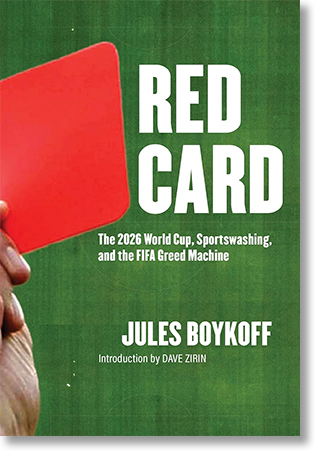
Red Card: The 2026 World Cup, Sportswashing, and the FIFA Greed Machine
160 pages, paperback
New York, NY: OR Books 2026
ISBN 978-1-68219-528-4
The World Cup is upon us. After Qatar 2022, we might be forgiven for having hoped that this iteration would be a little less political, that we could just enjoy the festival of football. Alas, after abducting one foreign leader, assassinating another, threatening to invade Greenland, further alienating NATO allies with an unnecessary war (not to mention extrajudicially killing fishermen!), the United States—which is cohosting this year’s tournament—is coming in for more socio-political criticism than usual.
In Red Card, Jules Boykoff unpicks the myriad ways that FIFA, football’s governing body, has fallen from its role as guardian of the game, serving instead to enrich its egotistical leaders, while entangling itself with vicious political leaders and their projects. By looking at recent and more distant history, Boykoff aims to show how the 2026 World Cup will be used by Trump to further entrench his illiberal regime.
Boykoff has made a vital intervention in the public discourse. (It is important to note that this is a public, not an academic, book; I return to this below.) Boykoff offers a compelling explanation of how the 2026 World Cup is an effort at sportswashing. This is a term that has crept into the public consciousness, especially after the 2022 World Cup in Qatar. As Boykoff makes clear, the term will remain relevant, with the 2028 LA Olympics taking place near the end of Trump’s term in Los Angeles and the 2034 World Cup in Saudi Arabia. So, what is sportswashing? It is worth quoting Boykoff in full:
Sportswashing is when political leaders use sports to appear important or legitimate on the world stage while stoking nationalism and deflecting attention from chronic social problems and human-rights woes at home. Sportswashers use sports to try to burnish national prestige, to convey economic or political success, to spur personal enrichment. (14-15)
Now, there is scope to disagree with Boykoff’s precise understanding here. It strikes me that boosting popularity domestically is often an unproblematic part of hosting sporting events; even stoking nationalism might not be much of a problem if that nationalism isn’t toxic. In my view, chronic social issues might not be sufficiently momentous to be the sort of thing that gets sportswashed—after all, no country is perfect, almost all host nations will have some chronic ills, and to wield “sportswashing” too widely is to blunt it. So, Boykoff’s definition might be a little too broad. But this is just academic quibbling at the margins; practically speaking, the cases of sportswashing that Boykoff focuses on involve major human rights abuses.
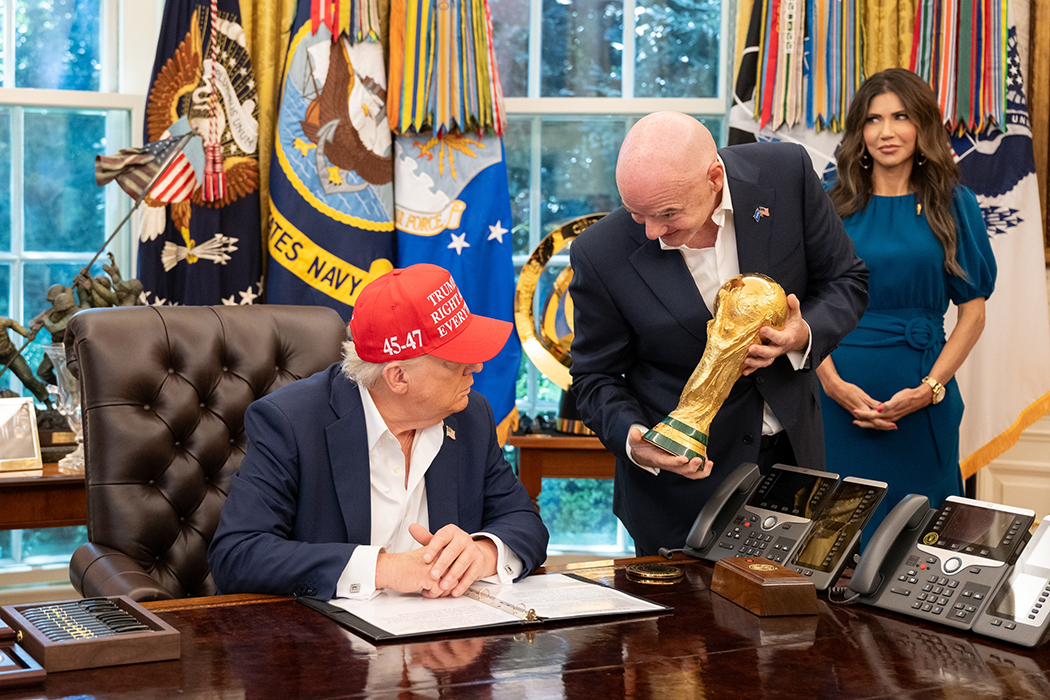
Infantino is rightly presented as a sycophant who violates FIFA’s own statutes, such as when he unilaterally established the FIFA Peace Prize and bestowed it on Trump, or when he violated principles of neutrality and appeared in a red “USA” baseball cap.
It is also important to add that Boykoff is not narrowly focused on what I see as sportswashing, namely using sport to distract from human rights abuses. Rather, he is interested in all of the broader corruptions and distortions that go along with this, and so his broader definition is appropriate for his purpose; as well as the attempts to bolster Trump’s image, Boykoff critiques the extractive hosting arrangements that suck money out of fans, and he looks at how sporting events often allow governments to increase surveillance and bolster security services, which can then be used in anti-democratic ways.
What Boykoff does so well is to paint a picture of how sportswashing works. The book is short and readable, but it is useful to see the general picture: Chapter 2 exposes Trump’s relationship with sport; Chapter 3 looks at historical uses of sport as a political tool; Chapter 4 looks at Russia 2018 and Qatar 2022 as clearcut cases of sportswashing; and Chapters 5 and 6 show that “Trump is aggressively using sports to appear important on the world stage while stoking nationalism, and bolstering the militarized state security apparatus” (17). (The foreword by Dave Zirin uses the case of Brazil 2014 to set the scene for one important theme, that World Cups have led to the rise of right wing political factions, albeit in a different manner to sportswashing.)
As I see it, there are three key prongs to Boykoff’s argument. Firstly, there is the fact that the Trump regime is widely violating human rights and committing a manner of political and social evils. What’s more, the United States’ global reputation has taken a major hit. Trump’s wars, threats to neighbours, position on NATO, and global tariffs do not exactly present the image of a country that wants to help its supposed allies. Trump’s approval ratings have also been very poor—which is unsurprising, with his ICE goons on the rampage, arresting, abducting, and killing legal residents and citizens—so there is a domestic edge to this, too. So, there is a clear need to burnish national prestige, appear legitimate on the world stage, and raise domestic popularity.
Secondly, Boykoff capably unfurls the various ways that Trump has entangled himself in sports, from the FIFA Peace Prize and his gormless insertion at the presentation of the Club World Cup, to the gaudy UFC event he is planning on the White House lawn. But doing bad things and being involved in sport does not make something sportswashing. That requires the third step: for this involvement in sport to somehow affect the perception of Trump in relation to those social ills.
The historical cases are helpful here. For instance, Boykoff cites a contemporaneous New York Times article that praised Hitler’s Olympics, noting that tourists left Germany thinking that the people were happy and Hitler was a great leader; domestically, Hitler’s popularity was at a high, and Boykoff suggests this “laid the groundwork for military aggression” (50). Boykoff likewise concisely shows that Argentina in 1978, Russia, for the 2014 Olympics and 2018 World Cup, and Qatar in 2022 derived a range of international and domestic benefits through hosting.
By hosting the World Cup, and by associating himself with it, Trump will—if Boykoff is right—be able to latch on to some of the glitz and glamour. Cristiano Ronaldo posting a picture of him and his wife walking with Trump and Messi visiting the White House are just tastes of what is to come. If I had one slight critique of Red Card, it’s that I would have liked to see a little more on why we should worry that Trump’s association with the World Cup will lend him prestige and boost his popularity. Still, the picture Boykoff paints of other right-wing regimes using the World Cup gives us enough material to work with, and perhaps Boykoff’s lighter touch better fits the polemical nature of this book.
Although this is a book for a general audience, Red Card—alongside Boykoff’s work on the 1936 Berlin Olympics (The 1936 Berlin Olympics: Race, Power, and Sportswashing)—makes an important academic intervention. Some academics worry that what we label “sportswashing” is just soft power, something that nations have always engaged in; more insidiously, there is a worry that to label the actions of some nations (but not others) as “sportswashing” relies on racism and anti-Arab tendencies. But Red Card is also a clear rejoinder to anybody who thinks that sportswashing is something that can only happen in non-Western dictatorships. The concept of sportswashing would be troubling if it were just a cudgel the Western media used against the Arab world; but the troubling aspect here would be xenophobia. Sportswashing is in fact troubling, not because it is a xenophobic concept, but because it is something that can happen almost anywhere. By making a compelling case that the 2026 World Cup will be used bolster Trump’s regime, Boykoff provides a powerful case that sportswashing is not just a mendacious concept; instead it is an important concept that alerts us to the use of sport to further right-wing regimes, and is something that can manifest in a wide range of social conditions across the globe.
So, what can we do about this? One possibility is a boycott, which Boykoff considers, providing a helpful discussion of some historical boycotts. But he is rightly skeptical that this will happen and he offers some helpful other forms of protest. One of the organizations that Boykoff discusses, People’s Football, organized a football festival with 5-a-side games, political talks, and opportunities to protest the World Cup. Whatever we do, football is, as Boykoff puts it, “something worth fighting for” (18). The World Cup has been taken over by elites who use it for their own good. Red Card makes that clear. But football is something that billions of people care about, and we should not just cede it to those selfish elites. Although Red Card is hardly an uplifting read, Boykoff does an admirable job of not losing sight of the fact that there is a need, and a space, for resistance.
This is an insightful and widely reaching book. Boykoff employs a range of cases to build his argument, and almost every reader will walk away having learned about some astounding new corruption (such as when Kissinger went into Peru’s dressing room ahead of their vital match against Argentina in 1978, in an attempt to coerce them into letting Argentina win [52-53]).
He is also incisive on FIFA’s own failures. Infantino is rightly presented as a sycophant who violates FIFA’s own statutes, such as when he unilaterally established the FIFA Peace Prize and bestowed it on Trump, or when he violated principles of neutrality and appeared in a red “USA” baseball cap. Infantino is, as Boykoff puts it, “Trump’s primary enabler when it comes to converting soccer into political advantage” (14). It is worth noting that Boykoff is on the advisory board of Fair Square Reboot, which has recently launched a petition against Infantino’s abuses.
The best thing about this book is that it is so sharp. This is not a flabby book, nor a book to be pored over. It is rhetorical and meant to shock. At 138 short pages, excluding the notes, I (a slow reader) devoured it in one afternoon sitting. This is not an academic discussion of the complexities of sportswashing, nor a detailed history, nor is it full of jargon and references. Rather, it is a book for a wide audience. Importantly, it comes in at an accessible price: $18 for the paperback, $10 for the e-book, $23 for both. I can see this book being a great read for anyone interested in the World Cup and its history, or for someone with an interest in the entanglements between sport and politics.
Red Card has an important message, and it delivers this message powerfully. But it also is its own form of resistance against sportswashing. As Boykoff puts it “When everyday people learn about how FIFA prioritizes profit over people, it makes an impression—and not a good one” (127). Part of the task of resisting sportswashing is to make sure that people know just how bad things have become. Red Card manifests this through its concision and readability, alongside the moral force of Boykoff’s writing.
Copyright © Jake Wojtowicz 2026




[…] Civil-society advocates and some journalists have framed part of the coverage in terms of “sportswashing,” arguing that large sporting spectacles can be used to project political legitimacy or distract from domestic and international controversies. Others counter that the event also creates jobs, tourism revenues and cultural exchange opportunities in host regions. The competing narratives have shaped both local planning and national commentary. (idrottsforum.org) […]