Łukasz Muniowski
University of Szczecin, Poland
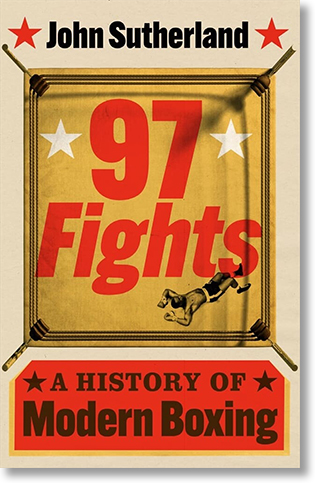
97 Fights: A History of Modern Boxing
496 pages, hardcover, ill
London: Reaktion Books 2026
ISBN 978-1-83639-268-2
In the current sports landscape, boxing is not as revered as it used to be at the beginning of the millennium. While the big-name fighters still get paid tremendous amounts of money and their fights garner worldwide interest, only boxing afficionados can now name anyone below the top-ten heavyweights, let alone other weight classes, which, barring exceptions like Naseem Hamed, Manny Pacquiao or Roy Jones Jr., never got the attention they deserved. John Sutherland’s book is an attempt at regaining the lost respect for this “most hurtful sport,” as the author refers to boxing on the back cover. His way of doing that is by selecting and analyzing 97 fights that shaped boxing, for better or worse.
The tone he takes is one of poetry and pathos, with scorn reserved for those who (in his view) tarnished his beloved sport. Selection is always subjective and the author does not even try to pretend that he will remain impartial through his writing. This allows him to write with emotion and passion, making the episodical, at times picaresque structure of the book work, with each chapter serving as a brick used to construct the temple of boxing, rather than a separate entity.
Unlike MMA, which is oftentimes described in a barbaric, brutal dialect, boxing requires a particular vernacular for the nobility to overtake monstrosity. There is a certain dichotomy ingrained in boxing, as the athletes are expected to be ruthless in the ring but civilized outside of it. Indeed, that is why boxing as an activity is only for the selected few, and only a selected few can write about it without buffoonery. Sutherland is one of the group of writers capable of pulling off that balancing act, sounding knowledgeable and enthusiastic … most of the time.
All in all, despite its flaws, the book is a welcome addition to the boxing books landscape.
Considering its scope, it is understandable that the book contains some editorial, logical and factual mistakes. In the chapter on Chris Eubank, the boxer’s birthday date is given twice, on back-to-back pages, as if the author forgot that he already provided that piece of information. Consider the two passages: “Christopher Livingstone Eubank was born in 1966 in Dulwich, South London” (p. 383). “He was born in 1966 in East Dulwich, close to Peckham Rye, the fifth child in the family” (p. 384). Also, sometimes the author is referring to a piece of information that he provides in a later chapter which disrupts the continuity of the reading. As for the logical mistakes, the most exemplary is one regarding Barbara Buttrick, a female fighter born in 1929, who is described as being fifteen in the 1930s (p. 256-257).
Factually, the most glaring mistakes concern professional wrestling, with the author mentioning “The Undertaker” as a finishing move – the Undertaker is a wrestler, his finisher is the Tombstone Piledriver – and characterizing Hulk Hogan as “the perennial bad guy,” despite Hogan being one of the biggest faces (good guys) in wrestling’s history (p. 458). In another instance, Polish boxer Zbigniew Pietrzykowski gets just one paragraph in the description of his fight with Clay, and on his example the author writes that “In the Soviet Bloc, amateur athletic sport was professionalism paid not with cash but privilege, status and, for the successful, life-long, well-paid work and a pension” (p. 216), which is not entirely correct. Athletes were employed by police, army, mining companies or railways, and while they did not have to show up to work when they were competing, when their careers were over many struggled financially.
Furthermore, when Sutherland acts as boxing’s gatekeeper and attempts to put down a fighter, the writing tends to get confusing. The author is particularly harsh on Mike Tyson and while calling the fighter controversial would be an understatement of the decade, some reasons for the disdain are hard to understand. When Sutherland writes that “Tyson’s great fights are short because he despised the masses who would shell out fifty bucks to see a man’s body and brain destroyed” (p. 345), I do not see the connection between the two. If anything, Tyson potentially holding out and prolonging the fight would be reminiscent of a tiger playing with his food, hence disrespectful to the opponent and the fans, who paid to see what Iron Mike was advised by his adoptive father and coach, Cus D’Amato, to do – conquer. Or consider the phrasing describing how Tyson paid respects to D’Amato after winning the fight following his death: “Cus had died in the November before the Berbick fight. Mike celebrated his mentor’s achievement by shaking and sprinkling a bottle of Dom Perignon over Cus’s grave” (p. 351, italics mine).
All in all, despite its flaws, the book is a welcome addition to the boxing books landscape. Going beyond romanticizing violence, it highlights the sport’s highs and lows, its heroes and villains, resulting in an impressive win, albeit on split decision.
Copyright © Łukasz Muniowski 2026