Angela Stănescu
Sport Research Institute, Universitat Autònoma de Barcelona
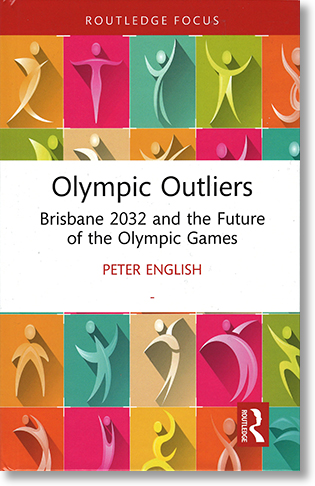
Olympic Outliers: Brisbane 2032 and the Future of the Olympic Games
117 pages, hardcover
Abingdon, Oxon: Routledge 2026 (Routledge Focus on Sport, Culture and Society)
ISBN 978-1-032-91574-6
Olympic Outlier. Brisbane 2032 and the future of the Olympic Games by Peter English is published by Routledge in the Focus on Sport, Culture and Society collection, which brings to the attention of the public impactful research on current debates in a concise form. In less than 100 pages, English is examining and discussing how the Olympic Games are changing in sight of the bidding process and the host cities selection. This book particularly addresses the case of the summer edition of the Olympic and Paralympic Games in Brisbane 2032, which is defined as an “Olympic outlier host”. Using the case of Brisbane, Peter English brings to the attention of the readers a much larger discussion about the way Olympic and Paralympic Games are changing to become a more sustainable model. That is moving away from a traditional model involving expensive megacities and exorbitant brand new venues to what English argues to be an “outlier” and represent the future of the Games.
Senior lecturer in sports journalism at the University of the Sunshine Coast, Queensland, Australia, Peter English has a strong background in sports journalism both as academic and professional, and his research work is focused on sports media and journalism. His experience with sports media around the Olympic Games is strongly reflected in the insights and interesting discussions highlighted in this book.
Combining official documents, published interviews, media analysis and Olympic history, the book represents a multidisciplinary approach to understanding the transition from an Olympic event based on size and spectacle to a model based on sustainability, adaptability and realistic expectations relatable and reliable for the local communities that host the Games.
Considering an “outlier” as “different from a main body” (p. 1), English explains why Brisbane is an Olympic outlier based on differences to other hosting cities. Unlike the megacities that hosted the Olympic and Paralympic Games since 2000 like Athens, Beijing, London, Paris, etc., Brisbane doesn’t rely on the global recognition and resources of such previous hosting cities. Or in the author’s terms: “Brisbane is not […] a location that immediately fits with the glitz and glamour of the Olympics” (p. 1). Also, Brisbane 2032 relies on a regional organization of the Games in Queensland, rather than centering the games exclusively around the city.
Brisbane 2032 is used in this book as a case study to examine the changing politics, economics, governance and sustainability around hosting the Olympic and Paralympic Games.
Structured in 4 chapters, this book’s main goal is explaining the future of the Olympic Games in the larger context of the transformation of the Olympic Movement to produce more sustainable Games that rely on reduced budgets, and significant and valuable positive legacy for the local communities that host the event.
In the first chapter, “The Shift to a New Olympic Future”, Peter English provides a contextualized understanding of why Brisbane 2032 is an Olympic outlier. Relying on official documents, declarations of responsible factors, media analysis and Olympic history, the first part of the book focuses on how Brisbane was selected as a host. The selection process of Brisbane was completely different to the traditional bidding process that involves large bidding costs and potential corruptive behaviour for buying votes.
The Olympic Agenda supports the transformation of the selection process for hosting the Olympic and Paralympic Games from a bidding model, where cities invested substantial budgets in the process even before being selected as a candidate, to a dialogue-oriented model (How is the IOC reforming the bidding process for the Olympic Games?, n.d.).
In this context, Peter English emphasizes the events and negotiations with the International Olympic Committee (IOC) that lead to the selection of Brisbane, Australia as a host for the Olympic and Paralympic Games 11 years in advance. A very strong point of this chapter is the historical contextualization of this selection that highlights how this decision is not an exception, but it is placed within the larger space of the Olympic Movement and it raises the broader critical analysis of how the IOC begins to rely on a more adaptable and flexible approach to hosting its mega sports event.
This first chapter of the book provides an important and needed critical analysis of the selection process. English covers discussions about the context, the opportunity, the risks, and critics of the selection, placing the conversations in the larger analysis of the transformation of the Olympic events and “understanding the first steps in the development of a mega-event entering unconventional territory” (p. 16). Brisbane 2032 is used in this book as a case study to examine the changing politics, economics, governance and sustainability around hosting the Olympic and Paralympic Games.
The second chapter, “Legacy Issues and Brisbane 2032”, is aiming to contextualize and explain the Olympic legacy. Relying on the definition provided by Preuss (2007), the Olympic legacy represents “all planned and unplanned, positive and negative, tangible and intangible structures created for and by a sport event that remain longer than the event itself” (p. 17–18). Based on significant academic literature on the Olympic legacy, this chapter includes potentially the most important conversation around the future of the Olympic Games. The main critics around the Olympic legacy include the planned budget and the sustainability of the Olympic and Paralympic Games. English provides a critical discussion around these two topics using the case of Brisbane 2032 and the ongoing discussions of the organizing committee around the planned infrastructure and budgeting.
In the new development of the Olympic host selection, budgeting receives closer attention. However, the initial budgeting of other Olympic events have previously been substantially exceeded as is the case with financial struggles around Rio 2016 and Tokyo 2021 (p. 11). Therefore, the critical analysis around the impact of Olympic and Paralympic Games budget for the local community becomes now more important than for the past editions.
The sustainability and legacy of the Olympics must become aligned with the climate change agreements. Sustainability has been an important point of previous Olympic events, but “sustainability aspirations can be easy to say but are much harder to achieve in a meaningful, measurable way” (p. 24). The IOC and the organizing committee frequently present the Olympic and Paralympic legacy in positive terms, reflecting the event as a catalyst for urban and infrastructure development, international recognition, national culture promotion (“a moment in time to be remembered”, p. 35), tourism, etc. However, English makes a strong argument in questioning these assumptions about Olympic legacy and changes the focus of the conversation towards the impact on local communities. Particularly, this chapter highlights how the planning and budgeting in the organizing phase must revolve around community growing and impact. Significantly, Brisbane 2032 budgeting, sustainability and legacy planning illustrate how IOC’s relationship with the hosting communities must change.
“Media Reporting on Outliers”, the third chapter of the book, focuses on the importance of media representation of the Olympic event for the hosting city. The Olympic Games have always had a “symbiotic relationship” (p. 54) with the media which contributes to the event’s success. Brisbane 2032 organizing committee must effectively communicate its relevance and impact for the local, national and international audiences. This communication also contributes to the creation of a positive sentiment about an Olympic outlier. English critically analyses media reports about Brisbane 2032 selection and planning by focusing on the content of 2 relevant newspapers. This analysis unveils contradictory reporting in shaping the local community sentiment about the organization of the Games. The author exemplifies how politics contribute to planning and governance of such a mega event, but also how media partisanship shapes the public’s sentiment and contributes to the “making of social and cultural history” (p. 84) around Brisbane 2032.
Finally, chapter 4, “Outliers versus the Mainstream”, is a conclusive chapter revolving around the argument of how a successful event in Brisbane 2032 could contribute to a shift in the organization and sustainability of future Olympic Games. This book analyzes the case of Brisbane 2032 from the perspective of selection, organization and planning in sight of sustainability and legacy, but raises important critical questions regarding a decisive reform of the IOC in relation to hosting the Games.
As a volunteer who has directly witnessed the dissonance between the Olympic sustainability aspirations and their implementation, I found this book particularly relevant to the current Olympic context.
This book is highly relevant in the context of ongoing debates about the future of the Olympic Games and their sustainability. It also contributes significantly to the mega sports event legacy scholarship and Olympic governance. Although written well in advance of the Games, the conclusion of this book could represent hypotheses or questions for future research and evaluations of the event in Brisbane 2032.
Withdrawing from the journalist background of the author, this book addresses a broader audience interested in the organization of an Olympic event. The book is particularly meaningful for researchers and students interested in Olympic and sport governance and management, Olympic studies, sport events management, and media representation of mega events, but I think it also provides an accessible framework for journalists interested in reporting about and from Brisbane 2032.
Deeply ingrained in Australian culture and socio-political context, some parts may require at times a broader knowledge about cultural and political backgrounds. However, Peter English does a great job in providing the readers with sufficient details for understanding such aspects. The author’s personal interest in the success of Brisbane 2032 is explicable and reasonable. Combined with his journalistic background, it provides profound understandings of how contradictory media representations shape the audience’s sentiment about the Games in a very practical way.
In conclusion, Olympic Outlier. Brisbane 2032 and the future of the Olympic Games is a valuable contribution to Olympic studies, and it explores fundamental questions about the cost, planning, legacy, sustainability and future of the Olympic and Paralympic events.
Personally, I found the book interesting, particularly in using the case of Brisbane to raise conversations around the impact of the Olympic Games for local communities. In the context of various profound global crises, the Olympic Games should be critically analyzed beyond the romanticized and idealized version usually presented. With this in mind, I find this book significantly valuable. As a volunteer who has directly witnessed the dissonance between the Olympic sustainability aspirations and their implementation, I found this book particularly relevant to the current Olympic context.
Copyright © Angela Stănescu 2026
Reference
How is the IOC reforming the bidding process for the Olympic Games? (n.d.). Retrieved September 17, 2026, from https://www.dshs-koeln.de/en/universitaet/newsroom/ioc-fit-for-the-future