Jim McKay
Independent scholar
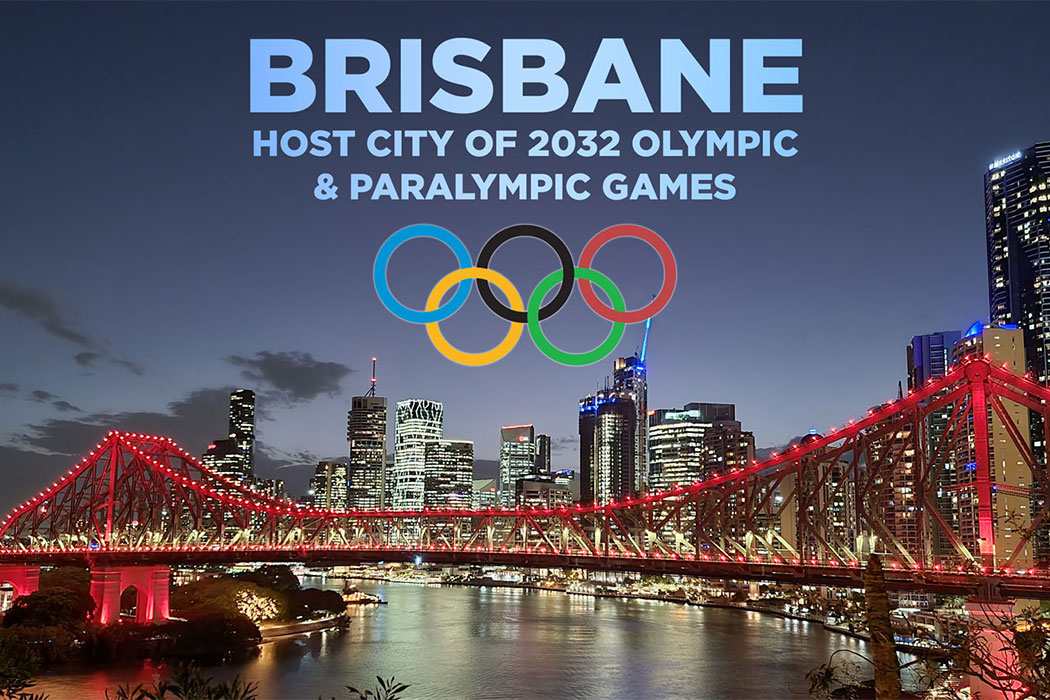 On 21 July 2021, the lead news item in Australia was that Brisbane had won the right to host the 2032 Olympic and Paralympic Games. Most media coverage focused on public celebrations, how the Olympics would showcase Brisbane to a global audience, and deliver important benefits to the state of Queensland. However, a predictable pattern unfolded: the euphoria and media hype waned and officials now have the same self-inflicted problems as some previous hosts.
Over the past five years, there have been two “independent” reviews of infrastructural problems, a series of broken promises by politicians, anger over the current government’s refusal to provide an itemised budget for the event, and public condemnations and protests after it decided to build a new Olympic stadium. A common sign at public rallies against the government’s coercive methods and warped priorities is “Hospitals Not Stadiums.”
According to David Richmond, who received a gold Olympic Order from the Australian Olympic Committee for delivering the venues and facilities at the Sydney Olympics, Brisbane currently faces an “uphill battle” to achieve its “ambitious” infrastructure plan and generating public trust.
From the new norm back to the old norm
Although Brisbane was the sole contender for the 2032 Games, the International Olympic Committee (IOC) also approved the plan of then Queensland Premier Annastacia Palaszczuk from the centre-left Queensland Labor party because it exemplified its “New Norm” protocols for addressing recurring bidding, planning, infrastructural, and financial problems. Accordingly, Palaszczuk decided not to build a new stadium and tried to keep costs down with a combination of new, existing, and rebuilt venues. However, the issue of financial blowouts surfaced, when the estimated price for the government to reconstruct the Brisbane Cricket Ground went from $1 billion in 2021 to $2.7 billion in 2023.
Shortly after Palaszczuk retired in December 2023, her successor, Steven Miles, appointed Graham Quirk, a former Brisbane lord mayor and member of Queensland’s centre-right Liberal National Party (LNP) to lead a 60-day review of infrastructural issues. Quirk recommended building a new stadium in Victoria Park, close to the city centre. Miles rejected his proposal, and in a rare show of cross-party solidarity, five former Brisbane mayors criticised Quirk for proposing this option.
The park was protected by state heritage law in 2007, is the largest remaining urban green space in Brisbane, contains a wide variety of native flora and fauna, and is culturally important to First Nations people, who call it “Barrambin.”
Building a new stadium was a prominent issue during the state election campaign in October 2024. LNP leader David Crisafulli repeatedly promised not to build one but journalists questioned his commitment after the LNP was elected, especially after he announced his board for the Games Independent Infrastructure and Authority (GIICA) that is responsible for administering 17 new and upgraded venues. Crisafulli appointed its chair, Stephen Conry, a former CEO of Australia’s largest commercial property company, to oversee a 100-day review of priorities for venues, infrastructure, and governance. Crisafulli still maintained Brisbane did not need a new stadium, but it was unclear what he would do if it was one of Conry’s recommendations.
The president of Brisbane’s organising committee, Andrew Liveris, a prominent, international business executive, later said he would “love” to see a new stadium built in Victoria Park. Palaszczuk briefly re-entered the political arena by saying the Olympics had become a “political football” and the review committee had already decided to build a stadium at the park that would cost Queenslanders billions of dollars they could not afford due to cost-of-living pressures.
A return to the old norm occurred on 25 March 2025, when Crisafulli responded to Conry’s report by saying there was not enough time to bring the cricket ground up to Olympic standards, so a new $3.8 billion stadium would be built in Victoria Park.
From the old norm to authoritarianism
The park was protected by state heritage law in 2007, is the largest remaining urban green space in Brisbane, contains a wide variety of native flora and fauna, and is culturally important to First Nations people, who call it “Barrambin.” Concerns about the park’s future heightened in June 2025, when the government transferred management of the park from the Brisbane City Council to GIICA, and bypassed its conservation status by exempting all Olympic venues from major planning and environmental regulations.
First Nations peoples, the Queensland Greens party, conservation and clean climate organisations, and two community advocacy groups, Save Victoria Park (SVP) and GamesWatchDog2032 (GWD), denounced the government’s tactics. First Nations peoples and SVP also held peaceful protests. First Nations peoples opened a tent embassy, lit a sacred fire to protect the area, and submitted applications for permanent conservation to the Federal Minister for the Environment and Water under the Aboriginal and Torres Strait Islander Heritage Protection Act (ATSIHP Act).
GIICA was not permitted to commence building until 1 June 2026, but police arrived two days earlier and ordered all protesters to leave by 2pm. There then were altercations as workers and police dismantled the embassy, and police arrested five protesters. A small First Nations group defied the order, but around 1am on 1 June, police removed everyone from the sacred fire site. Paradoxically, these events occurred during National Reconciliation Week, with the theme “All In.” This was a call by Reconciliation Australia “for all Australians to commit wholeheartedly to reconciliation every single day.”
On 3 August the government released a draft masterplan to redevelop the park for public consultation, but a few days later mature trees were cleared from the site. SVP spokeswoman Sue Bremner said the act was “an absolute mockery of the consultation process” and described the uncosted scheme as an “insulting fantasy vision with no details.” GWD said Conry should resign for overseeing a “rogue authority” that had conducted illegal and unethical operations.
One such study found the average cost overruns in real terms for 11 winter Games (1968-2014) and summer Games (1976-2016) were 142 per cent and 213 per cent, respectively.
First Nations peoples were included in two previous city council plans but were not even mentioned in the draft. By mid-August, an estimated 200 trees had been destroyed, and First Nations elders involved in unresolved applications under the ATSIHP Act had taken their case directly to the federal government.
Although these groups have vowed to keep protesting, they face an array of powerful organisations with strong vested interests, especially a $7.1 billion arrangement with federal and state governments and GIICA. Governments sign these neoliberal agreements without value-for-money or social impact assessments by truly independent experts that would reveal the exorbitant costs and huge financial risks.
One such study found the average cost overruns in real terms for 11 winter Games (1968-2014) and summer Games (1976-2016) were 142 per cent and 213 per cent, respectively. According to an expert on economics, public policy, and government subsidies for sports stadiums, “50 years of consistent research findings show that sports venues don’t generate a financial windfall for host cities [and] are not worthwhile public investments.”
Authoritarian neoliberalism and state capture
In broad terms, the above events typify a longstanding neoliberal practice in liberal democracies of “state capture;” this refers to:
… a type of systematic corruption whereby narrow interest groups take control of the institutions and processes through which public policy is made, directing public policy away from the public interest and instead shaping it to serve their own interests.
Governments sustain state capture by legislating and informally enabling inequitable neoliberal policies that minimise government involvement in mythical free markets and privatise, deregulate, and outsource public services.
Neoliberalism is not a monolithic ideology — it is necessarily mediated by circumstances across and within nations. The conduct of the Queensland government is a well-known case of authoritarian neoliberalism. This hybrid form includes governments engaging in typical neoliberal practices, e.g., eschewing accountability, transparency, and competitive tendering for businesses, while methodically instituting practices that “limit democratic dissent and protect capitalist interests and economic elites.”
Authoritarians also use punitive and coercive measures to stifle dissent, like clearing Victoria Park and arresting protesters.
A common manoeuvre of authoritarian politicians is to centralise power in the executive branch. This enables them to circumvent democratic practices, like checks and balances and parliamentary oversight. An example is how the Queensland government sidestepped local council edicts to exclude Olympic venues from planning and environmental rules.
Authoritarian leaders also use populist tropes. These take a distinctive regional tone in Queensland, which is often depicted as a parochial state and hotbed of authoritarian politics. Prior to announcing his decision about the stadium, Crisafulli performed the role of populist ventriloquist, declaring, “Queenslanders no longer want to be embarrassed on the world stage [and] can be proud of and showcase what makes us a great state on the world stage.”
Authoritarians also use punitive and coercive measures to stifle dissent, like clearing Victoria Park and arresting protesters. These measures are often framed in crisis narratives, such as Crisafulli claiming his 2026-27 budget constituted “a fresh start by building Queensland’s future and getting the Games back on track after 1,200 days of chaos under Labor.”
State capture is also manifest in the promise Brisbane would be the world’s first climate-positive Games. Brisbane’sorganising committee states it is committed to “delivering a lasting, positive impact, with sustainability at the heart of what we do.” This undertaking has been weakened and shrouded in secrecy to the point it has made Brisbane “the outlier the New Norm was supposed to prevent.”
This hubris also pertains to the organising committee’s “big vision” that the Olympics will have impacts beyond sport by “bringing people together, creating change, and making the world a better place. There are three intertwined problems with this extravagant discourse. First, it is a local reiteration of the IOC’s wearisome, grandiose declarations that mask its history of cronyism, corruption, and hypocrisy. Second, it ignores how the IOC has purposefully embedded the Olympics in a rapacious neoliberal world order. Finally, claims about togetherness are absurd, when the main media frame about the Olympics over the last eighteen months has been the government’s authoritarian conduct on multiple fronts.
Another of the organising committee’s grand pledges is to “uplift Aboriginal and Torres Strait Islander peoples and communities economically, socially, emotionally, and physically before, during, and after the Games.” Yet it has a huge, possibly irreparable, credibility gap with First Nations peoples, from the coercive actions of the police to omitting them from the draft masterplan. Moreover, Liveris reportedly was “ecstatic” over Crisafulli’s announcement that there would be a new stadium. These developments are consistent with the government’s cancelation of its Truth-Telling and Healing Inquiry in 2024 and “whitewashing” First Nations peoples at the Olympics.
A common denominator in the debacles over the stadium, sustainability, and First Nations people is the IOC’s “new” rules lack oversight and cannot address glaring discrepancies between official promises about legacies and repressive actions by local governments.
Authoritarian neoliberalism trumps the public interest
In defending why he chose Victoria Park, Crisafulli disingenuously claimed, “Any other choice would have meant placing the government’s interests ahead of the interests of Queensland.” His deputy, Jarrod Bleijie, exposed the reality behind his government’s rhetoric with a Trump-like Instagram video post about the park titled “Drill baby drill!”
There was a recent twist in these machinations when Crisafulli, a former real estate investor, was on the receiving end of ruthless neoliberalism, after S&P Global Ratings downgraded Queensland’s credit rating for the first time since 2009
There was a recent twist in these machinations when Crisafulli, a former real estate investor, was on the receiving end of ruthless neoliberalism, after S&P Global Ratings downgraded Queensland’s credit rating for the first time since 2009. Its rationale was Queensland had weak financial management and likely would have budgetary problems due to infrastructure spending.
Liveris raised concerns about rising costs in an address to the IOC at the winter Olympics this year, saying his operational budget had “no resemblance to reality.” The government insists the $7.1 billion budget is sufficient but refuses to supply cost updates on commercial-in-confidence grounds. This earned the ire of Brisbane’s most popular newspaper, the Courier Mail, which the government also stopped from viewing images of unsuccessful designs for the new stadium under Right to Information laws. Its editor called the government’s opaque budget “the latest example of official secrecy surrounding the games”, and a way of avoiding “disruptive public debate.” The government also blocked Labor’s attempt to use the credit downgrade to obtain detailed budget costs in parliament. Independent economists estimate the cost of meeting the government’s program is at least $20 billion.
Crisafulli blamed the lower credit rating on the Queensland and federal Labor parties, even though he ignored the New Norm guidelines and rejected Labor’s scaled-down and cheaper plan that was approved by the IOC, and the federal government contributed almost half of the $7.1 billion for the infrastructure program.
From the perspective of critical public policy, the above events are a microcosm of how neoliberal leaders in three spheres dominated by men – sport, business, and politics – subvert the public interest. Graeme Turner, one of the most incisive analysts of Australian society, appropriately identified this larger, anti-democratic development as “the repurposing of politics as a game in which power, rather than government, is the goal.”
Copyright © Jim McKay 2026