Egil Galaaen Gjølme
Norwegian University of Science and Technology (NTNU)
1. Introduction
Swimming and lifesaving education should equip students to participate in aquatic activities and respond to challenges in different aquatic environments. This requires teaching that connects practical skills with understanding, judgement and responsible decision-making. A central pedagogical question is therefore how teaching can make explicit the relationship between what students know, what they can perform and what they choose to do.
Moran (2013) conceptualised water competence as the totality of a person’s aquatic movement capabilities that contribute to drowning prevention, together with the knowledge, attitudes, values, judgement and behaviours supporting safety in, on and around water. This definition provides a broad framework for teaching. Swimming skills form part of an integrated competence in which situational understanding and judgement influence how skills are applied.
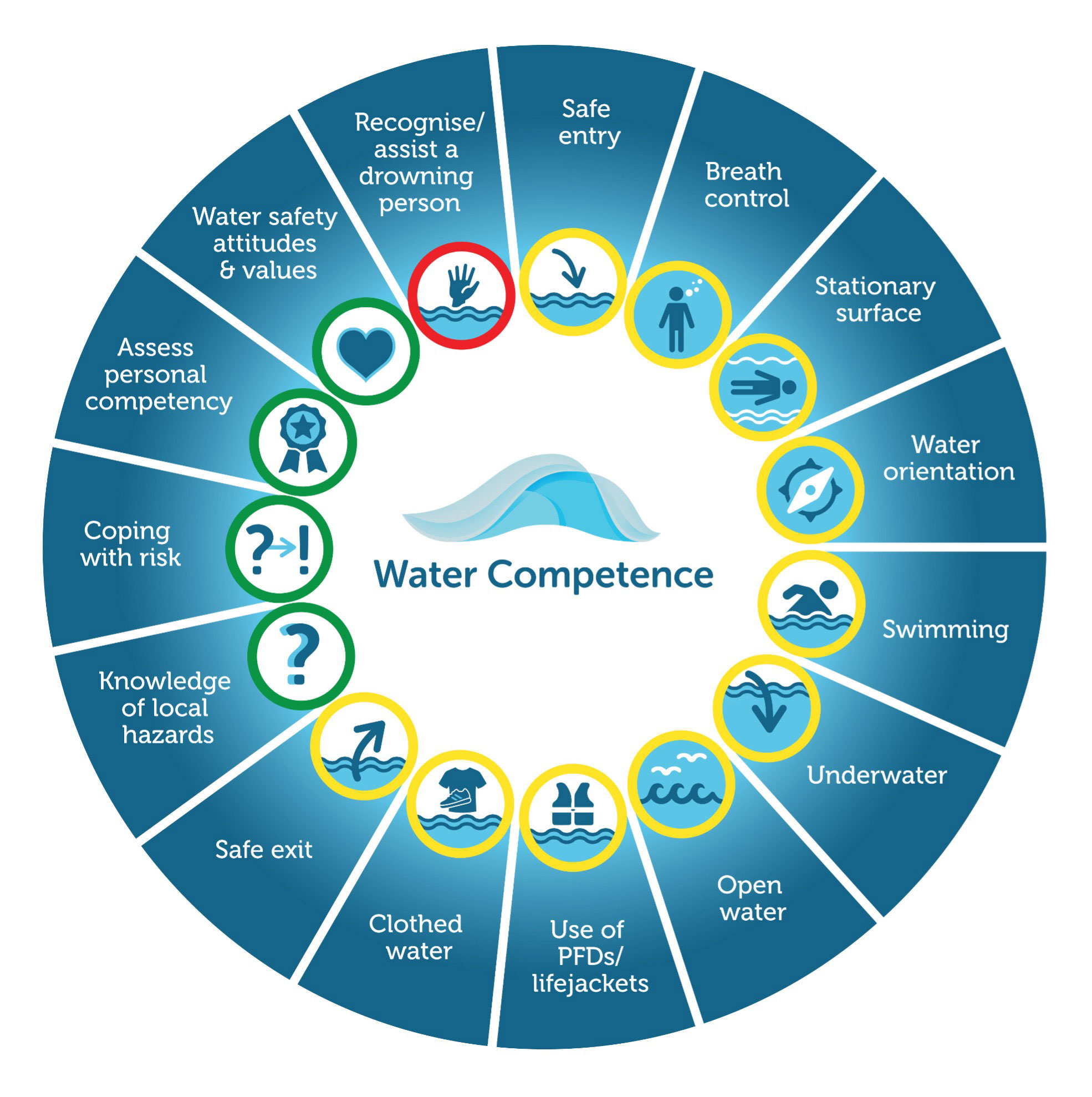
Stallman et al. (2017) elaborate this understanding through fifteen competence areas. Their framework includes breath control, flotation, orientation, propulsion, safe entry and exit, the use of flotation devices, clothed and open-water competence, risk assessment, self-assessment and rescue competence. This breadth presents both opportunities and challenges for teaching. It provides teachers with a basis for identifying relevant content, while requiring them to organise that content so that students recognise the relationships between competence areas.
For example, a student may learn to float without understanding when flotation might be useful. A student may also know safety rules without being able to apply them in a particular situation. The pedagogical task is therefore to connect skill development with an understanding of purpose, conditions and available courses of action.
Newell’s (1986) framework helps explain how learning and movement are influenced by interactions between the individual, task and environment. Through the Drowning Chain of Survival, Szpilman et al. (2014) make explicit the relationship between prevention and assistance in drowning situations. Together with the water competence framework, these perspectives provide a basis for teaching in which practice, judgement and reflection are connected.
The purpose of this article is to present the development of a colour-coded pedagogical model and discuss how it can support teaching, learning and assessment. The article addresses the following question: How can a pedagogical model make the different dimensions of water competence understandable and applicable in swimming, self-rescue and lifesaving education?
2. Methods
2.1. Conceptual and Pedagogical Model Development
The work constitutes conceptual model development with a pedagogical purpose. An existing visual model and selected theoretical contributions were synthesised to develop a representation that could support the communication and organisation of water competence in teaching.
The development sought to connect subject content with pedagogical application. The central concern was to clarify what students need to learn, how the competence areas are related and how learning can be connected to situations in and around water.
This article draws on the model developers’ account of the development process and a theoretical interpretation of the resulting model. It does not present a systematic literature review or an empirical evaluation.
2.2. Source Material and Theoretical Contributions
The starting point was material from Water Safety Auckland, New Zealand, which Gjølme and Ness adapted with the organisation’s permission. This provided a visual and pedagogical foundation that was integrated with theoretical contributions serving complementary functions.
Moran’s (2013) definition provided an overarching understanding of water competence as a relationship between movement capabilities, knowledge, attitudes and action. Stallman et al. (2017) helped specify relevant competence content. Newell (1986) provided a basis for understanding how learning tasks and environmental conditions influence students’ opportunities for action. Szpilman et al. (2014) helped clarify the connection between preventive judgements and assistance to others.
The selection was purposive. These contributions were synthesised because they addressed educational content, the conditions for successful performance and the practical significance of action. Haga et al. (2025) are used in the discussion to situate the model within a broader educational context and did not inform the development of the model in 2021.
2.3. Pedagogical Synthesis
The conceptual logic of the synthesis can be described through three questions:
- In which areas should students develop competence?
- Under what conditions should that competence be applicable?
- How can teaching connect understanding with action?
These questions were brought together in a colour-coded organisation comprising green, yellow and red. The colours were intended to provide teachers and students with a shared language for knowledge and judgement, practical skills and safe assistance to others. The organisation was also intended to facilitate connections between competence areas within learning tasks.
This description provides a retrospective account of the model’s pedagogical and theoretical rationale. It does not imply that the development followed a predefined analytical procedure involving formal coding categories.
2.4. Researcher Positionality and Scope
The model developers are interpreting their own work. This provides insight into the model’s purpose and rationale but may also influence the appraisal of its usefulness. The article therefore distinguishes between pedagogical intentions, theoretically informed applications and demonstrated effects.
No participant data or effect measurements are presented. The results comprise the model’s organisation and the pedagogical connections it is intended to support.
3. Results
3.1. A Pedagogical Structure for Integrated Learning
The synthesis resulted in a model comprising three interdependent domains: green, Water Smarts; yellow, Water Skills; and red, Helping Others. The model provides a visual structure for connecting knowledge and judgement with practical skills and assistance to others.
Its pedagogical purpose is to make competence content accessible while retaining the relationships between its components. The model can be used to formulate learning objectives, select tasks and structure discussions about experience. It also provides a basis for examining whether teaching addresses both practical performance and an understanding of when and why particular actions are appropriate.
The model’s visual representation is registered as a trademark with the Norwegian Industrial Property Office under registration number 327516 (Patentstyret, 2023).
3.2. Green — Water Smarts: Learning to Understand, Assess and Decide
Water Smarts directs attention to the knowledge and judgements that guide action. In teaching, this involves addressing local hazards, environmental conditions, personal capabilities and the potential consequences of different choices.
Students might, for example, examine an activity site, identify possible entry and exit points and justify where an activity should take place. Such tasks connect general safety knowledge with specific observations. Teachers can support understanding through questions that encourage students to explain which conditions they consider and how these influence their decisions.
The domain also provides an opportunity for self-assessment. Students can articulate expectations before a task and compare them with their subsequent experiences. The purpose is to develop a more realistic relationship between perceived competence and situational demands.
3.3. Yellow — Water Skills: Learning Through Practical Experience
Water Skills encompasses the development and application of practical aquatic skills. The pedagogical task is to enable students to experience how breath control, flotation, orientation, propulsion and exit function as components of meaningful actions.
A flotation task might, for example, be connected to resting and observing the surroundings. A swimming task might involve selecting a direction and evaluating a possible exit. Skills thereby acquire a clear purpose that students can experience and reflect upon.
Teaching can alternate between practice of individual skills and tasks that combine several skills. This creates opportunities to address both execution and application. Through appropriately adapted variation, students can investigate how clothing, flotation equipment or other conditions influence their movement solutions.
3.4. Red — Helping Others: Learning to Assist with Sound Judgement
Helping Others encompasses recognising that someone needs assistance, assessing the situation and providing a safe and appropriate response. Teaching must therefore connect practical exercises with reflection on responsibility, available courses of action and personal safety.
Scenario-based tasks can allow students to choose between different forms of assistance and justify their decisions. Calling for help, communicating and using available equipment can be included within the same task. Assessment of the response consequently concerns both how the action is performed and whether it is appropriate.
This domain illustrates particularly clearly why the dimensions of competence must be learned in relation to one another. Students need knowledge to understand the situation, skills to provide assistance and judgement to recognise their own limitations.
3.5. Relationships Between the Domains
The colours provide a recognisable visual language, but do not prescribe a fixed progression in which one domain is completed before the next begins. Students can work with all three domains within the same sequence of lessons. A self-rescue sequence might begin with an assessment of the location and personal capabilities, continue with practical tasks and conclude with reflection on appropriate assistance, in the event that someone is unable to manage the situation. The model can thereby support movement between understanding, experience and renewed judgement. This organisation makes reflection part of skill learning. Students’ experiences can provide a basis for adjusting both practical solutions and perceptions of their own competence.
4. Discussion
4.1. The Model as a Pedagogical Tool
The model’s pedagogical contribution lies in making a comprehensive competence framework accessible for teaching. Stallman et al. (2017) identify relevant content, while the colour-coded organisation offers a structure for selecting, connecting and exploring that content with students.
The model can support alignment BETWEEN learning objectives, tasks and assessment. If the objective is to develop self-rescue competence, tasks must give students opportunities to assess the situation and apply relevant skills. Assessment should subsequently examine these dimensions together.
Such use may clarify the purpose of teaching. Students can develop an understanding of why they practise particular skills and how those skills may contribute to actions beyond the immediate learning task. This pedagogical potential requires investigation in practice.
4.2. Experience, Reflection and Situated Learning
Newell’s (1986) framework helps explain why tasks must be adapted to both the student and the environment. A change in temperature, equipment or support can influence task difficulty and the solutions available to the student.
For teachers, this means that adaptation can involve several elements: the task objective, the degree of support, the equipment used or the environment in which the task takes place. Students can therefore work towards related learning objectives through different solutions and challenges. Reflection on experience is central to the model’s pedagogical application. When students examine what changed and why a solution worked, practical experience can be connected to situational understanding. Transfer of learning must nevertheless be investigated. Successful performance in one context does not automatically establish equivalent competence in another.
4.3. Assessment to Support Learning
The model can provide a structure for feedback and student self-assessment. Feedback can address execution, justification and adaptation. A student may, for example, successfully complete a practical sequence while requiring support to assess when that solution is appropriate. Assessment practices combining observation, dialogue and reflection can provide a broader account of competence. Students’ explanations may reveal understanding that is not directly evident in movement, while practical performance may reveal limitations that students have not identified themselves. Expectations before a task and reflection afterwards can be used to develop realistic self-assessment. The aim is for students to develop confidence in their capabilities while recognising uncertainty and the need for support.
4.4. Prevention, Participation and Educational Meaning
Szpilman et al. (2014) make explicit the relationship between prevention and assistance in drowning situations. In teaching, this can give practical skills a clear purpose and highlight that decisions to modify or refrain from an activity may also demonstrate competence.
Haga et al. (2025) contribute a broader educational perspective through their emphasis on meaningful experiences and lifelong participation. Aquatic education should equip students to participate in activities that may remain valuable throughout life. Safety, understanding and successful participation can therefore be treated as connected educational objectives.
The model can support this connection by making both opportunities and limitations subjects of teaching. Students can develop practical options for action while learning to assess which activities and conditions they are equipped to manage.
4.5. Limitations and Future Research
The model is based on a conceptual synthesis of selected contributions. This article articulates its theoretical rationale and pedagogical intentions, but does not provide a basis for establishing effects on teaching or learning.
Visual simplification may make the content easier to communicate, but may also lead to the domains being perceived as separate. Application of the model therefore requires teachers to make the connections explicit. Future research should examine how teachers use the model in planning, teaching and assessment, and how students understand the colours and relationships between the domains. It is also relevant to investigate whether the model supports reflection, realistic self-assessment and the application of competence in new situations. Its contribution to drowning prevention requires separate empirical investigation.
5. Conclusion
The colour-coded model provides a pedagogical structure for connecting the content of water competence with teaching, learning and assessment. Through Water Smarts, Water Skills and Helping Others, it makes explicit the relationship between what students understand, what they can perform and the actions they choose.
The model’s theoretical foundations emphasise that competence develops and is applied through interactions between the individual, task and environment. Its pedagogical purpose is to support teaching in which practical experience, reflection and judgement form an integrated whole. How the model functions as a pedagogical tool must be examined through systematic studies of teaching practice and student learning.
Copyright © Egil Galaaen Gjølme 2026
References
Gjølme, E. G., & Grydeland, M. (2021). Drukningsforebyggende arbeid og water competence [Drowning prevention efforts and water competence]. In E. G. Gjølme (Ed.), Utendørs svømme- og livredningsopplæring [Outdoor swimming and lifesaving training] (pp. 35–54). Universitetsforlaget.
Haga, M., Sääkslahti, A., Schenker, K., Bruun, T. H., Guldager, J. D., Gísladóttir, Þ. L., Danielsen, B. B., Gjølme, E. G., Sundan, J., Olsen, H. W., & Bjerke, Ø. (2025). Aquatic education for school children: An educational expert statement from the Nordic Consortium. Journal for Research in Arts and Sports Education, 9(2), 39–61. https://doi.org/10.23865/jased.v9.6785
Moran, K. (2013). Defining ‘swim and survive’in the context of New Zealand drowning prevention strategies: A discussion paper, July 2013.
Newell, K. M. (1986). Constraints on the development of coordination. I M. G. Wade & H. T. A. Whiting (Red.), Motor development in children: Aspects of coordination and control (s. 341–360). Martinus Nijhoff. https://doi.org/10.1007/978-94-009-4460-2_19
Patentstyret. (2023, 17. juli). Varemerkeregistrering nr. 327516. Norsk varemerketidende, 29/2023. https://services.patentstyret.no/search-details/trademark/202308019-327516?lang=no
Stallman, R. K., Moran, K., Quan, L., & Langendorfer, S. (2017). From swimming skill to water competence: Towards a more inclusive drowning prevention future. International Journal of Aquatic Research and Education, 10(2), artikkel 3. https://doi.org/10.25035/ijare.10.02.03
Szpilman, D., Webber, J., Quan, L., Bierens, J., Morizot-Leite, L., Langendorfer, S. J., Beerman, S., & Løfgren, B. (2014). Creating a drowning chain of survival. Resuscitation, 85(9), 1149–1152. https://doi.org/10.1016/j.resuscitation.2014.05.034