Payam Ansari
The Bournemouth University Business School
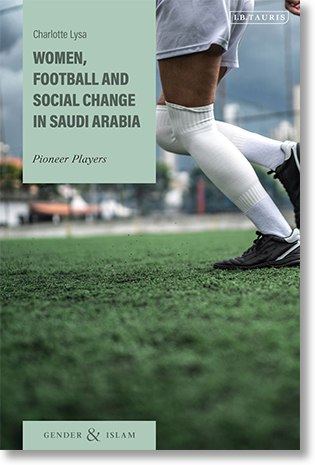
Women, Football and Social Change in Saudi Arabia: Pioneer Player
234 pages, hardcover
London: I.B. Tauris (Bloomsbury) 2025 (Gender & Islam)
ISBN 978-0-7556-4420-9
Football provides a particularly revealing lens through which to examine social change because the game is never simply about what happens on the pitch. It reflects, and sometimes challenges, wider ideas about gender, religion, politics, identity and belonging. In Women, Football and Social Change in Saudi Arabia: Pioneer Players Charlotte Lysa demonstrates this particularly well. What makes the book compelling is not only its reconstruction of the largely undocumented history of women’s football in Saudi Arabia, but its use of that history to examine how social norms are produced, negotiated and eventually changed. Lysa’s perspective is particularly valuable because it emerges from more than a decade of following Saudi women’s football and engagement with many of the women involved in its development. This sustained engagement enables the book to move between institutional change and women’s everyday experiences. More importantly, it treats women’s football not as an isolated sporting development, but as a lens through which wider cultural, political and social transformations in Saudi Arabia can be examined.
The book has two interconnected purposes: to provide a history of women’s football in Saudi Arabia, particularly the pioneering women behind its development, and to study norms, how they emerge, evolve, are challenged and change. Importantly, Lysa does not present social transformation simply as the consequence of government reform. Instead, she deliberately incorporates bottom-up perspectives, examining not only the role of the state and other powerful actors but also the agency of individual women in processes of social change. This is perhaps the book’s most significant contribution. The women encountered throughout the study are not merely beneficiaries of a changing Saudi Arabia; they are actors within that transformation.
Particularly interesting is Lysa’s discussion of norms. The book challenges a simplistic opposition between ‘traditional’ and ‘modern’ Saudi Arabia. Tradition, she argues, is not necessarily contradictory to modernisation but is itself continually interpreted and reconstructed.
The organisation of the book supports this argument effectively. Seven chapters are arranged across three parts, moving between macro and micro perspectives. The first establishes the historical and social context in which football and women’s football developed in Saudi Arabia. The second moves closer to the experiences of the pioneering players and the establishment of women’s teams, while the final part reconnects these grassroots experiences with institutional reform, international pressures and changing narratives surrounding women’s sport. This progression avoids treating either top-down reform or grassroots activism as a sufficient explanation in itself. Instead, Lysa gradually brings the macro and micro levels together to demonstrate the interaction between policy, social norms and individual agency.
Particularly interesting is Lysa’s discussion of norms. The book challenges a simplistic opposition between ‘traditional’ and ‘modern’ Saudi Arabia. Tradition, she argues, is not necessarily contradictory to modernisation but is itself continually interpreted and reconstructed. This complexity is equally apparent in the development of women’s football. Restrictions were undoubtedly important, but women were not simply waiting for formal permission to play. Pioneer players established teams, recruited players, sought coaches and facilities, organised competitions and negotiated with families and communities. In doing so, they often worked within existing social expectations while simultaneously pushing their boundaries.
Lysa’s use of the term ‘norm-entrepreneurs’ to describe these pioneer players is particularly insightful, as it captures how they actively contributed to challenging and reshaping social norms around women’s participation in football. Lysa discusses that social change does not necessarily require outright confrontation with existing norms. Women could instead challenge assumptions about football and femininity while presenting participation as compatible with values already considered legitimate, including health, charity and religion. The book consequently presents agency in a nuanced way; the pioneer players were capable of challenging the gendered organisation of Saudi society while also strategically operating within it. This provides a more convincing account of change than one based solely upon resistance to restrictions.

The stories of the pioneer players are among the strongest parts of the book for precisely this reason. They complicate any straightforward narrative in which Saudi women’s football suddenly emerged following recent governmental reforms. Women had founded teams and competitions and worked to change attitudes within their communities well before the dramatic institutional changes associated with Vision 2030. By 2023, as Lysa notes in her conclusion, the first division of the Saudi Arabian Football Federation Women’s Premier League contained 237 registered players across eight clubs, while the Saudi Arabian Football Federation reported 48,000 girls playing in schools. Yet these developments are situated within a much longer history of women creating spaces in which to play.
There is, however, an interesting tension within the bottom-up/top-down distinction itself. The framework is analytically useful, yet Lysa’s evidence repeatedly demonstrates how difficult these processes are to separate. Grassroots actors negotiate family expectations, religious interpretations and institutional restrictions while also responding to opportunities created by policy changes. Similarly, government reforms are situated within domestic developments and international pressures. The book therefore raises a further question: rather than understanding change as two directions that eventually meet, could the development of Saudi women’s football be understood as a continuously interconnected process in which different forms of power and agency operate simultaneously?
Another important strength is that Lysa never treats football in isolation. Football becomes what she describes as a ‘field contested’, in which struggles concerning women’s participation reflect much broader disagreements about gender and social organisation. The concluding discussion is particularly effective in showing that women’s football is both shaped by social change and capable of contributing to it.
Overall, Women, Football and Social Change in Saudi Arabia: Pioneer Players makes an important contribution to scholarship on women’s football and sport and society. Its greatest strength lies in recovering the agency of women whose efforts preceded the highly visible institutional transformation of recent years, while avoiding an overly simple story of either state-led modernisation or grassroots resistance. For scholars of women’s football, gender, sport sociology and social change, Lysa provides a valuable case study. More broadly, the book demonstrates why football offers such a powerful window into societies undergoing complex processes of transformation.
Copyright © Payam Ansari 2026