Hans Martin Lundberg
EGADE Business School, Monterrey, Mexico

Foundations of Managing British Olympics: Institutions through Time
206 pages, hardcover
Bingley, UK: Emerald Publishing 2025 (Frontiers of Management History)
ISBN 978-1-80262-096-2
This is the 6th volume in the Emerald book series Frontiers of Management History, operational since 2019. It is a book series worth your attention if interested in a broad, yet focused take on management and business history that integrates historical and social scientific lenses. This book series elegantly combines broadness in subjects covered with distinct topical focus on key aspects of management and business history (see Table 1).
In this 6th volume, the institutional development of and the historical roots for international sport governance is the topic in focus. The specific empirical focus is the foundations of managing British Olympics, an intricate interplay of institutional, political and governance mechanisms and factors played out by notable people involved in these whereabouts during the period analysed (1850s–1908).[1] As such country-specific developments of course not emerge in isolation, the “backdrop of international movements” (p. 2) provided by authors is very thorough, thereby serving both their intended purpose (as backdrop) and serving as essential reading beyond sport and British Olympics with a potential to “illuminate future theory building” (p. 2) within institutional theory, corporate governance, project management, and organisational behavior.
Table 1. Subjects covered and management/business topics in focus in book series “Frontiers of Management History” (Emerald) 2019–2025. (Source: Author, based on https://www.emerald.com/collection/105/Frontiers-of-Management-History.)
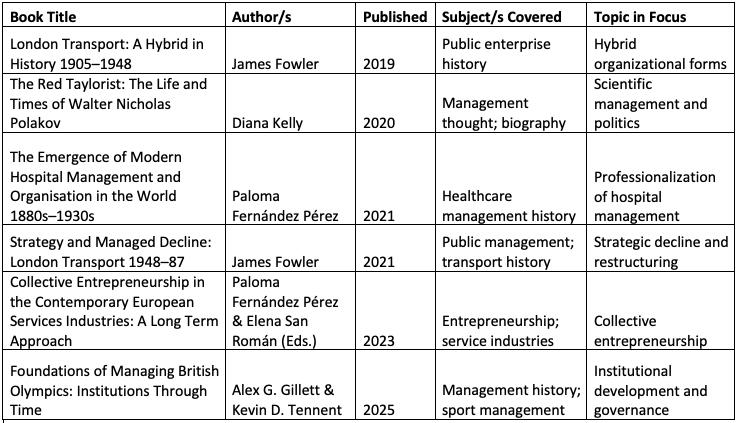
This study, and the fact that it is published in a book series on frontiers in management history, thereby is a breakthrough for studying sport for the sake of something else than sport itself. Sport is partly established in humaniora and social sciences (e.g., sport history, sport sociology, sport psychology, sport management), where the dominant analytical order is the use of history, sociology, psychology, and management to understand sport better.[2] The breakthrough here, at least relative to management science and business administration, I argue, is that Gillett and Tennent flip this coin; they study sport to better understand management history, institutional theory, corporate governance, project management, and organisational behavior.
Authors also show detailed knowledge on how to write up long range narratives, how interpretive archival approaches are to be performed, and how the difficult questions on archival and narrative silences are to be dealt with.
This shift from sport being what is explained to that which is explanatory (from explanandum to explanans in philosophy; from dependent/response variable to independent/explanatory variable in positivism; from the told to the teller in narrative theory) is significant. I will henceforth call it an ‘upgrade’. Now, in my 22nd year as reviewer for idrottsforum.org, I can draw on numerous reviews where I end up in a call for an ‘upgrade’ of the scholarly treatment of sport. The problems with sport studies too long and too much having focused on sport for the sake of sport itself are many, and some areas I have touched upon in my reviews are (Lundberg 2005; 2011a; 2011b; 2012; 2014; 2017; 2022):
- The taken for granted norm by many sport scholars that sport is inherently good and positive.
- The lack of critical perspectives when studying sport.
- The at times myopic focus on sport for its own sake at the expense of the fundamental role sport has in our societies.
- The obscene dominance of US perspectives in sport management.
- The uncritical presence and use of models, theories and concepts within sport management that are substantially criticised or even considered as outmoded within management science and business administration.
- The (at large) absence of management science scholars in Nordic sport studies in times when they are the most needed (in an historical period where sport have undergone a hyper-commercialisation not seen before).
In such an academic-historical backdrop, this study by Gillett and Tennent is an ‘upgrade’. The fact that they also are the editors of the book series in which this study is published should increase the chances of this not becoming a one-hit wonder but actually can produce constructive followers.
The more specific contributions and advantages with this book are, in my reading, the following:
Robust balance between parts and whole, scope and focus, backdrop and unit of analysis: Given the magnitude of subject (Olympics), the time span (about six decades) and the geographical scope (international level), it is a methodological challenge to balance the text and the material in just above 200 pages. The authors solve this in excellent ways mainly via avoiding putting the “backdrop of international movements” (p. 2) as a minor section early on and then go all in on chosen empirical focus (often leading to the reader forgetting all about the backdrop halfway through the book). Instead, the international aspects serve as chapter titles, starts off each chapter, and are thereafter ongoing integrated and interwoven with the British aspects, chapter by chapter, in a chronological order. This provides an excellent flow in the text and also make the abundant archive material used to come to life in dynamic ways in the text.
Seasoned and rigorous use of historical methods: The primary sources used in study are well chosen, plentiful, and carefully treated in line with established methodology in history. Main primary sources are collections available in public, corporate, university, museums, and library archives. Another frequently used primary source that adds detail, intensity, and empirical presence in the text are national and regional newspaper sources consulted via digital archives. Authors also show detailed knowledge on how to write up long range narratives, how interpretive archival approaches are to be performed, and how the difficult questions on archival and narrative silences are to be dealt with.
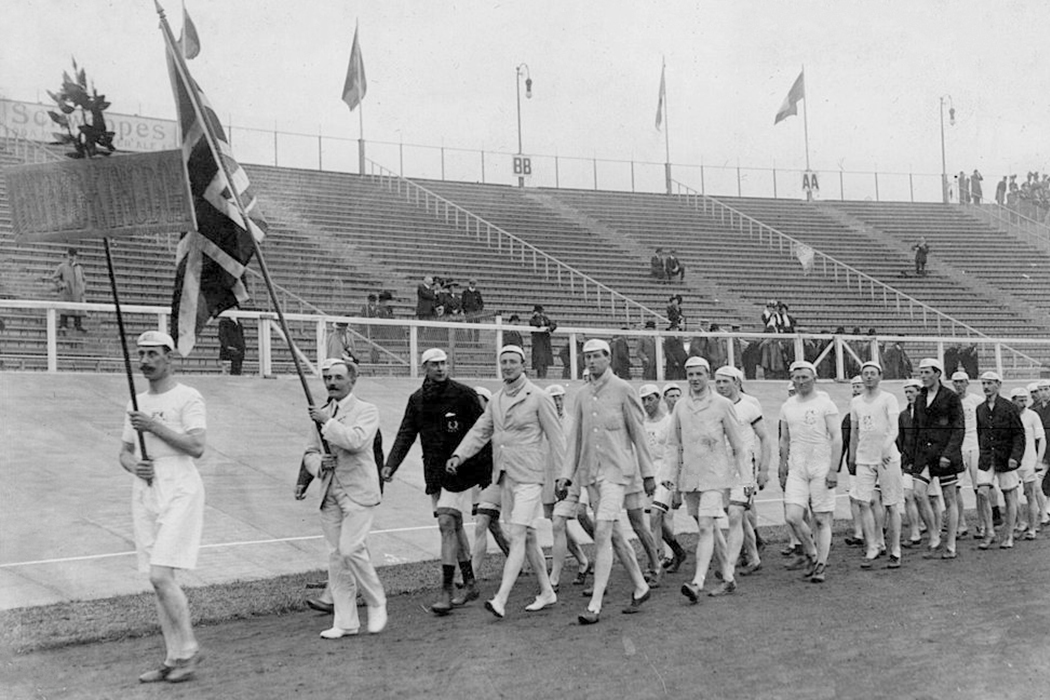
Good use of details in the craft of doing historical studies: Being a trained historian myself (not practicing though, until now recently taking it up), it is a true joy to see that close reading and deeper understanding is made possible by authors’ extensive use of the footnote system so common in history but so threatened beyond. Honour to Emerald, editors and authors for not giving this up in our times of streamlined publication productivity tendencies. Other details where one see fine respect for the craft of doing historical studies are reflections on authors’ insider position (British scholars) vis-à-vis subject (British Olympics), reflections on how to avoid writing a hagiography given such a position, and awareness of detailed practices in historical writing such as not providing contemporary conversions for monetary amounts.
Delivery: The book delivers on what it sets out to do – it convincingly provides a long range narrative on how and why British sport institutions emerged and evolved through time, in intimate interplay with the formation of and exchange with international sport institutions and their key persons. Besides providing the ‘big picture’ and the long perspectives, the book also delivers on the second classical quality of historical studies, empirical detail and empirical thoroughness. There is an abundance of it, organized and written up with clarity and focus, and with many possibilities to enter layered reading via the footnotes – so just dive in!
Also excellent studies have shortcomings, naturally. A few ones I have found in this study are:
Conclusions: The conclusion chapter (chapter 10) is very short and ends very abrupt and without a decent summary or wrap-up. It also lacks adequate pointing towards the announced potential to “illuminate future theory building” (p. 2). As the study is rich and well done, such theory building is fully possible, but it is left to the reader to take it up.
Missing key reference: Given the book’s subtitle – Institutions through Time – I was convinced to find the eminent key reference it alludes to, Organizations in Time. History, Theory, Methods (Bucheli & Wadhwani, 2014). But it is missing, which is weird. This so, as it is a key reference that in several ways serves as a starting point for the small but yet significant development of using historical methods and approaches in management science that now is spreading in sub-disciplines such as entrepreneurship, family business studies, among others.
All-in-all, though, this book is brilliant as it delivers on its topic in focus (the institutional development of and the historical roots for international sport governance) as well as on its specific empirical focus (the foundations of managing British Olympics). And as extra bonus for readers with interests also beyond this, the book is a breakthrough for sport as explanans in management and business history.
Copyright © Hans Martin Lundberg 2026
References and Sources
Emerald Publishing Ltd, web page: https://www.emerald.com/collection/105/Frontiers-of-Management-History. Retrieved 24 January, 2026.
Bucheli, M. & Wadhwani, R. D. (2014). Organizations in Time. History, Theory, Methods. Oxford, England, UK: Oxford University Press.
Lundberg, H. (2005). Läsvänlig på Gränsen till Infantilisering. Review of Strategic Sports Event Management: An International Approach (G. Masterman). idrottsforum.org, 2005-04-05, 1–3. ISSN: 1652–7224. DOI: https://doi.org/10.13140/RG.2.2.23357.31200
Lundberg, H. (2011a). Föråldrad Syn på Sport Management. Review of Managing Organizations for Sport and Physical Activity: A Systems Perspective (P. Chelladurai). idrottsforum.org, 2011-03-09, 1–3. ISSN: 1652–7224. DOI: https://doi.org/10.13140/RG.2.2.12871.55205
Lundberg, H. (2011b). Ekonomikunskap Eftersatt i Svensk Idrott. Review of Sport Finance (G. Fried, S. J. Shapiro & T. D. DeSchriver). idrottsforum.org, 2011-03-30, 1–3. ISSN: 1652–7224. DOI: https://doi.org/10.13140/RG.2.2.14549.27365
Lundberg, H. (2012). Marknadsanpassning av Torkildens Fritidsforskning. Review of Torkildsen’s Sport and Leisure Management (P. Taylor, Ed.). idrottsforum.org, 2012-12-05, 1–3. ISSN: 1652–7224. DOI: https://doi.org/10.13140/RG.2.2.33843.07206
Lundberg, H. (2014). Important Milestone in the Development of Sport Business Research. Review of Handbook of Research on Sport and Business (S. Söderman & H. Dolles, Eds.). idrottsforum.org, 2014-09-09, 1–4. ISSN: 1652–7224. DOI: https://doi.org/10.13140/RG.2.2.29627.26408
Lundberg, H. (2017). A Much Needed and Very Welcome Contribution to Balance the North American Dominance in European Sport Management Syllabuses. Review of When Sport Meets Business: Capabilities, Challenges, Critiques (U. Wagner, R. K. Storm & K. Nielsen, Eds.). idrottsforum.org, 2017-06-15, 1–3. ISSN: 1652–7224. DOI: https://doi.org/10.13140/RG.2.2.20294.93764
Lundberg, H. (2022). Few Flickering Lights in an Otherwise Overwhelming Darkness. Review of International Sport Business Management: Issues and New Ideas (J. J. Zhang, B. G. Pitts & L. M. Johnson, Eds.). idrottsforum.org, 2022-01-27, 1–5. ISSN: 1652–7224. DOI: https://doi.org/10.13140/RG.2.2.14317.26084
Wikipedia, web page, https://en.wikipedia.org/wiki/List_of_international_sport_federations). Retrieved 24 January, 2026.
Notes
[1] The key events authors use to frame this periodisation are the Great Exhibition in London 1851 (14, 000 exhibits, 6 million visitors) and the London 1908 Summer Olympics (2,008 participating athletes, 22 participating National Olympic Committees). This periodisation is well chosen, as these years were fundamental and formative for most international sport organising and much national sport organisations as we know it and them today. Leading international sport federations formed and formally founded during this period are WG (1881), WR (1886), FISA (1892), IOC (1894), UCI (1900), FIA (1904), FIFA (1904), IWF (1905), WS (1907), ISSF (1907), and WAQU (1908) (https://en.wikipedia.org/wiki/List_of_international_sport_federations).
[2] A notable exception is the study of sport in cultural studies, as visible in Sport in Society for instance.</h6