Peter Hassmén
Southern Cross University, Australia
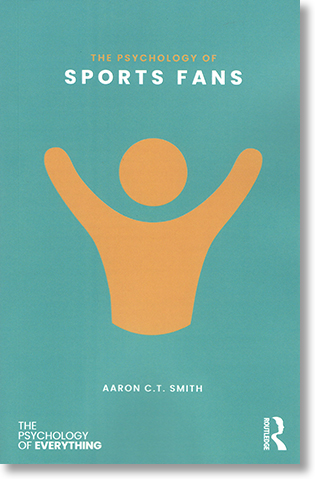
The Psychology of Sports Fans
112 pages, paperback
Abingdon, Oxon: Routledge 2026 (The Psychology of Everything)
ISBN 978-1-032-95783-8
What does it really mean to be a sports fan?
Why are so many people committed to sports?
Why do fans remain loyal when this seems illogical and counterintuitive?
These questions may seem straightforward, but fandom is not easily reduced to simple interest or entertainment. Fans remain loyal through repeated disappointment, invest emotionally in events they cannot control, and often draw identity, belonging, and meaning from sport in ways that go far beyond the game itself. In The Psychology of Sports Fans, Professor Aaron Smith takes this phenomenon seriously. He argues that sports fandom is a layered psychological and social experience shaped by thought, emotion, belief, meaning, and identity. That central claim gives the book both its purpose and its value.
At 112 pages, this is a concise text, but it addresses a broad and important topic. Smith structures the book around five interconnected dimensions of fandom: sports thinking, sports faith, sports emotions, sports meaning, and sports fandom. This framework gives the book a clear internal logic and makes it highly accessible. It also allows Smith to move beyond narrow views of fans as passive consumers or spectators. Instead, he presents them as active participants whose engagement with sport is shaped by cognitive processes, emotional investment, symbolic attachment, and wider questions of personal and social identity. This is one of the book’s major strengths. It treats fandom as a serious object of study and shows that following sport is not merely a leisure preference but a meaningful human activity.
The opening chapter, on sports thinking, lays the foundation for the rest of the book by examining how fans interpret events, judge performances, and make sense of success and failure. Fans do not simply watch sport; they process, organise, and interpret it through expectations, memories, loyalties, and judgements. This chapter is effective because it establishes from the outset that fandom is cognitively active rather than merely reactive. For readers interested in sport psychology, this offers a useful way into the topic by linking the spectator experience to appraisal, attribution, perception, and decision-making. The discussion is clear and readable, though at times it leans more towards broad reflection than close conceptual analysis. Even so, it succeeds in positioning sports fandom as intellectually and psychologically engaging, supported by numerous examples from the FIFA World Cup to former professional Pakistani squash player Jahangir Khan.
For many fans, sport becomes tied to family traditions, place, biography, and community. In this sense, fandom is not only about entertainment or emotional release but also about how individuals situate themselves within larger social worlds.
The second chapter, on sports faith, shifts attention from interpretation to commitment. Here, Smith explores the extent to which fandom can resemble a form of faith-like attachment, expressed through loyalty, ritual, hope, and enduring belief despite disappointment. This is one of the more interesting chapters in the book because it takes the symbolic force of sport seriously without becoming exaggerated or sentimental. The comparison with faith works best when Smith uses it to show how teams can become objects of devotion and how rituals of support can take on a stabilising role in people’s lives. This perspective broadens the discussion beyond standard consumer models of fandom and encourages readers to see attachment to sport as emotionally deep and culturally significant.
The third chapter, on sports emotions, examines the affective aspect of fandom. Emotions are central to the fan experience, and Smith discusses the highs and lows of sporting outcomes, as well as themes like stress, joy, frustration, emotional contagion, and collective feeling. He makes a convincing case that spectators are rarely detached observers. Instead, they are emotionally involved participants whose mood, sense of control, and even sense of self may shift with the team’s fortunes. This chapter connects fandom to questions of arousal, regulation, group emotion, and behaviour. It also reinforces one of the book’s broader points: that sports fandom cannot be understood solely through cognition, because feeling is central to the experience of following sport.
Chapter 4, on sports’ meaning, widens the discussion further by asking what sports come to mean in people’s lives. This is one of the book’s most promising chapters because it moves beyond immediate reactions and considers fandom in relation to belonging, purpose, memory, and continuity. Smith suggests that support for a team may carry meanings that extend well beyond the match itself. For many fans, sport becomes tied to family traditions, place, biography, and community. In this sense, fandom is not only about entertainment or emotional release but also about how individuals situate themselves within larger social worlds. This is an important contribution, particularly for readers of sport studies interested in the wider cultural and existential significance of sport.
At the same time, this chapter also illustrates one of the book’s main limitations. Smith briefly raises the question of whether sport can occupy a place in people’s lives comparable to religion, providing existential meaning. This is an important question, but it is only briefly explored. The connection between sports fandom and religion, particularly in relation to ritual, symbolism, identity, and collective belonging, has long been recognised (Statz et al., 2022). Because Smith raises the issue so directly, the relatively short treatment feels like a missed opportunity. A fuller engagement with this theme would have added depth to one of the book’s most original and potentially important lines of argument. It is not that the discussion is weak; rather, it stops just as it becomes most interesting.
The fifth and final chapter, on sports fandom itself, draws together the previous themes by focusing more explicitly on fan identity. It is here that Smith presents the Sport Fan Psychology Cognitive-Emotional Resonance Theory, or CERT, as a working framework for understanding how cognition, emotion, commitment, and meaning interact in fandom. The introduction of CERT is useful because it gives the book an integrative structure rather than leaving it as a set of loosely related reflections. Smith is not content to describe fandom; he attempts to explain it. That effort is valuable, and it gives the book a stronger sense of purpose.

However, this final chapter is also where the book’s clearest weakness emerges. Smith briefly suggests that CERT may help explain more extreme fan behaviours, including violence and unhealthy obsession. Still, this discussion is too short for an issue of such practical and theoretical importance. Given the objective of understanding the psychology of sports fans, it is important that destructive forms of fandom receive more attention than they do here. Aggression, abuse, obsession, and hostile group behaviour are not minor side issues in contemporary sport. They are central to ongoing concerns about identity threat, group norms, spectator conduct, safety, and the wellbeing of those working in sport settings. A fuller treatment of these topics, perhaps in a dedicated sixth chapter, would have strengthened the book considerably. Without it, the darker side of fandom remains underdeveloped.
This omission matters because fan hostility has real consequences. It affects not only fellow supporters and opponents but also umpires and sports officials, who are often direct targets of abuse (Brick et al., 2022; Cleland et al., 2025). A book that takes fandom seriously as a social and psychological force should also engage more fully with the point at which intense attachment becomes harmful. Smith clearly recognises this issue, but he does not devote enough space to it. As a result, the book is strongest when discussing fandom as meaningful and identity-shaping, but less convincing when confronting its more damaging expressions. This leaves the overall account feeling slightly unbalanced.
A related issue concerns the book’s scholarly depth. The themes it addresses are timely and important, and Smith succeeds in making them engaging and accessible. However, academic readers will also want to know how firmly the arguments are grounded in existing research. A book of this kind is most persuasive when it engages closely with relevant work in sport psychology, social identity theory, affective science, group processes, and fan studies. Smith’s argument clearly intersects with these fields, but the discussion sometimes remains broader and more conceptual than analytically precise. This is especially noticeable in sections dealing with thinking, emotion, and belief, where everyday language can blur distinctions that matter in academic work. This does not undermine the book, but it does shape how it is best read. It is better understood as a stimulating and accessible conceptual introduction than as a definitive scholarly treatment.
That said, accessibility is one of the book’s real strengths. Smith writes clearly, organises his material well, and succeeds in bringing together topics that are often treated separately. The focus on thought and emotion aligns with core issues in sport psychology, while the attention to faith, meaning, and identity opens useful links with sociology, cultural studies, and social psychology. This interdisciplinary reach is valuable. In many sports science contexts, spectators and fans remain secondary to athletes, coaches, or performance systems. Smith’s book is a useful reminder that fans are central to the wider ecology of sport. Their loyalties, emotions, interpretations, and collective identities help shape club cultures, media narratives, social behaviour, and the broader meaning of sport in everyday life.
All things considered, The Psychology of Sports Fans is an insightful and valuable book that convincingly argues for taking fandom seriously. Its greatest strength lies in the way it presents fandom as a multidimensional experience shaped by cognition, emotion, belief, meaning, and identity. Its five-part structure works well, its writing is clear, and its interdisciplinary scope gives it relevance across several areas of sport studies. At the same time, the book’s brevity limits its scholarly reach. Some of its most interesting themes, especially the link between fandom and religion and the role of fandom in hostility and aggression, are introduced rather than fully developed.
For that reason, the book is best judged not as a definitive account of fan psychology but as an engaging and useful starting point. It opens important questions, offers a clear organising framework, and broadens the conversation about what it means to follow sport. Readers looking for a concise and accessible introduction to the psychological and social dimensions of fandom will find much of value here. Readers seeking a deeper and more critical treatment may come away wanting more. That, in the end, is both the book’s limitation and its achievement: it demonstrates that The Psychology of Sports Fans is rich enough to deserve more attention than it usually receives.
Copyright © Peter Hassmén 2026
References
Brick, N. E., Breslin, G., Shevlin, M., & Shannon, S. (2022). The impact of verbal and physical abuse on distress, mental health, and intentions to quit in sports officials. Psychology of Sport and Exercise, 63, 102274. https://doi.org/10.1016/j.psychsport.2022.102274
Cleland, J., Sharpe, S., & Crozier, A. (2025). “We deserve the respect. Without us, there would be no games”: Examining the experiences of Australian Rules Football umpires. The International Journal of Sport and Society, 16(3), 71–91. https://doi.org/10.18848/2152-7857/CGP/v16i03/71-91
Statz, K. M., Delia, E. B., & Gordon, B. S. (2022). Identification in sport and religion: Exploring the overlap between two group identities. Sport Marketing Quarterly, 31(2), 89–100. https://doi.org/10.32731/SMQ.312.0622.01