Łukasz Muniowski
University of Szczecin, Poland
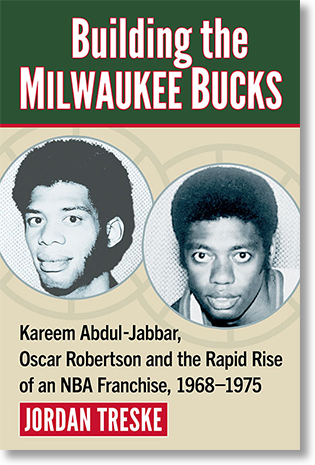
Building the Milwaukee Bucks: Kareem Abdul-Jabbar, Oscar Robertson and the Rapid Rise of an NBA Franchise, 1968–1975
195 pages, paperback, ill
Jefferson, NC: McFarland 2025
ISBN 978-1-4766-9775-8
The Milwaukee Bucks hold two NBA Championships, which is 200 percent more than the Charlotte Hornets, Los Angeles Clippers, Memphis Grizzlies, Minnesota Timberwolves, New Orleans Pelicans, Orlando Magic, Phoenix Suns, and Utah Jazz combined, yet it is hard to escape the notion that they should have won more, considering the talent that Milwaukee was able to acquire, as well as its size—in 1965 Milwaukee was America’s 11th largest city. The state of Wisconsin has two major league professional sports franchises, and the Bucks are a distant second to the community-owned Green Bay Packers, but Milwaukee’s stature should validate it as one of the more esteemed sports cities in the region.
Historically, that has not been the case. Milwaukee lost its sole pro franchise to Atlanta in 1965, 12 years after the MLB’s Braves moved to Wisconsin from Boston. In 1953 they were welcomed by 50,000 Milwaukee citizens, who embraced the franchise before its players even took the field. However, just as Boston lost out on its team after the Braves were offered first-class facilities in Wisconsin, Milwaukee fell victim to similar tactics when their franchise again switched locations. Looking for another franchise to serve as proof of the city being major-league along with other state capitals, with American football and baseball out of the equation, Milwaukeean Marvin Fishman turned his attention to another American sport—basketball.
In his book Jordan Treske gets into the details of the first years of the franchise but the narrative never quite gets off the page, with a palpable distance between the author and the former players.
What followed were some of the best first seasons of an expansion franchise in NBA history, making the NBA Finals twice and winning the championship once, following a 407-249 regular season record in their first eight years. Six of those were spent with Lew Alcindor/Kareem Abdul-Jabbar at the center position, the player Milwaukee lucked in drafting in 1969. In his book Jordan Treske gets into the details of the first years of the franchise but the narrative never quite gets off the page, with a palpable distance between the author and the former players. Awe and respect are understandable, but assuming the thoughts of real-life people—for example “he took solace in” (p. 158), “he looked forward to” (p. 163)—goes beyond descriptions of real-life events, which were interesting on their own.
The man responsible for bringing the Bucks to Milwaukee was Marvin Fishman, who initially wanted to bring the American Football League to the city, but the proximity of the Green Bay Packers prevented that from happening. The Packers were coming off the most successful seasons in their history with three championships in five years under legendary coach Vince Lombardi, and challenging that was impossible. Still, a statement like “It was never Fishman’s intention to harm the Packers in any way” (p. 11) sounds counterintuitive to basic economic competition, which is always involved in running a sports franchise next to an existing one. How would this presumably peaceful coexistence work in practice remains hypothetical, as in 1966 the AFL and the NFL announced a merger which made running two football franchises in the region pointless. That was when Fishman focused all of his efforts on the NBA and two years later, on January 22, 1968, Milwaukee and Phoenix were announced as the new expansion destinations for the league.
The first season, as expected, was a struggle, but the losing was rewarded with the first pick in the 1969 draft, which was Ferdinand Lewis Alcindor, Jr. The expectations were high regarding the rookie and the team that picked him was supposed to be set for years. A New York kid who moved to UCLA to play basketball, Alcindor was pampered throughout his amateur basketball career and the Bucks did what they could to appease their potential franchise player, who already as a college student got into social activism. Young Abdul-Jabbar was on the path of self-discovery, which began with him changing his name to reflect his conversion to Islam. A loner by nature, the big man was unhappy in Milwaukee and even winning the NBA Championship while playing next to point guard extraordinaire Oscar Robertson did not change that. With Robertson retired, Abdul-Jabbar demanded to be moved as well, bringing an end to the most successful era in Bucks basketball history.
50 years after their first win, the Bucks won their second title, again following the lead of a generational talent, the incredibly athletic big man Giannis Antetokounmpo. And it seems that this era is coming to an end as well following the Greek and the franchise openly talking about considering parting ways. Unlike Abdul-Jabbar who could not escape the bright lights of Los Angeles or New York (which were his two proposed trade destinations), Antetokounmpo for years has been talking about being happy in Milwaukee and watched as the management fumbled season after season of his prime by surrounding him with players and coaches that could not reach the finals despite his best efforts. As the summer of trade talks and speculations is upon us, Building the Milwaukee Bucks provides a lesson on how to treat your former stars and deal with the aftermath of the breakup of a potential dynasty. Kareem’s Bucks and Giannis’ Bucks are not that different. It remains to be seen whether the latter will follow in the footsteps of the former in their post-superstar era. Then again, if Giannis stays, these divagations may turn out to be irrelevant.
Copyright © Łukasz Muniowski