Anna Kavoura
Department of Psychology, University of Ioannina, Greece
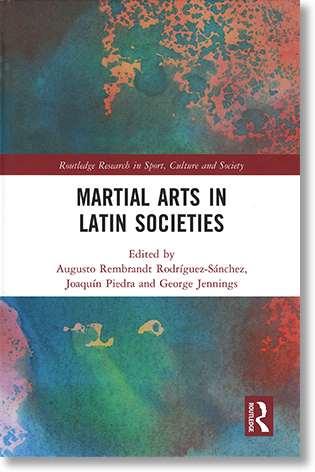
Martial Arts in Latin Societies
275 pages, hardcover
Abingdon, Oxon: Routledge 2025 (Routledge Research in Sport, Culture and Society)
ISBN 978-1-032-64860-6
Despite the rapid growth of martial arts and combat sports studies as an academic field, certain regions and communities have received limited scholarly attention, with Latin societies remaining comparatively underexplored. This is precisely the gap that Augusto Rembrandt Rodríguez-Sánchez, Joaquín Piedra, and George Jennings identify, and their edited volume Martial Arts in Latin Societies seeks to address it. Published in 2025 by Routledge as part of the Routledge Research in Sport, Culture and Society series, the collection examines the historical, cultural, and political processes that have shaped martial arts in Latin societies “i.e. countries, postcolonial territories, and provinces that speak Romance languages of Latin origin (French, Italian, Portuguese, Romanian, and Spanish), as well as the Philippines, which shares the dominant Roman Catholic faith” (p. 1). In addition, the book explores how colonization, globalization, migration, and national politics intersect with the development of martial arts and combat sports across these regions, particularly in relation to questions of identity, belonging, and inclusion/exclusion.
These are important topics that are often overlooked in the existing scholarship; therefore, this book is an important and timely contribution, bringing together perspectives from anthropology, sociology, cultural studies, media studies, history, physical education, and sport psychology. The contributors (many of whom are both leading martial arts scholars and experienced practitioners) present a wide-ranging array of case studies. Some focus on well-known disciplines such as judo, capoeira, boxing and Brazilian jiu-jitsu, while others examine more regional forms of wrestling and combat traditions. I found the latter particularly intriguing, as several were unfamiliar to me and their lesser-known histories introduce perspectives that are rarely addressed in the literature.
On the one hand, female wrestlers must contend with the objectification and sexualisation of women’s bodies; on the other, many strategically mobilise this “erotic capital” to navigate the male-dominated terrain of sports organisations and media industries, thereby maintaining visibility and popularity.
Regarding its structure, the book opens with a well-written introduction by the editors, in which they outline the key themes that run through the subsequent eighteen chapters, namely the relationship between martial arts and Latin cultural identities, and the impact of colonialism and globalisation on the development of Latin martial arts. The remainder of the book is organised into five thematic parts.
The first part provides valuable context by tracing the historical conditions that shaped the development of various martial arts, including Filipino martial arts, Leonese wrestling, Brazilian jiu-jitsu, Capoeira, Huka-Huka, Marajoara wrestling, and Canarian wrestling. As the contributors demonstrate, the origins of many of these practices are deeply connected to histories of colonisation, slavery, resistance, and Indigenous cultural traditions (see, for example, Chapter 1 on Filipino martial arts and Chapter 3 on Capoeira and Huka-Huka). Others, however, were closely aligned with conservative institutions, military regimes, and nationalist ideologies. Chapters 2 and 4, for instance, show how Leonese wrestling and Canarian wrestling were mobilised during Franco’s dictatorship to promote fascist ideology and reinforce nationalist identities.
The second part turns to questions of culture and identity, exploring how martial arts contribute to the construction of glocal and national identities. Through ethnographic, historical, media, and phenomenological research, the contributors illustrate how martial practices can operate both as vehicles for the preservation of cultural identities and as instruments of exercising political power. Chapter 9, for example, traces the development of judo in Brazil that initially served as a means of socialisation and cultural preservation within Japanese communities, while later it was instrumentalised by Brazilian institutions as a tool for validating national sporting achievement in international competitions. I also found particularly compelling the story of Andrés Lucas Valdés, presented in Chapter 8, who is regarded as one of the early introducers of Kung Fu and Taijiquan in Argentina. His work during the politically turbulent 1970s (including the period leading up to the 1976 coup) reveals how martial arts instruction intersected with political activism, as he taught classes to militant cadres of revolutionary organisations such as the Montoneros.
The third part addresses the pedagogical dimensions of martial arts, examining teaching and learning processes, community building, instructor–student relationships, and the transmission of embodied knowledge. Of particular theoretical interest are Chapters 11 and 12, which draw, respectively, on the works of Wacquant and Foucault to explore pedagogy, embodiment, and the cultivation of hierarchies, obedience, and disciplined bodies within martial arts settings.
The fourth part turns to issues of gender, perceptions of violence, race and citizenship. Through media-based analyses, the contributors examine women’s representation in wrestling (Chapter 13), public perceptions of mixed martial arts (MMA) as violent practices and the “civilising processes” they underwent to challenge this discourse (Chapter 14), as well as the intersections of ethnicity, race, gender and citizenship in boxing (Chapter 15). I found chapter 13 to be particularly engaging, as it addresses a paradox well documented in feminist scholarship. On the one hand, female wrestlers must contend with the objectification and sexualisation of women’s bodies; on the other, many strategically mobilise this “erotic capital” to navigate the male-dominated terrain of sports organisations and media industries, thereby maintaining visibility and popularity. The author further highlights the culturally contingent nature of these representations, showing how ideals of femininity and the value placed on different bodily images vary across socio-cultural contexts.

Finally, the fifth part returns to the impact of globalisation, migration and colonial processes on issues related to race (Chapter 16), gender (Chapter 17) and disability (Chapter 18) in martial arts. The chapters in this section address questions of inclusion and exclusion, the hierarchical structures that practitioners often embody (and challenge or reproduce), and the ways in which long-standing social inequalities shape different experiences for different people in martial arts and combat sports.
While the overall contribution of Martial Arts in Latin Societies is significant, I found that many chapters lacked the theoretical depth suggested by the editors’ beautifully written introduction. The engagement with issues related to gendered and racial identities in martial arts (and how these are shaped by processes of colonisation and globalisation) was at times rather thin. Although these themes were mentioned across the volume, relatively few chapters offered sustained theoretical analysis. In my opinion, a deeper dialogue with postcolonial, decolonial and intersectional feminist scholarship, would have considerably strengthened the book.
Gender, for example, appeared explicitly in only three chapters, which addressed important concerns frequently raised by cis women practitioners, including sexualised and objectifying representations, gender hierarchies and stereotypes, as well as gendered practices and clothing. An intersectional perspective (one that I believe could have been more present throughout the book) was applied only in Chapter 15, to explore how gender intersects with race and citizenship, and there was a notable lack of engagement with LGBTIQ+ issues.
The rather thin treatment of martial artists multiple intersecting identities and how they have been shaped by processes of colonisation and globalisation, may partly reflect the interdisciplinary breadth of the collection, which brings together contributors from diverse disciplinary backgrounds and methodological traditions. Nonetheless, the unevenness in critical engagement highlights an ongoing challenge within martial arts studies and the need for more theoretically rigorous interrogation of the socio-cultural and political forces that structure martial arts practices and identities. These critiques are not intended to detract from the book’s value; rather, to signal opportunities for further scholarly engagement.
Importantly, the book’s multidisciplinary approach is also one of its principal strengths. The diversity of topics and approaches demonstrate that martial arts are not static or isolated traditions, but living, evolving practices shaped by global and local forces, as well as by economic, historical, socio-cultural and political conditions.
In my opinion, the book’s most valuable contribution is that it decenters certain dominant narratives, such as the persistent notion that martial arts (or sport in general) are inherently “non-political” or politically neutral. By contrast, the chapters in this volume clearly situate martial arts as politically charged cultural practices. Several contributions explicitly examine how colonial practices, military regimes, nationalist ideologies, political activism and movements of resistance have shaped the development of martial arts across Latin societies. Although the book focuses on Latin socio-cultural contexts, these insights speak to broader debates and encourage further research on the politics of martial arts (and sport more broadly) in other contexts as well.
In conclusion, Martial Arts in Latin Societies is an insightful and timely addition to the expanding body of martial arts scholarship. It not only broadens the geographical and cultural scope of the field but also invites scholars to reconsider the historical, cultural and political forces that have shaped martial arts development. The volume successfully opens new avenues for inquiry and stands as a valuable resource for researchers, students and practitioners interested in the socio-cultural dimensions of martial arts and combat sports.
Copyright © Anna Kavoura 2025