Brian Hillman
Towson University, Maryland, USA
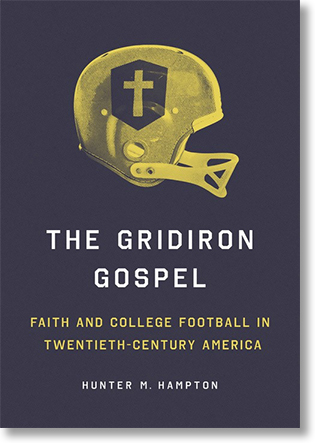
The Gridiron Gospel: Faith and College Football in Twentieth-Century America
224 pages, paperback
Urbana and Chicago, IL: University of Illinois Press 2025 (Sport and Society)
ISBN 978-0-252-08899-5
College football and Christianity are among the most important components of contemporary American culture. Hunter M. Hampton’s The Gridiron Gospel: Faith and College Football in Twentieth-Century America explores the intersection of America’s most popular sport, played the collegiate level, with various forms of American Christianity from the early twentieth century to the present. Hampton argues that American college football and American Christianity mutually informed and molded each other, with college football serving the interests of Christian universities and football gaining respectability through the growth and stability of college football programs.
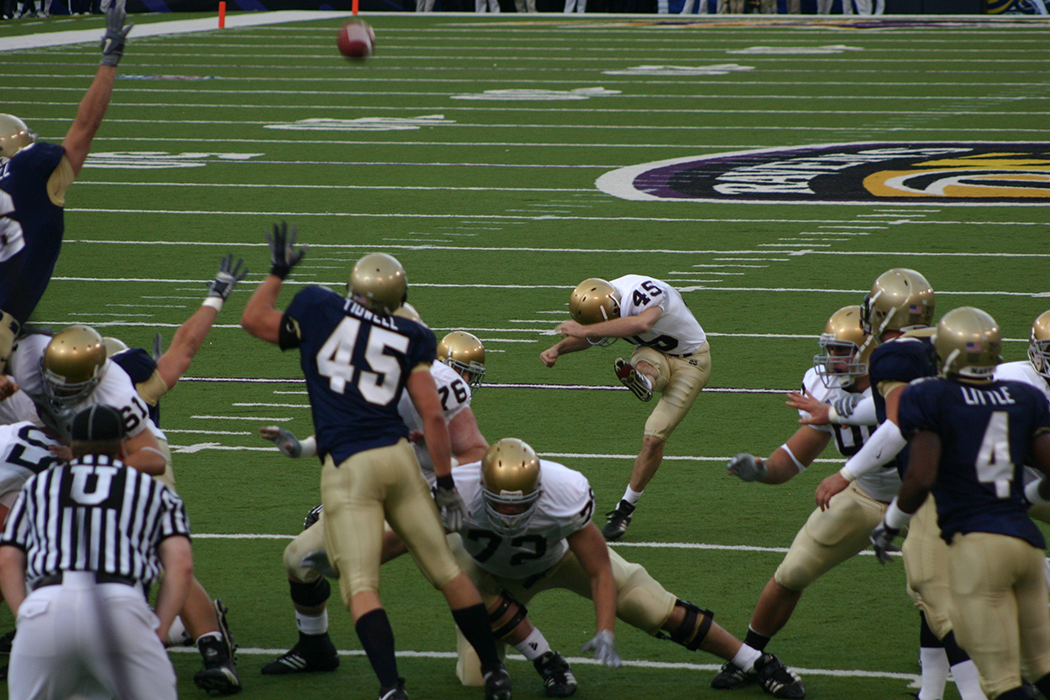
The Gridiron Gospel is organized around six chronologically ordered case studies, each focusing on a different Christian denominational university. Chapter one begins at the dawn of college football when the “Rugby Rules” version of football that resembles the contemporary game gradually came to prominence (13-14). Although the game was played by students at elite colleges such as the University of Michigan and Harvard University, the violent nature of the sport generated significant criticism from affiliates of denominational and non-denominational universities. Whether students should be allowed, if not encouraged, to play football was hotly debated on campuses such as the University of Notre Dame, founded in 1842 as a Catholic university in South Bend, Indiana, since its first game in 1887. Critics argued that the game’s violence, as well as the popularity it engendered, would keep students in a prolonged state of adolescence and was an impediment to their education, creating incentives for athletic rather than academic or moral excellence. Proponents held that football promoted strong body character in those engaging in the warlike sport. Notre Dame’s football program also increased its exposure to non-Catholic schools. This was even more important after World War I, when many Catholics were accused of being “papists,” whose support for America was, at best, subordinate to their fealty to the Roman Catholic Church. Playing football allowed Notre Dame students to demonstrate a distinctive form of Christian masculinity that both reinforced Catholic ideals and allowed them to prove their Americanness to non-Catholic institutions. At times, Hampton’s analysis would have benefitted from greater engagement with primary accounts, particularly the voices of students. In this chapter more than others, Hampton asserts, rather than explains in depth with primary sources, how Notre Dame football negotiated a conception of Catholic masculinity that responded to the changes in American ideals in the late-nineteenth and early-twentieth centuries.
Chapter two explores how embracing playing college football at Brigham Young University (BYU) in Provo, Utah was an important factor in how the Church of Jesus Christ of Latter-Day Saints (LDS) became a mainstream American religious movement.
Just as embracing college football was one way that Notre Dame Catholics attempted to demonstrate their legitimacy as Americans, so too did Mormons. Chapter two explores how embracing playing college football at Brigham Young University (BYU) in Provo, Utah was an important factor in how the Church of Jesus Christ of Latter-Day Saints (LDS) became a mainstream American religious movement. In its early years, Mormonism was considered taboo in America in part because of its acceptance of polygamy. After polygamy was outlawed in 1890, the LDS movement sought legitimacy in Protestant America. A successful institution of higher education with a football team helped facilitate Mormonism’s growth and acceptance in broader American society. Despite some enthusiasm for football in the late nineteenth century, BYU formally outlawed football from 1900 to 1919 due to reported on-field deaths. Football at BYU responded to dynamic conceptions of football and, relatedly, masculinity.
Once football was embraced as an acceptable pastime, it was embraced by many at BYU as a pathway to healthy Mormon masculinity, recast as in the spirit of the “Word of Wisdom” (1833), an early Mormon text that outlined an abstemious regimen that promoted physical health. As the BYU program became increasingly successful, including winning an injunction that allowed students to serve on a two-year mission without jeopardizing their NCAA sports, Mormonism became increasingly accepted in mainstream American society.
The vicissitudes of Wheaton College’s football team from 1925 to the postwar period is the focus of chapter three. Founded in Wheaton, Illinois, the college began as a fundamentalist Christian institution. Football was initially deemed outside the scope of fundamentalist masculinity. Following World War I, Wheaton gravitated towards Evangelicalism. The football program was instituted not with the goal of furthering the college’s reputation or financial success, but as a tool for the development of Evangelical masculinity. Football, it was held, fostered community, physical health, and prepared students to spread the gospel. Even as Wheaton football’s success improved the school’s reputation, it resisted the temptation to join “big time sports’ even it admitted football players who did not meet its academic or behavioral standards.
The rise and fall of the football program at Wiley College, an HBCU (an acronym referring to Historically Black Colleges and Universities) located in Marshall, Texas with Methodist roots, is the focus of chapter five. The successful football team, along with its academic standards, fomented Wiley’s reputation. Starting in the 1930s, Wiley’s annual match against fellow HBCU Prairie View A&M University, named the State Fair Classic, cemented Wiley’s status as a Texas football institution. Black students, spurred by the civil rights movement, unsuccessfully sought to integrate the lunch counters in Marshall, due, in part, to a lack of support from the college. Under financial strain, and the influx of Black students and athletes to primarily white institutions, the Wiley football program folded in 1969 in order to keep the university financially solvent.
As discussed in chapter five, football was an aspect of the Texas Baptist Baylor University’s educational and religious mission. Like other universities, Baylor was slow to adopt football due to the game’s violence. After World War II, both male and female student enrollment increased in part due to the “GI Bill.” Attending Baylor football games became integral to the social and dating fabric of the university. Nonetheless, its coaches and players championed Baylor’s Baptist ethos. For example, in the mid-1950s Bill Glass was both an All-American and an outspoken evangelist, profiled in several media outlets as a teetotaling preacher who brought other students closer to Christ. Fielding a competitive football team is often in tension with academic achievement, particularly when athletics programs have significantly greater funding that increases the pressure to win. Hampton persuasively argues that, during the 1960s, Baylor’s continued employment of head coach John Bridgers, despite a mediocre record, testifies to how the university prioritizes its mission over winning football games. Staunchly evangelical, Bridgers was lauded for supporting his students academically and religiously.
The sixth and final chapter charts the rise to prominence of Liberty University’s football team. Liberty was founded in 1971 by televangelist Jerry Fallwell. Fallwell (who also founded the conservative Moral Majority organization) aspired to develop Liberty into a conservative Evangelical institution that would rival BYU or Notre Dame. Fallwell leveraged his media empire, including his Fallwell Family Network that broadcast Liberty events, and Liberty’s Life-Long Learning program that sold classes on VHS. Hampton carefully tracks how Liberty navigated serious legal and financial issues, gradually moving up the ranks of college football until it reached the highest level, Division 1. Falwell, who died in 2007, and his son, Jerry Falwell, Jr., who took over Liberty until a sex scandal led to his resignation in 2020, used Liberty’s platform to support conservative politics including bringing future president Donald Trump to campus in 2012.
A subplot of The Gridiron Gospel is the tension between football as a boon to the development of healthy religious masculinity and football as a competitive sport that can pay substantial economic and reputational dividends. The fact is that denominational schools are often willing to hire administrators, coaches, and players who do not uphold the school’s values. A case in point is Liberty University’s decision to hire Hugh Freeze after he was fired from the University of Mississippi for using a university phone to contact sex workers. Some Liberty students used the discourse of Christian forgiveness to justify his hire.
Several of the book’s discussions would have benefited from greater breadth and depth of analysis of primary sources or first-hand accounts, particularly as it attempts to explain how students, rather than administrators, negotiate the tensions between football and Christianity. A salient exception is the use of student newspapers throughout the book, materials that added a layer of raw, narrative texture to an already enjoyable-to-read monograph.
The Gridiron Gospel joins several recent works on Sports and Religion that explore how sports and religion in America shape each other. Three standout titles are Dyed in Crimson: Football, Faith, and Remaking Harvard’s America by Zev Eleff (University of Illinois Press, 2023, published in the same “Sport and Society” series as The Gridiron Gospel); The Spirit of the Game: American Christianity and Big-Time Sports by Paul Emory Putz (Oxford University Press, 2024); and Bodies in Motion: A Religious History of Sports in America by Arthur J. Remillard (Oxford University Press, 2025). By focusing on six case-studies across a roughly a century, The Gridiron Gospel adroitly balances breadth and depth in its exploration Christianity and college football.
Copyright © Brian Hillman 2026