Arve Hjelseth
Department of Sociology and Political Science,
Norwegian University of Science and Technology
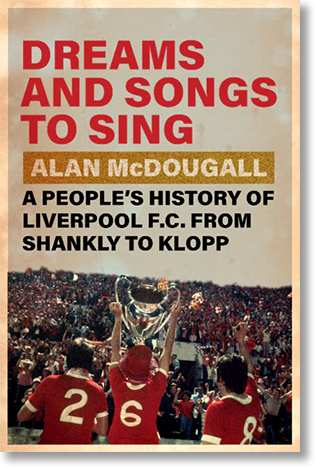
Dreams and Songs to Sing: A People’s History of Liverpool FC from Shankly to Klopp
351 pages, hardcover, ill
Cambridge, Cambs: Cambridge University Press 2025
ISBN 978-1-00934-023-6
I read this book partly as an academic study of a football club, but partly also as a personal memoir. The author is a sport historian and a Liverpool fan. He was born in Canada but grew up in southern England. His father, however, was raised in Liverpool. The subtitle indicates that the book belongs to a particular branch of history, that is, the history as told and interpreted by people themselves, rather than by their leaders. In this case, it is the history through the lenses of those who follow the club. The data consist of a large number of interviews with fans from all over the world, conducted through both physical and digital conversations. McDougall’s own voice is, however, also present in most parts of the book, asking questions and providing specific viewpoints and interpretations.
Much has been written about Liverpool F.C, both academically and not least in popular culture. Scholars have looked into the club from historical, anthropological and sociological lenses, while a large number of life-long fans have written their personal memoirs. Some have combined the two, and McDougall’s book probably fits best into the latter category.
The amount of literature available makes it hard to provide much that is unknown to readers familiar with the club. Still, it is noteworthy that read as a personal memoir, McDougall – in spite of his ties to Liverpool – grew up as a supporter while consuming the club mainly through the media. Most fan stories are written by people who regarded Anfield and the Kop as the “mainstay of their lives” from an early age, as Alan Edge (1996) put it. McDougall saw most of his first Liverpool games in and around London, where his family lived at the time. As a reader and as a Liverpool fan, I can certainly connect to this. I have followed the club as closely as I have been able to for more than 50 years, and for the last 20 of those, I have had the opportunity (not always taken) to watch practically every competitive game on TV. I’ve visited Anfield on about 20 occasions. But still, I was raised as a Liverpool supporter through TV, newspapers and eventually online resources. I would have supported them equally much if I’d never had the chance to visit Anfield. Even if I may try to pretend to be familiar to Liverpool culture when visiting, I – like tens of thousands of Scandinavians – am part of a global following.
While crowds at football games had traditionally shouted very short chants at best, the emerging youth culture introduced a singing choir on the terraces. In a well-known program from BBC Panorama in 1964, we can watch the fans singing She Loves You by the Beatles.
This illustrates an important point made in the book: Liverpool F.C. is a global club as much as a local one. The club has dedicated followers in all parts of the world. Local supporters are different, but not superior by default. For example, a popular webpage dedicated to the history of the club, listing details from every match since 1892, is established and run by two fans from Iceland (page 89).
As interviews with fans form the basis for large parts of the book, it is the story of people following the club as much as a story about the club as such. “Fans often make the best critics”, as McDougall puts it on page 10, and “to understand an event or a place, you must understand who’s watching” (page 25).
As the subtitle indicates, the book mainly covers the years from 1959, when Bill Shankly arrived as manager, to 2024, when Jürgen Klopp left. Chapter 2, however, is about the changing face of Anfield during a time span of more than 100 years, while chapter 3 is mainly about Billy Liddell, the star of the post-war team in the late 1940s and 50s, before the arrival of Shankly. Liverpool won the league in 1946/47 but spent the the years from 1954 to 1962 in the Second Division. Then came Shankly and everything changed. Chapters 2 and 3 also offer a lot of insights. On page 29, concerning when Anfield turned into an all-seater stadium, McDougall notes that “A mass of standing spectators is a crowd, a mass of seated spectators an audience”. This is a telling way to indicate some of the essence of football fans.
From chapter 4 on, a particular event makes up the starting point. It may be the arrival of Shankly (chapter 4), his sudden and unexpected departure, which Shankly himself probably almost immediately regretted (chapter 5), the Hillsborough disaster (chapter 10) or the famous CL final against AC Milan (chapter 12). These events act as starting points for further discussions of the era in which they took place.
Almost from the beginning, football has been a popular pastime in England. Its character changed, however, in the years during which Shankly – manager from 1959 to 1974 – established his first great team (roughly 1962-1966). Liverpool were league champions in 1964 and 1966, and FA cup winners in 1965 (the cup was much more prestigious in those days than is the case today). This coincided with the emergence of the Beatles, who conquered the world parallel to Liverpool FC and rivals Everton conquering England. To some extent, the success of the Beatles influenced the way supporters at the stadium behaved. While crowds at football games had traditionally shouted very short chants at best, the emerging youth culture introduced a singing choir on the terraces. In a well-known program from BBC Panorama in 1964, we can watch the fans singing She Loves You by the Beatles. It sounds strange, as the song has no relation whatsoever to football. But it is a strong indication of the merging of football and popular culture in those days, which culminated in the World Cup in 1966 and with the arrival of the George Best phenomenon. When You’ll Never Walk Alone (the version recorded by the Liverpool band Gerry & The Pacemakers) established itself as the club anthem, it was because it started as a popular hit that gradually produced meaning to the fans (“through the wind and rain”).
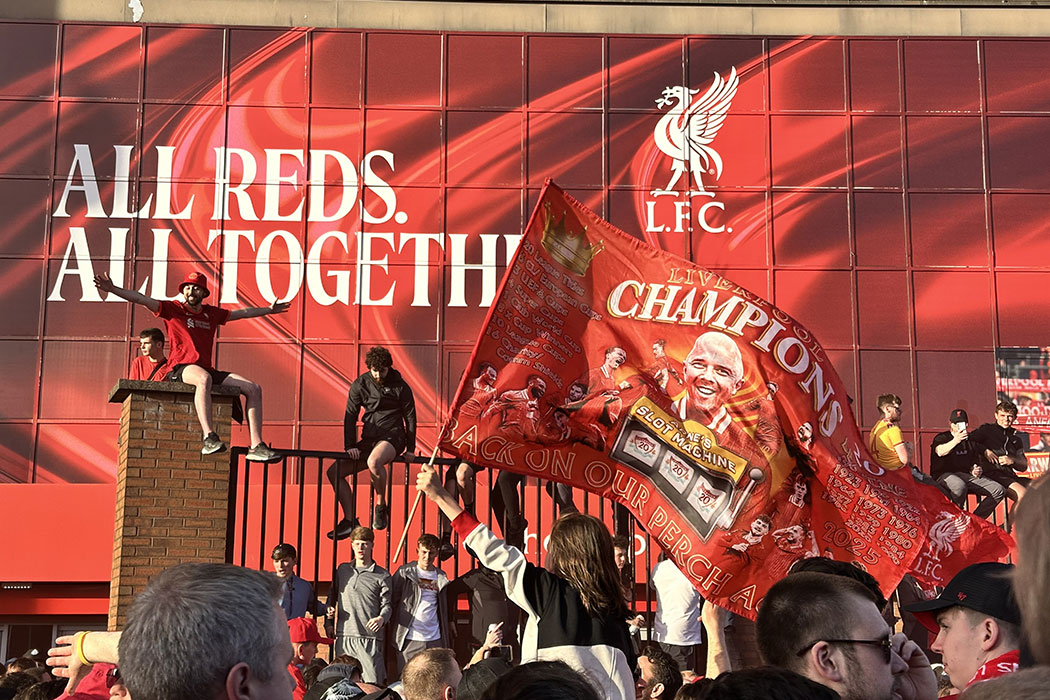
Besides insisting on Liverpool as a global phenomenon, McDougall also presents a partly novel version of history by paying particular attention to aspects of the club related to black players (chapter 8) and to women’s football (chapter 11). In these and other respects, he does not hesitate to take a critical stance. Both the fate of the black player Howard Gayle, one of the heroes of a famous away game against Bayern Munich in 1981, as well as the disregard of women’s football, are cases in point. Regarding the latter, McDougall points out (p. 226) that “the unspoken element (…) is the fan”. Who is watching women’s football? Sadly, until recently, it has been “a handful of people”.
The recent progress of women’s football, not least in terms of followers, is both encouraging and interesting. Sadly, Liverpool haven’t been able to challenge the leading clubs recently, but there is a huge potential in women’s football in general. It may be, for instance, that it encourages a more inclusive spectator culture. Further, it is – at least yet – less dependent on the powers that many supporters hesitate to accept. Or, in McDougall’s words, “there is so much to dislike [with the Premier League] or distrust: the near impossibility of getting tickets (…), the remote hedge fund owners, the blind eyes turned to sportswashing, VAR, tragedy chanting, the endless, and endlessly spiteful, online banter, the ex-pros talking rubbish”. These aspects haven’t yet really hit women’s football. But obviously, it will take time for women’s football to attract the kind of dedicated following that men’s football has done for more than hundred years. And there is a paradox here, too: To the extent that women’s football achieves the status it undoubtedly deserves, it is likely that it will take on some of the more ambiguous aspects of men’s football. At some point, women’s football is also likely to surrender to the powers that be. And as the money at stake surge, players will also become more cynical. I still remember how brilliant England were in cynically wasting time in every possible way during the final minutes of the EURO2022 final against Germany.
In chapter 9, McDougall also provides a critical analysis of how the club has handled the aftermath of Heysel disaster in 1985, where Liverpool supporters were at least partly responsible for the death of 39 mostly Italian fans. Even if the unfolding of the events were also due to the ignorance of the UEFA and Belgian police as well as a stadium that was in urgent need of upgrading, it is an uncomfortable truth that the behavior of some Liverpool fans were decisive in turning it into one of the most tragic events in the history of football. The discussion on how Liverpool erased the final from the record of club honors in a pamphlet released for the following season is interesting. To me, it seems more reasonable to see it as a “mark of respect for the dead” rather than “shame-faced erasure of history”, as McDougall puts it when providing the reader with alternative interpretations (page 179). Maybe it’s just an indication of how hard it is to handle such issues. Any choice could probably be attributed to both bad and decent intentions.
I like this book, even if it didn’t provide me with a lot of new insights. The dedication of many fans, as well as the individual stories about how people started and continued to follow the club, makes a good read. As mentioned, the critical lenses he puts on to discuss the darker sides of the club’s history is a reminder that football has not always been a very inclusive game. Finally, the voices provided by different fans offer an exciting mosaic of a truly global phenomenon.
Copyright © Arve Hjelseth 2026
Reference
Edge, A. (1997). Faith of our Fathers. Football as a Religion. Edinburgh: Mainstream Publishing