Brian Hillman
Towson University, Maryland, USA
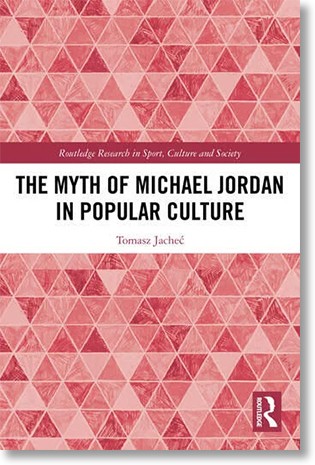
The Myth of Michael Jordan in Popular Culture
258 pages, paperback
Abingdon, Oxon: Routledge 2025 (Routledge Research in Sport, Culture and Society)
ISBN 978-1-03-259128-5
Few athletes are as famous or acclaimed as basketball legend Michael Jordan (b. 1963). Commonly acknowledged as the greatest basketball player of all time (the G.O.A.T.), Jordan has a mystique that transcends the sport of basketball. Tomasz Jacheć, in The Myth of Michael Jordan in Popular Culture, explains how the “Jordan Myth” developed. Jordan’s remarkable achievements on the basketball court, including game-winning shots and balletic dunks, as well as the strong masculine image he projected were buttressed by media coverage and advertising.
Jacheć uses the framework of the “hero’s journey” from Joseph Campbell’s The Hero with a Thousand Faces (1949). Campbell developed this framework centered on several “mythemes” with examples drawn from classical literature (e.g. the Homeric epics and the Hebrew Bible). In contrast, Jordan is analyzed as a “modern myth” which Jacheć defines as “an evolving, secularized, symbolic narrative, which is rooted in ritual and based on factual events” whose purpose is “to glorify and explain the individual as a phenomenon, and create, reflect, and promote the culture’s values and customs” (p. 10). The term “secular” may not be necessary. Sport and sports fandom, with their attendant sacred spaces, sacred texts (rules), rituals, communities, and the ways they supply meaning, purpose, and identity, function like religion. Nonetheless, with this definition, Jacheć identifies that modern myths are grounded in real events yet are narratives that promote a culture’s values. The “Jordan Myth” both draws on and supports late capitalist American values of individualism, hard work, and financial success.
Like Beowulf, Jordan had two successful periods of victory (his periods of three consecutive championships) but the Washington Wizards Jordan, old and weary, would not fight again.
Jacheć’s study traces Jordan’s playing career as well as how his image is shaped by popular media, especially journalism and advertising. The lengthy first chapter examines Jordan’s career from 1982 to 1991, highlighting the elements of Jordan’s story that map onto Campbell’s framework. In 1982, Jordan was a freshman at the University of North Carolina at Chapel Hill. In the NCAA championship game against Georgetown, Jordan made a game-winning shot that gained him national notoriety. This, for Jacheć, exemplifies the “call to adventure” mytheme that begins a hero’s journey. Jordan had already overcome (supposed) being cut from his varsity basketball team in high school, which fomented his desire for basketball greatness.
Before entering the NBA in 1984, Jordan signed a lucrative shoe contract with Nike. Jacheć playfully connects this to the “meeting with the Goddess” mytheme. Nike, and its advertising of Jordan’s shoes, would contribute greatly to the “Jordan myth.” After a successful rookie season for the Chicago Bulls, Jordan injured his ankle in early 1985 and missed most of the season. His period of injury exemplifies the “belly of the whale” mytheme in which Jordan emerged reborn, ready to dominate the league. Jordan’s remarkable talent led both journalists and his peers to employ religious discourse to describe him, exemplified by Boston Celtics star Larry Bird referring to him as “God disguised as Michael Jordan” after a legendary playoff performance.
An NBA championship eluded Jordan through the first seven years of his career. Only when he received “supernatural aid” from his teammate Scottie Pippen and the tutelage of coach Phil Jackson was Jordan able to win a championship. To do so, he had to put aside his ego and learn to trust his teammates. Fomented by journalists such as David Halberstam, the perception that Michael Jordan had taken the crown of “greatest basketball player” emerged in 1991 after Jordan won his first championship with the Bulls. The first period of his career concludes with Jordan’s “apotheosis” (another mytheme).
Chapter Two, “The King’s Reign,” treats the years 1991-1998. Jordan’s Bulls won three championships from 1991-93, before Jordan “refused the call” of his own greatness. In the wake of the murder of his father James in 1993, Jordan shockingly retired from professional basketball to pursue professional baseball. As Jordan’s apotheosis was buttressed by his continual success in the NBA, and his leading the United States Olympic basketball team to victory in 1992, criticism of his personal conduct emerged. His gambling habits became notorious, his apolitical nature was criticized, and his involvement with Nike and its labor practices was scrutinized. Sam Smith’s The Jordan Rules (1991) depicted him as a maniacally competitive and combative teammate. While Jordan’s sojourn in baseball could be attributed to many factors (e.g. mental exhaustion, increased media scrutiny, grief, or even a secret gambling suspension), but he emerged in 1995 with an “ultimate apotheosis,” leading the Bulls to another three-peat of championships from 1996-1998.
After his retirement in 1999, Jordan became part-owner of the Wizards. Unable to remain on the sidelines, Jordan returned to the court in an impressive but diminished version, unable to lead his team to playoff success. In chapter three, Jacheć describes Jordan’s stint with the Washington Wizards from 2001-2003 as his “Beowulf period.” Like Beowulf, Jordan had two successful periods of victory (his periods of three consecutive championships) but Wizards Jordan, old and weary, would not fight again.

Chapter four explores how the myth is poised to persist well into the future, even as some staunch defenders of Los Angeles Lakers star LeBron James believe he has overtaken Jordan as the G.O.A.T. Media, especially the documentary The Last Dance (2020), released in the early months of the Covid-19 pandemic, have reinforced the Jordan myth. As Jordan himself helped to produce the ten-part series, which focused on the 1997-1998 NBA season Jordan spent with the Chicago Bulls, it is a “meta-documentary” in which Jordan reinforces and extends his own mythology. The Last Dance introduced many younger basketball fans to aspects of Jordan’s career they may not have witnessed. Moreover, The Last Dance reframed aspects of the Jordan myth, especially Phil Jackson’s persuasion of Jordan to embrace a team-oriented approach as Jordan himself recognized that his gravity on the court created open shots for teammates.
Just as importantly, advertisements for Jordan’s shoes present him as an everyman whose greatness could be touched with the right footwear. The slogan “be like Mike” and commercials in which Jordan says “I can accept failure. I can’t accept not trying,” present his greatness as approachable while acknowledging his transcendent talent.
The book would have benefited from more engagement with Jordan’s career statistics. As new fans encounter the perception that Jordan is the G.O.A.T., they will likely first assess that claim based on the statistical record. Jordan’s career, with his measurable scoring prowess, defensive aptitude, and awards, is another important vector sustaining the Jordan myth. The Athletic’s ranking of the 100 greatest NBA players in history is based primarily on their statistical achievements. Exploring how Jordan’s career numbers (including more recently created advanced statistics) contributed to the “Jordan myth” would have complemented the narrative sources discussed in the book.
Chapter five delineates four functions of the Jordan myth. In the “metaphysical function,” Jordan exemplifies human potential through his relentless work ethic, inspiring awe in all who perceive him. Jordan’s status as the first global “corporate athlete” exemplifies the “cosmological” function of the Jordan myth. In the 1980s, at the peak of American corporate culture, Jordan was an individually great athlete who was non-threatening to a predominantly white consumer public. In the 90s, as American cultural imperialism reached its apex, Jordan’s Bulls dominated the NBA as Jordan as a brand reached a global audience after his Olympic dominance.
The “sociological” Jordan myth emphasizes the (ostensibly) colorblind American values of hard work and family. Finally, the Jordan myth functions “pedagogically” by espousing the lessons of self-confidence, hard work and authenticity. Just as Jordan rebounded from being cut by his high school varsity team to athletic dominance, so can everyone “be like Mike.”
The global reception of the Jordan myth is determined by different cultural mores as discussed in chapter six. Jordan’s popularity in China is attributed, in part, to his humility. Even as many people in China opposed American cultural imperialism, Jordan’s physical fitness as well as his relative humility when compared to other basketball stars such as Shaquille O’Neal, made him appealing and created a market for his branded merchandise. Jacheć also reflects on Jordan’s appeal for him as a young man living in Poland after the fall of communism and the arrival of American cultural products.
The Myth of Michael Jordan is an exemplary academic engagement with popular culture. It identifies and interrogates the multiple factors that created and sustained the Jordan myth while grounding its analysis in a sophisticated framework. Although one may quibble with some of the particulars of Campbell’s approach, it serves Jacheć well in articulating both how the Jordan myth developed and functions as well as its unique appeal in modern society.
Copyright © Brian Hillman 2025