Peter Hassmén
Southern Cross University, Australia
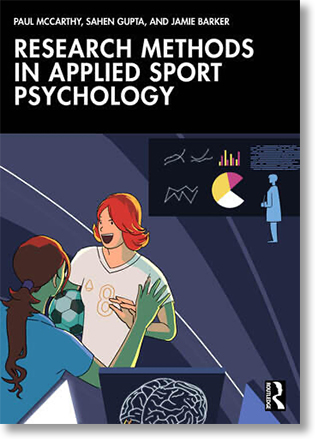
Research Methods in Applied Sport Psychology
256 pages, paperback
Abingdon, Oxon: Routledge 2026
ISBN 978-1-03-249041-0
The new textbook by McCarthy, Gupta, and Barker, Research Methods in Applied Sport Psychology, divides the subject into five sections: (1) conceptual issues about science and knowledge; (2) the research process, including ethics and planning; (3) methods, including designs, sampling, surveys, and interviews; (4) data analysis, including parametric and non-parametric tests as well as qualitative methods; and (5) reporting research.
One question arises immediately: why does the title refer only to research methods when data analysis is one of the book’s five sections? Of the 15 chapters, one focuses on quantitative data analysis (Chapter 10) and another on qualitative data analysis (Chapter 13). A more informative title might have been “Research Methods and Data Analysis in Applied Sport Psychology” (or even “Research Methods, Quantitative, and Qualitative Data Analyses in Applied Sport Psychology”). This is worth noting because titles shape how readers identify a book’s scope. As qualitative and mixed-methods research becomes more common in sport and exercise psychology, some students may overlook a book whose title does not clearly signal coverage of both research designs and data analyses.
That concern aside, the book has substantial strengths. It is a highly valuable text for undergraduate students, as it guides them through the full research cycle, from the first idea to the finished manuscript, in a way that few single textbooks do. It is also well-suited for teaching sport psychology to sport science students.
Section 1: Chapters 1–3
The first chapter addresses foundational questions such as what science is and what research is. It then introduces paradigms and research traditions, including positivism, post-positivism, critical theory, and constructivism, as well as approaches such as realism, phenomenology, social constructionism, and pragmatism. The chapter closes with practical advice on reading and understanding applied sport psychology research, supported by learning activities and a worksheet for further study. This is a content-rich chapter that many undergraduate readers will likely need to revisit several times.
Whereas Chapter 10 explains quantitative analyses in considerable detail, Chapter 13 devotes less than one page to thematic analysis, one of the most widely used approaches in qualitative research in sport psychology.
The second chapter, on traditions of applied sport psychology research, is also well written and informative. It introduces quantitative and qualitative research designs before turning to mixed-methods research. It also outlines exploratory, explanatory, and descriptive research and distinguishes between basic and applied research. Chapter 2 further addresses cross-cultural, multicultural, and intercultural issues. Although the authors do not explicitly discuss the WEIRD focus (Western, Educated, Industrialised, Rich, and Democratic; see Henrich and colleagues, 2010) that has shaped much sport psychology research, they do acknowledge the broader concern. Even so, this discussion could have been expanded, as it deserves more attention.
Chapter 3 describes the stages of the research process, outlines the key elements of each stage, and discusses ethical considerations. The stages are presented clearly: choosing a topic, reviewing the literature, selecting a design, seeking ethical approval, collecting data, analysing data, and writing up the study. Chapter 14 returns to the final stage in more detail. For readers unfamiliar with ethics approval, this section is especially useful because it shows that the process is time-consuming and should not be treated lightly.
Section 2: Chapters 4–6
Chapters 4 and 5 focus on two practical questions: what to study and when enough literature review has been done. Chapter 4 explains how to create and refine a research question, define aims and objectives, and use them effectively. It also includes several learning activities and a worksheet that may benefit even more experienced researchers.
Chapter 5 explains how to carry out a literature review, including the use of relevant databases. The authors also provide an example of how not to write a literature review, which usefully highlights the need to critique rather than merely describe previous work. Chapter 6 then introduces methods, theories, and concepts in applied sport psychology. The discussion of theories and theoretical frameworks is particularly helpful, as is the guidance on carefully choosing theories and concepts. The authors also provide an example of this process based on Jones and colleagues’ (2009) theory.
Section 3: Chapters 7–10
Chapter 7 surveys the research designs most commonly used in sports research, both quantitative and qualitative, and sets up the material that follows in Sections 3 and 4. Quantitative cross-sectional, longitudinal, experimental, non-experimental, and single-case designs are described, followed by qualitative approaches such as phenomenology, grounded theory, action research, ethnography, autoethnography, focus groups, and case studies. Because these descriptions are necessarily brief, readers new to these approaches will benefit from the additional references provided.

The next three chapters cover quantitative research methods (Chapter 8), quantitative data collection (Chapter 9), and quantitative data analysis (Chapter 10). Thomas Kuhn’s paradigms provide a starting point for discussing quantitative research, followed by ontology, epistemology, and methodology. Axiology is introduced earlier, in Chapter 1. For clarity, it might have helped to present these concepts together in one place: ontology, epistemology, axiology, methodology, and then methods. This is a minor organisational point rather than a major criticism, but clearer sequencing would likely help undergraduate readers.
Chapter 9 focuses on collecting quantitative data through questionnaires and discusses Stevens’ four levels of measurement: nominal, ordinal, interval, and ratio. Chapter 10 introduces statistical software such as Excel and SPSS and covers both parametric and non-parametric analyses. This is one of the book’s strongest chapters because it provides a broad and accessible overview of data analysis. The authors’ statistical expertise is clear, yet the material remains readable even for those with limited prior knowledge.
Section 4: Chapters 11–13
After the quantitative emphasis of Section 3, Section 4 turns to qualitative approaches and methods, qualitative data collection, and qualitative data analysis. Here, the book’s main weakness becomes clearer. These chapters are shorter and less informative than the preceding quantitative chapters.
The contrast is especially noticeable in Chapter 13. Whereas Chapter 10 explains quantitative analyses in considerable detail, Chapter 13 devotes less than one page to thematic analysis, one of the most widely used approaches in qualitative research in sport psychology. No single textbook can treat every method in depth, but a better balance between quantitative and qualitative coverage would have strengthened the book considerably.
Section 5: Chapters 14–15
The final two chapters focus on writing the research report and on practical guidance for completing it. Chapter 14 is especially useful because it addresses a common student difficulty: uncertainty about how to structure and write a research report. Its use of the traditional IMRaD structure should be particularly helpful for beginners.
One notable omission, however, is the lack of discussion of artificial intelligence (AI) and large language models (LLMs) such as ChatGPT, Claude, and Gemini. Their influence on student writing and research practice is now difficult to ignore. Although a full treatment may not have been possible, some discussion of the use of AI and LLMs would have strengthened these final chapters.
Conclusion
Research Methods in Applied Sport Psychology is a highly useful textbook, especially for undergraduate students who need guidance from project design to final write-up. Its breadth, clarity, and pedagogical structure make it well-suited for teaching. Its main limitations are the relatively thin treatment of qualitative analysis, the limited discussion of cross-cultural scope, and the absence of engagement with AI-assisted research writing. Even so, it is a strong and recommended contribution to the field of applied sport psychology.
Copyright © Peter Hassmén 2026
References
Henrich, J., Heine, S. J., & Norenzayan, A. (2010). The weirdest people in the world? The Behavioral and Brain Sciences, 33(2-3), 61–135. https://doi.org/10.1017/S0140525X0999152X
Jones, M., Meijen, C., McCarthy, P. J., & Sheffield, D. (2009). A theory of challenge and threat states in athletes. International Review of Sport and Exercise Psychology, 2(2), 161–180. https://doi.org/10.1080/17509840902829331
Kuhn, T. S. (1970). The structure of scientific revolutions (2nd ed.). University of Chicago Press. https://archive.org/details/structureofscien00kuhnrich/mode/2up
Stevens, S. S. (1946). On the theory of scales of measurement. Science, 103, 677–680. http://expsylab.psych.uoa.gr/fileadmin/expsylab.psych.uoa.gr/uploads/papers/Stevens_1946.pdf