Jay Coakley
University of Colorado, Colorado Springs, USA
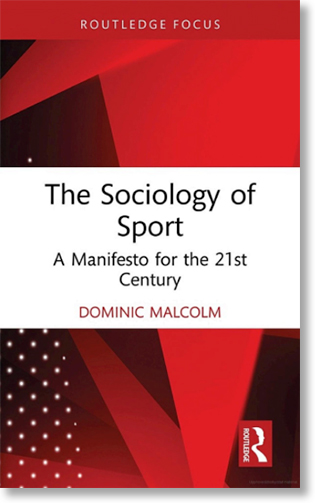
The Sociology of Sport: A Manifesto for the 21st Century
116 pages, hardcover
Abingdon, Oxon: Routledge 2026 (Routledge Focus on Sport, Culture and Society)
ISBN 978-1-04-123672-6
Dominic Malcolm is widely known and respected as a scholar. As a Professor of the Sociology of Sport at Loughborough University, he is also a Deputy Lead in the 83-person Sport, Business and Society program and Deputy Director of Doctoral Programmes in the School of Sport, Exercise and Health Sciences. He has written 5 book-length monographs based on his research, edited nine anthologies on sport-related topics, and published 200 articles and book chapters on sports and the sociology of sport globally and in specific national contexts. He has given numerous presentations worldwide, made media appearances in multiple countries, and served on many dissertation committees.
Malcolm published The Sociology of Sport: A Manifesto for the 21st Century earlier this year. It is a concise, timely, and provocative 98-page (plus 16 pages of references) constructively critical and informative analysis organized around three major questions:
- What is the value of the sociology of sport?
- What has it achieved?
- What are its prospects for the future?
This is the first manifesto written about the sociology of sport worldwide. Given its timeliness, I suspect that many of us in the field would benefit from considering and discussing what Malcolm has to say and how it fits with our personal conceptions of the past, present, and possible future of the sociology of sport. Malcolm’s critique of the sociology of sport is likely to evoke thoughts about the context of our professional careers and how it influences our teaching, research, and involvement in sport-related projects outside the university. If there have been changes in our local and national cultures or in our universities that impact the status and place of the sociology of sport, Malcolm provides recommendations likely to stimulate lively discussions with colleagues as devise strategic responses to the personal and institutional challenges, changes, and opportunities we encounter today and in the near future.
This led to creative research that crossed disciplinary boundaries and had practical applications in health, education, community development, and other fields in which useful research-based knowledge was in short supply.
As a dedicated sociologist, Malcolm uses his three decades of experience in the field to inform his manifesto. For example, he carefully chose the following 10 chapter titles to represent his analytical approach to chapter content:
- The Looking Glass Self: Reflecting the Sociology of Sport
- The Social Construction of Reality: The Development of the Sociology of Sport
- The Coming Crisis of Western Sociology: Knowledge Professions in a Post-truth World
- The Poverty of Science: Knowledge Production, Medicine, and Sports Science
- The Division of Labour in Society: Medicine, Social Science, Physical Activity and ‘Truth.’
- The Two Cultures: Concussion, Brain Injury and the Sociology of Sport in a Post-truth World
- The Presentation of Self in Everyday Life: Strategies for the Advancement of the Sociology of Sport
- Distinction: A Programme for the Sociology of Sport
- Conclusion: A Sociological Imagination for the Sociology of Sport
- Epilogue: Bowling Alone: The Sociology of Sport in America.
In the first two chapters, Malcolm focuses on the emergence of research on sports and physical activities as social phenomena and on the formation of professional associations, including the International Sociology of Sport Association and similar organizations in Europe, North America, Latin America, Japan, Taiwan, South Korea, and China. He recognizes that the failure of mainstream sociology to endorse research on the body, the social and developmental implications of physical play and games, and the dynamics of human movement and physical competition, led sociologists of sport to initially align their academic activities with physical educators, anthropologists, and social psychologists.
Malcolm notes that without a formal connection with mainstream sociology in most countries, the sociology of sport developed with porous disciplinary boundaries that encouraged interdisciplinary research. In fact, scholars in the field often had academic appointments in departments and programs other than sociology. This led to creative research that crossed disciplinary boundaries and had practical applications in health, education, community development, and other fields in which useful research-based knowledge was in short supply.

In chapters 3–6, Malcolm identifies the challenges associated with multi- and interdisciplinary research and the skepticism about the integrity and validity of science that emerged during the 1980s. This skepticism in many national contexts was bolstered by an upsurge of political populism and neoliberal ideology, both of which led to questions about the legitimacy of institutional authority and the advice of experts, including scientists. The emergence of these social and cultural changes constituted the early foundation of a “post‑truth” era during which trust in institutions declined and as deregulated markets and a profit-driven media fueled uncertainty and doubt about research and advice from experts.
In Chapter 6, Malcolm discusses the sport-related concussion crisis and what constitutes “truth” when questionable and sometimes conflicting forms of evidence about CTE among athletes is produced across multiple scientific disciplines and challenged by sport organizations that influence media content consumed by millions of people. Malcolm faults sociology of sport scholars for focusing primarily on the power structures associated with sports instead of the values of the sporting communities in which athletes continue to participate despite knowing the dangers of brain injuries in their sports.
The mistake made by sociology of sport scholars was focusing on media content and the dynamics of power in sport contexts rather than “the subjective evaluations of potential costs and benefits made by those” supported by the scholars (p. 62). When doing the sociology of sport in a post-true era, Malcolm notes that it is necessary to acknowledge people’s sport-related experiences, to understand what draws them to sports as fans and athletes, and to understand those experiences in ways that do not destroy what brings people to them. This will expand the field in a positive direction.
Malcolm’ critique of and recommendations for the sociology of sport become more explicit direct in chapters 7 and 8 and in his Conclusion and Epilogue. In Chapter 7 he discusses strategies to enable the sociology of sport to survive and prosper in a neo liberalized, populist, media saturated, post-truth era. To that end, he assesses the merits of various strategies for organizing the work done by sociologists of sport. Additionally, he critiques the possibilities of further developing theory and methods in the field, coordinating actions to expand the scope and geographical reach of research, engaging in social activism and public sociology, and supporting interdisciplinarity and expanding working relationships across academia.
Chapter 8 outlines a programme for establishing a theory of sport in which sport’s distinctiveness as a cultural form is identified and clarified. Focusing on the social significance of sport rather than anti-sport portrayals would establish a public sociology of sport organized around a holistic and balanced model. This approach accentuates the breadth of a sociological understanding of sport as a social phenomenon instead of simply contesting the beliefs of the Great Sport Myth.
Malcolm stresses that his approach to establishing a theory of sport is based primarily on identifying the distinctive role of sport in social life today, rather than focusing on revolutionary change as the underlying purpose of the sociology of sport. A theory highlighting the tangible social role of sport provides a practical focus around which the field can survive and thrive in the face of coming challenges and opportunities.
Malcolm further explains the merits of this approach in his Conclusion and in his Epilogue in which he equates the lack of social cohesion in American sociology of sport with Robert Putnam’s notion of Bowling Alone.
My conclusion is that Malcolm’s manifesto serves up plenty of points to be discussed, debated, and used to clarify how best to socially construct the sociology of sport during challenging times—a task too important to ignore.
Copyright © Jay Coakley 2026