Nicholas R. Buzzelli
Journalism and Sports Media, High Point University
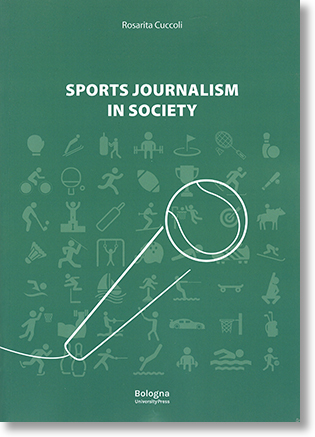
Sports Journalism in Society
189 pages, paperback
Bologna: Bologna University Press 2025
ISBN 979-12-5477-541-7
By now, it is no secret that sport and mass media have a symbiotic relationship; the fact that sport provides media corporations with a product to disseminate, generating sponsorship and advertising revenue in the process, while press coverage aids in a sport’s publicity and promotion, is often cited among sport and mass communication researchers. The same applies to the inherent connection between sport and society—the academic community has written extensively on these two ideals, noting that they do not exist independently but instead continuously change with their environment. Simply put, scholars have justified the academic paradigm of sports journalism inquiry because of this correlation.
However, what Rosarita Cuccoli brings to the forefront in her latest book, Sports Journalism in Society, is the role of “fringe” topics in modern sports media and how the inclusion of sport sociology themes in journalistic content can reinforce the perception that sports reporting remains legitimate and credible—even in a click-driven society. Combining historical and contemporary perspectives with a thorough review of literature sets this work apart from other academic books focused on the role of modern sports journalism in the Western world. Unlike Bradshaw and Minogue (2019) or McEnnis (2021), whose books both delve into the disruption and implications of sports media in the digital age, Cuccoli frames her work around a distinct social dimension matrix of sport sociology uniquely created for this book (more on that below).
Instead, the book seeks to “provide tools rather than prescriptions”, and it does so successfully, offering journalists and journalism scholars a framework for deciding how sports journalism and sport sociology should further intersect moving forward.
In doing so, she acknowledges that sport is guided by ongoing economic factors and is broadly positioned as both a form of entertainment and a distraction for participants and spectators alike. Whereas an abundance of sports and sport-related subjects exist, all of which arguably warrant journalistic attention, mainstream news outlets have traditionally been fixated on what is deemed popular at the time—regardless if a focus on the trendy balances breaking news with sociologically motivated angles. Cuccoli, a professor at the University of Verona in Italy, spends the latter half of the introductory chapter reasoning why professional sports media should cast a wider net in terms of editorial output. This, it is reasoned, would divert journalistic emphasis away from the trivial nature of player statistics and/or game outcomes and toward a broader reflection of the sociological issues that manifest within sport.
In Chapter 1, Cuccoli proposes the aforementioned framework for classifying topics and subtopics at the intersection of sport sociology and sports journalism. These social dimensions, as she calls them, shape fundamental understanding of social analysis of mediated sport—that is, how the framing of sport by media gatekeepers connects to larger social, cultural, or political influences. To create this one-of-a-kind matrix of “analytical categories for social analysis in the media coverage of sport,” Cuccoli first made note of the most recurrent topics from 14 different textbooks dedicated to sport sociology (of note, 12 of these textbooks were published or revised since 2010, with the other two considered “classics” in the field; p. 32, 34). This resulted in 21 distinct thematic topics, ranging from “deviance” and “disability” to “race,” “religion,” and “violence.”
She then expanded the matrix’s framework by incorporating concepts from the White Paper on Sport, a European Union proposal that outlines the innate contributions of sport to citizens and EU policies. Combining themes from the White Paper on Sport with those already compiled from the textbook survey resulted in 21 total topics and 131 subtopics, creating what Cuccoli labels as “the largest possible range of socially relevant issues which could in principle be of interest for media coverage” (p. 34). Topics ranged from things such as “sport and/for charity” and “sport and/for gambling” to “sport and/or illegal equipment” and “sport and/for volunteering” (p. 34-38); subtopics encompassed items like “banned drugs,” “elite migrant athletes,” “exploitation of underage players,” and “availability of sport facilities” (p. 35, 37-38).

Chapters 2, 3, and 4 cover important concepts like “The sports-media convergence,” “The role of a sports journalist,” and “Sports journalism as literature for the people.” The social dimension of sport matrix then gets put to the test in Chapter 5 via a content analysis of Italian newspaper coverage spanning September 2018 to April 2020; six total newspapers (three general interest and three sport-specific) based in Italy were selected as this study’s basis since the coexistence of multiple print outlets of this caliber, each with a national reach, is atypical within the global media ecosystem).
Results from the more than 6,500 news pages examined, which were qualitatively coded using grounded theory, advance the following: (a) general interest and sports newspapers often fail to cover the same topics (i.e., corruption, gambling, illegal equipment, labor rights, etc.); (b) the social analysis dimension is typically more visible in the general press; (c) social analysis of sport is generally found outside the sports section in the general press; (d) general interest newspapers tend to publish social analysis of sport in either the news or features sections; (e) no real difference exists between the sport-specific press and general press in non-neutral periods; (f) sports newspapers are more interested in inspirational feature stories on athletes; and (g) the sports press is not concerned with issues such as fitness, nutrition, etc.
Sports Journalism in Society effectively balances theoretical and practical concepts, like gatekeeping, public journalism, and corporate social responsibility, with real-world applicability, positioning this book for industry professionals and sports media researchers. Although most other academic books centered on a similar topic usually cater to one group or the other, Cuccoli provides something for both audiences. The overall goal, she writes, is not to tell sports journalists how to do their job—nor is it to redefine the attributes of quality sports journalism for the academic community. Instead, the book seeks to “provide tools rather than prescriptions” (p. 13), and it does so successfully, offering journalists and journalism scholars a framework for deciding how sports journalism and sport sociology should further intersect moving forward.
For industry professionals, this translates to becoming more aware of how the various social dimension matrix themes can be embedded in standard sports coverage, and the possible upside of a reporter and/or news outlet carving a social analysis of sport editorial niche. For academics, the value lies in using the social dimension matrix as a starting point to further study how sport-specific and general interest newspapers in other countries cover the convergence of sport and social issues.
As Cuccoli notes, “The power to select news is enough to make a journalist a catalyst for social change” (p. 19). In a way, this statement has never been more relevant. Since today’s news climate is marked by economic instability and shrinking public trust, it is even more important for journalistic gatekeepers to heighten credibility and legitimacy by producing social analysis-based sports journalism to better drive conversation toward these issues. This, the book contends, would satisfy the needs of all parties, placing more eyes on the journalists’ unique content while also strengthening the attractiveness of a newspaper’s sports section to advertisers.
She did not have to develop her own set of sociologically driven themes and subthemes; Cuccoli could have easily relied on the work of others by using a pre-existing framework to ground her study. However, the fact that she brought this distinct social dimension matrix to the forefront speaks to the unequivocal value that Sports Journalism in Society adds to the growing body of literature on modern sports journalism norms and routines.
Copyright © Nicholas R. Buzzelli 2025