Steph Doehler
The Open University, UK
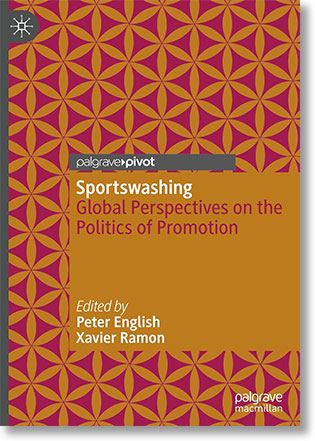
Sportswashing: Global Perspectives on the Politics of Promotion
169 pages, hardcover
Cham, CH: Palgrave Macmillan 2026 (Palgrave Pivot)
ISBN 978-3-032-17291-4
The relationship between sport and politics is hardly a new phenomenon. Yet, the growing involvement of nation-states in the commercial structures of global sport has brought renewed attention to this relationship, particularly through the increasingly prominent concept of sportswashing. Edited by Peter English and Xavier Ramon, Sportswashing: Global Perspectives on the Politics of Promotion is a timely addition to this developing field of scholarship. Drawing on international perspectives across a range of sporting contexts, the collection explores how sport is used for political and reputational purposes, while challenging some of the assumptions that shape contemporary understandings of sportswashing.
One of the book’s strengths is its recognition that sportswashing is neither straightforward nor universally understood. Although commonly associated with authoritarian states seeking to divert attention from human rights abuses, the chapters demonstrate that the relationship between sport, political legitimacy and national reputation is considerably more complicated. The collection encourages readers to think critically about who determines what constitutes sportswashing, whose interests such definitions serve, and how these practices are understood across different political and cultural contexts. This conceptual tension is particularly evident in David Rowe’s chapter, which challenges the tendency of Western liberal democracies to position sportswashing as a practice associated primarily with politically illiberal states. Rowe argues that such distinctions risk overlooking the historical and contemporary ways in which Western nations have also used sport for political purposes. His discussion draws attention to the often-blurred distinction between sportswashing and sports diplomacy, particularly when comparable activities are interpreted differently depending on the political identity of those involved.
This conceptual tension is particularly evident in David Rowe’s chapter, which challenges the tendency of Western liberal democracies to position sportswashing as a practice associated primarily with politically illiberal states.
The significance of these competing interpretations is developed further through Mohammed Alghamdi’s examination of Saudi Arabia’s investment in international sport. By considering sportswashing alongside economic diversification, tourism development and domestic sporting ambitions, the chapter challenges explanations that view state investment exclusively as an exercise in reputational manipulation. This does not diminish legitimate concerns surrounding human rights, but it does acknowledge that political, economic and social motivations may coexist within the same sporting investment. Both chapters demonstrate the importance of recognising the different interests and motivations involved in sportswashing.
Another strength of the book is its attention to the role of sports media in shaping, challenging and potentially reproducing sportswashing narratives. Seeger and Nieland’s comparative analysis of German and Qatari coverage of the 2022 FIFA World Cup illustrates how the same event can generate markedly different interpretations. While Qatari reporting emphasised national achievement and infrastructure development, German coverage foregrounded concerns surrounding labour conditions, corruption and discrimination. Kirsten Frandsen’s examination of Danish public service broadcasters offers a different perspective, exploring the difficulties of balancing critical scrutiny with conventional sports coverage.
These chapters highlight the importance of understanding sportswashing as a communicative process, shaped by the media environments in which sporting events are presented and discussed. The responsibilities of sports journalists are explored further by Rojas-Torrijos and Barbero, whose examination of Spanish journalists covering LIV Golf considers the expectation that reporters should concentrate on sporting performance instead of the political circumstances surrounding a competition. This invites consideration of whether established conventions of sports journalism might inadvertently contribute to the normalisation of controversial sporting investments. Although the collection demonstrates the significance of media framing, there is scope for further exploration of how audiences interpret, negotiate or reject these narratives. Understanding how media coverage is received, as well as produced, would add another dimension to the discussion.
The book also examines the institutional and commercial structures through which sportswashing operates. Christopher D. Tulloch’s chapter on Premier League football considers how state-linked investment becomes embedded within the identities and expectations of clubs and supporters. Of particular interest is the suggestion that sporting success may influence supporters’ moral positions, exposing tensions between political concerns and emotional attachments to sporting institutions. Alice Němcová Tejkalová’s discussion of the Olympic Games turns attention to the responsibilities of international governing bodies, especially when claims of political neutrality sit uneasily alongside decisions with significant political consequences. Horky and Schöber extend this discussion into the developing world of esports, examining Saudi Arabia’s involvement and the changing political and commercial interests associated with this sector.
Damion Sturm’s examination of Formula One in the Middle East introduces an additional dimension through its consideration of environmental concerns. By identifying connections between sportswashing and greenwashing, the chapter broadens the discussion beyond human rights and political legitimacy. It also draws attention to the ways in which the commercial interests of sporting organisations intersect with wider debates surrounding sustainability and corporate responsibility.

One of the most interesting contributions comes from Luke Bird and Toni Bruce, whose examination of resistance to Visit Saudi’s proposed sponsorship of the 2023 FIFA Women’s World Cup shifts the focus towards the possibility that sportswashing strategies can fail. Their analysis of opposition from athletes, sporting organisations and other stakeholders challenges the assumption that financial investment will necessarily deliver reputational benefits. The chapter also positions athletes as political actors with the capacity to challenge powerful institutions. The gendered dimensions of this resistance are especially significant, highlighting how athletes can use their visibility and influence to contest the political and commercial arrangements surrounding sport.
This is an area that deserves greater attention, particularly in understanding whose voices are heard, whose concerns are taken seriously, and the circumstances in which resistance can bring about meaningful change. A stronger focus on these dynamics across the book would have added further depth to its examination of power and political influence.
For all its strengths, the collection leaves an important conceptual issue unresolved. The range of perspectives is welcome, but it also exposes the difficulty of establishing clear boundaries around sportswashing as an analytical concept. If the term encompasses activities ranging from international diplomacy and commercial sponsorship to domestic sports development, what distinguishes it from other forms of political communication? More importantly, what criteria allow scholars to identify sportswashing without relying primarily on assumptions about the political legitimacy of particular states? This is not necessarily a weakness of the individual chapters, but it does highlight an ongoing challenge for researchers working in this area. Without greater conceptual precision, there is a danger that sportswashing becomes an overly broad label, applied according to political perspectives as much as identifiable practices.
A related limitation concerns the book’s geographical emphasis. Despite its global framing, much of the discussion centres on the Middle East, particularly Saudi Arabia and Qatar. This focus is understandable given the prominence of these states in contemporary debates, although it sits somewhat uneasily alongside Rowe’s critique of Western exceptionalism.
More sustained comparisons with Western states and institutions would have helped develop this argument and offered a broader understanding of how similar practices are interpreted across different political settings. Such comparisons could also help establish whether sportswashing is best understood through the activities themselves or through the political and cultural contexts in which they are judged.
Overall, Sportswashing: Global Perspectives on the Politics of Promotion offers an engaging and relevant examination of a subject that continues to attract growing academic and public attention. Its strength lies in demonstrating the complicated relationships between political interests, commercial investment, media representation and sporting institutions, while challenging narrow interpretations of sportswashing. The book will be of particular interest to scholars working in sport sociology, sport communication, media studies and the politics of sport. Its greatest contribution may be the questions it raises rather than the answers it provides. As sport becomes increasingly intertwined with commercial and political interests, greater conceptual clarity, geographical reflexivity and attention to resistance will be essential. This collection provides a useful foundation for those conversations.
Copyright © Steph Doehler 2026