Alexis Sossa
Society and Health Research Centre, Universidad Mayor, Chile
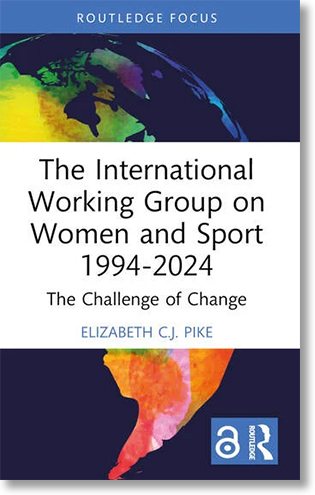
The International Working Group on Women and Sport 1994-2024: The Challenge of Change
99 pages, paperback
Abingdon, Oxon: Routledge 2025 (Women, Sport and Physical Activity)
ISBN 978-1-032-41220-7
Elizabeth C.J. Pike’s The International Working Group on Women and Sport 1994–2024: The Challenge of Change offers a timely historical examination of the most extensive network dedicated to advancing gender equity within physical culture. Situated at the intersection of sports governance, political sociology, and transnational feminist mobilisation, the volume charts the institutional evolution of the International Working Group on Women and Sport (IWG). However, while the text successfully maps the bureaucratic trajectory of this movement, its reliance on executive-level discourse inadvertently reveals the persistent theoretical tensions between elite policy formulation and grassroots feminist praxis.
Pike, herself a figure within the international women-and-sport movement, produces a work that functions simultaneously as an institutional archive and a historical account of the organisation’s development. The book traces the development of IWG across three decades of profound geopolitical and socio-cultural transformation, situating its evolution within shifting global regimes of governance, communication, and feminist politics. Consequently, the text delineates the complex dialectic between formal, structurally conservative sport governance architectures and the broader, often contentious discourse surrounding transnational human rights advocacy.
Methodologically, Pike constructs her historical narrative through a series of first-hand interviews with co-chairs and secretaries general from successive IWG Secretariats. This approach provides valuable insight into the organisation’s internal decision-making processes, strategic priorities, and governance challenges. At the same time, the reliance on executive-level perspectives inevitably shapes the scope of the analysis. While the volume offers a detailed account of institutional development, it provides comparatively less attention to how the organisation’s initiatives were experienced or contested by athletes, activists, and other stakeholders beyond leadership positions.
Across these successive leadership periods, several recurring themes emerge, including the tension between institutionalisation and activist flexibility, the challenge of maintaining financial sustainability, the uneven distribution of influence across regions, and the persistent gap between policy commitments and tangible outcomes.
To contextualise the establishment of the IWG in 1994, Pike situates its emergence within a period of significant geopolitical and social transformation. The early 1990s were characterised by post-Cold War restructuring, expanding transnational networks, and growing international attention to gender equality. Against this backdrop, the book highlights the persistence of gender disparities within sport governance and the challenges faced by those seeking to promote institutional change. This contextual framing helps explain both the urgency of the IWG’s creation and the obstacles it encountered in advancing its objectives within established sporting structures.
The volume is organised into ten chapters, with Chapters 2–9 forming its chronological core. Structured around the succession of Secretariats that led the IWG between 1994 and 2024, Pike traces the organisation’s evolving approaches to advancing gender equality in sport through policy advocacy, international networking, engagement with multilateral institutions, and the development of key governance instruments, most notably the Brighton Declaration and its subsequent iterations. Across these successive leadership periods, several recurring themes emerge, including the tension between institutionalisation and activist flexibility, the challenge of maintaining financial sustainability, the uneven distribution of influence across regions, and the persistent gap between policy commitments and tangible outcomes. While each Secretariat navigated unique political, cultural, organisational, and epidemiological contexts, including disruptions caused by the COVID-19 pandemic, the overarching narrative underscores both the IWG’s institutional resilience and the persistent structural constraints that shape transnational feminist sport governance.
Methodological Reflections and Critical Appraisal
The reliance on elite, first-hand interviews provides a detailed account of institutional decision-making, financial constraints, and organisational tensions. However, this methodological approach privileges executive perspectives, limiting analytical distance and constraining the ability to assess grassroots impact. As a result, the narrative reproduces self-referential accounts of success that are not systematically corroborated through independent evaluation.
While the volume’s commemorative purpose is understandable given its historical focus and institutional origins, this orientation inevitably shapes the scope of the analysis. The book is primarily concerned with documenting organisational development, leadership transitions, and policy initiatives rather than providing a systematic assessment of their broader social consequences. Readers seeking detailed accounts of athletes’ experiences, grassroots activism, or the lived effects of policy interventions may therefore find these dimensions comparatively underdeveloped. Nevertheless, as an institutional history, the volume provides a detailed account of the strategic and organisational challenges involved in sustaining a global advocacy network over three decades.
A further limitation concerns the book’s epistemic orientation. Although Pike presents the IWG as a global movement, the narrative remains predominantly framed through institutional logics rooted in the Global North, particularly those associated with Commonwealth governance traditions. While dedicated chapters examine the Secretariats hosted by Namibia (1994–1998) and Botswana (2014–2018), a critical reading suggests that relocating administrative leadership to African contexts did not fundamentally alter the movement’s underlying governance assumptions. The organisational structures, funding arrangements, and policy frameworks documented throughout the text continue to reflect priorities and institutional practices largely shaped by Northern actors and agendas. As a result, the geographical expansion of the IWG into the Global South, and especially Latin America, appears to have been accompanied by a more limited epistemic transformation. The volume, therefore, raises important questions about the extent to which transnational women-and-sport governance can move beyond Western-centric frameworks and accommodate alternative forms of knowledge, leadership, and policy development emerging from the Global South.
Theoretical Contribution and Organisational Tensions
A key theoretical insight emerging from the volume is the persistent tension between the IWG’s identity as a flexible, rotating network and the functional demands of institutional permanence. The original decision to avoid formal constitutional structures reflected a feminist critique of bureaucratic hierarchy. However, as the empirical trajectory demonstrates, this organisational fluidity generates recurring administrative inefficiencies, including loss of institutional memory, funding discontinuities, and logistical instability during Secretariat transitions.
Moreover, the contemporary global governance landscape has become increasingly fragmented, with multiple competing gender equality frameworks emerging across sport. This proliferation raises questions about the IWG’s distinctiveness and long-term relevance. The proposal advanced in the conclusion, combining a permanent administrative Secretariat with rotating conference locations, appears to offer a plausible resolution to these structural tensions.
Concluding Remarks
Beyond its value as a historical record, the book makes a broader contribution to debates on transnational governance, feminist institutionalism, and policy change in sport. The IWG provides an illuminating case for examining how advocacy networks seek to influence global agendas while navigating tensions among activism, bureaucratisation, and organisational survival. In this respect, Pike’s analysis extends beyond sport itself and offers insights relevant to scholars of social movements, international organisations, gender policy, and governance studies. The volume, therefore, represents an empirical resource for researchers interested in the institutional dynamics through which normative commitments are translated into policy frameworks and organisational practice.
Similarly, the volume captures a movement in transition, from advocacy-based norm-setting towards more structurally embedded and financially accountable governance models. It offers a foundation for future research into the institutionalisation of feminist sport governance and the complex relationship between global advocacy and measurable social change.
Copyright © Alexis Sossa 2026