Mayte Ortiz Romero
Nord University, Bodø, Norway
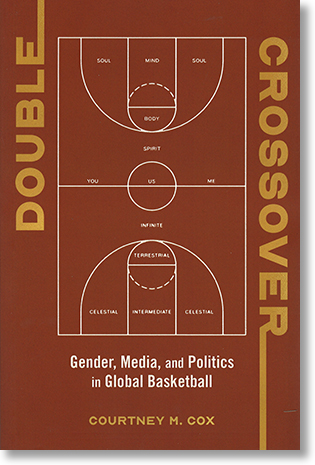
Double Crossover: Gender, Media, and Politics in Global Basketball
216 pages, paperback
Urbana and Chicago, IL: University of Illinois Press 2025 (Studies in Sports Media)
ISBN 978-0-252-08868-1
The publication of Double Crossover comes at a moment when women’s basketball, particularly in the United States, has gained unprecedented visibility, media attention, and cultural relevance. From record-breaking viewership in collegiate competitions to increased public discourse around pay equity and athlete activism, the sport has become a key site for examining broader social inequalities. Within this context, Cox’s book offers a timely and necessary intervention in debates on gender, race, labour, and representation.
The book is structured in a way that mirrors the game itself: four ‘quarters’, preceded by a ‘pregame’ and followed by ‘overtime’. This organizational choice is not merely aesthetic; rather, it reinforces the analytical framework of basketball while connecting and guiding the reader through distinct but interconnected thematic segments. And this is, in my view, one of the book’s key strengths: instead of presenting isolated theories or stand-alone chapters, it unfolds as a sustained narrative thread.
As Cox explains in the opening pages, the notion of the ‘crossover’ serves as a central metaphor to capture how athletes navigate multiple constraints and transitions, both on and off the court:
I begin Double Crossover: Gender, Media, and Politics in Global Basketball with a footwork debate for three reasons: (1) it is a good reminder of how much sport changes and is changed by societal shifts and global labour; (2) it tangibly illustrates how athletes struggle to “get from one place to the other” both on and off the court; and (3) it is a key component of the crossover, a spectacular basketball move I use as a metaphor to describe how women and nonbinary athletes manoeuvre through a sporting industry not designed with them in mind. (p. 3)
If I were to highlight the aspects of the book that are particularly valuable, I would focus on the following:
First, the theme of care in the opening quarter, where the author foregrounds care as an ethical and political practice. Here, Courtney challenges performance-centred understandings of sport, demonstrating how care work is integral to athletes’ labour.
Some scholars argue that for these athletes, the care work involved with children in the bubble represents yet another disparity between the NBA and WNBA. (p. 34)
Second, the book’s attention to the transnational and precarious nature of women’s basketball careers in the second quarter. Cox shows how athletes navigate structural economic constraints by pursuing opportunities abroad, a process she conceptualizes, following Seungbum Lee words, as ‘unorthodox sport labour migration’ (p. 66). Particularly compelling is her use of the notion of ‘translation’ in this chapter: drawing on this concept, she captures the cultural, social and professional negotiations required in these contexts, emphasising both the ingenuity and the vulnerability of athletes operating within systems marked by instability, surveillance, and uneven recognition.
This methodological and stylistic choice gives the work a distinctive voice and reinforces storytelling as a form of knowledge production. For me, this approach strengthens the impact of the book, while the inclusion of visual materials further enhances the analysis by situating these narratives in concrete contexts.
Third, I particularly appreciated how Cox engages with key concepts and contemporary debates in the last quarters. One of these is her use of the term ‘gender-bland sexism’ (p. 115), which refers to subtle, ostensibly progressive dynamics that obscure persistent structural disparities, an issue that is increasingly visible in contemporary media coverage of women athletes. Another is her engagement with queer inequalities, a theme that runs throughout the book. Alongside these, her discussion of misogynoir is especially compelling, revealing how increased attention does not eliminate marginalisation, but rather reshapes the conditions under which it operates, while also opening space for resistance and greater visibility.
In general, the book offers a nuanced and layered analysis of gender from a labour-sport perspective, focussing on the inequalities and struggles experienced by Black women, not only in society (discrimination, homophobia, criticism of their body and appearance …), but also as workers within this sports-labour context. In doing so, the book makes a valuable conceptual contribution by consistently framing sport as work, a dimension that is often overlooked. It reminds us that behind the figure of the athlete, there is a worker, raising critical questions about rights, opportunities, and the value of their time and effort.

In terms of style, the author departs from conventional academic writing and instead adopts a more narrative and affective tone, enriched by the use of multiple metaphors that give the book a distinctive character (for example, the ‘crossover’ or the metaphor of “translation” in the second quarter). Although still engaging with academic content, theories, and carefully grounded in scholarly literature, she also incorporates reflections and personal experiences as well as athletes’ testimonies, allowing the reader to engage more directly with the feelings and issues described and constructing a narrative grounded in lived experience. This methodological and stylistic choice gives the work a distinctive voice and reinforces storytelling as a form of knowledge production. For me, this approach strengthens the impact of the book, while the inclusion of visual materials further enhances the analysis by situating these narratives in concrete contexts.
Methodologically, the book is equally strong. Cox employs a multimethod approach that combines interviews, participant observation, often following athletes across different countries (for example, Russia and France) and over time in order to trace their sporting trajectories, and media analysis, including the documentary 114, among other sources.
That said, the book would benefit from a more in-depth analysis of the experiences of nonbinary women, since although queer and nonbinary issues are consistently referenced throughout, the analysis in this area feels less developed in comparison to the other two axes (gender and race). I found myself missing a greater degree of analytical depth in their specific conditions.
To sum up, Double Crossover stands out as a thoughtful and engaging contribution to sport studies, particularly in its intersectional analysis of race, gender, identity, and labour. The book would be particularly interesting for students and scholars in sport, media, gender studies, and sociology. At the same time, its accessible style also makes it valuable for practitioners, as well as for readers more generally interested in questions of gender inequality and representation in sport.
After reading this book, I have gained a deeper understanding, not only about their inequalities and challenges, but also about the informal support networks among Black women athletes. These networks and their activism, as forms of both collective struggle and mutual support, persists despite the restrictions and regulations imposed by institutions and societal systems, and despite the presence of misogyny, homophobia, and racism. In other words, the book succeeds in opening important avenues for reflection on the conditions under which women athletes live and work, as well as the forms of resistance they collectively promote.
Copyright © Mayte Ortiz Romero 2026