Klara Boije af Gennäs
Department of Sport Sciences, Malmö University
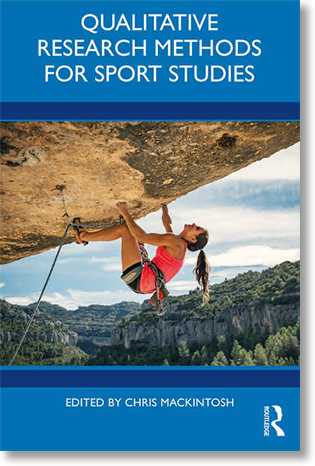
Qualitative Research Methods for Sport Studies
381 pages, paperback
Abingdon, Oxon: Routledge 2026
ISBN 978-1-03-277724-5
As I am currently nearing the end of my own PhD journey, I realise that there is still so much to discover and learn. Methods and methodology are subjects that I genuinely enjoy reading about. Therefore, when I was asked to review a new book on sport science research methods, I could only say yes.
The title of the book is Qualitative Research Methods for Sport Studies, edited by Chris Mackintosh. It is a research methods book that guides researchers through qualitative methodologies and is particularly aimed at sport science scholars. The book was first published by Routledge in 2026. It spans 353 pages, contains 23 chapters, and divided into five parts:
- Introducing Qualitative Research
- Before Entering the Field
- Doing Fieldwork: Research Methods and Researcher Stories
- Methods of Qualitative Data Analysis
- Mapping and Navigating Your Qualitative Research Methodological Journey
The editor describes the book as being grounded in principles that embody themes of ethics, intersectionality, positionality, and empowerment within the fields of sport and social justice (p. xxi). In short, the aim of the book is to demonstrate that the qualitative methodological journey is iterative rather than linear. Summarised, the book aims to:
- outline, explain, and provide insight into core methodological approaches;
- support the transition from learning in the classroom to conducting research in the field;
- explore and outline key approaches to qualitative data analysis; and
- emphasise that qualitative research is a craft learned through practice, reflection, and engagement within scholarly communities.
By the end of the opening chapters, I had even laughed quietly to myself several times. I mean, you must be quite nerdy to be amused by a methods book, yet this one is written in a way that genuinely engages the reader.
After reading the “Introduction” and the second chapter “Knowing Stuff about Things That Matter”, I was intrigued. By the end of the opening chapters, I had even laughed quietly to myself several times. I mean, you must be quite nerdy to be amused by a methods book, yet this one is written in a way that genuinely engages the reader. I also believe that the authors’ approach to ontology and the question of how we come to know things that matter invites readers to relate to the content throughout the book. The authors have managed to transform what can sometimes be a very dry subject into something engaging by giving academic readers something to connect with. Their own experiences are intertwined with scientific theory, putting abstract concepts into practice in chapters on participatory action research, one-to-one interviews, group interviews, and participant observation. Further, the chapters on “Online Methods”, “Visual Methods”, and an Introduction to “Digital Storytelling” are particularly valuable. These are highly relevant topics that deserve attention and inclusion in a methods book in today’s increasingly digitized society. Methods such as these are likely to become even more prominent in future qualitative research practice. Bringing these approaches into the traditional sport science methodological toolbox is a timely and important contribution by the authors.
The authors share perspectives as PhD researchers, supervisors, and established scholars. This diversity of viewpoints strengthens the reader’s understanding of the work that researchers undertake before entering the field and during the research process itself. The book also includes practical guidance on choosing, doing and understanding qualitative data analysis, including narrative analysis, thematic analysis, grounded theory and interpretative phenomenological analysis. It draws on established methodological literature while also introducing readers to newer developments and contemporary discussions within the field. The fifth part of the book focuses on helping researchers navigate their methodological journeys and reflect on the decisions, challenges, and opportunities that emerge throughout the research process. The chapter “Getting Your Head Around Theory” particularly encourages reflection on how researchers’ backgrounds, positionalities, and prior experiences shape the research process.

The book also contributes to a culture of openness and knowledge-sharing by highlighting the value of learning through others’ experiences. It succeeds in delivering a researcher narrative-led approach through chapter-by-chapter “vignettes from the field” written by undergraduate students, postgraduate researchers, experienced qualitative scholars, and internationally recognised professors. These contributions provide readers with authentic insights into the realities of qualitative research and help bridge the gap between methodological theory and research practice.
At a time when technological development and the use of artificial intelligence are advancing at an unprecedented pace, this book provides something that cannot easily be replicated through prompt-generated and fragmented information alone: shared experiences, practical wisdom, and reflections drawn from real research practice. In doing so, it demonstrates that research methods are not simply a matter of following a sequence of tasks but rather an intellectual, relational, and embodied undertaking.
In conclusion, the authors successfully achieve the aims set out at the beginning of the book. While the breadth of topics covered is one of the book’s greatest strengths, some readers may find that certain methodological approaches are necessarily introduced only briefly. These readers will naturally need to continue exploring these methods through additional literature. The authors make this easy by providing suggestions for further reading in every chapter. Each chapter is also supported by in-text references and a comprehensive reference list, providing readers with a strong starting point to delve deeper into topics of interest. Therefore, this book serves as both an accessible introduction and a valuable companion throughout the research process.
I would recommend this book to PhD students regardless of where they are in their doctoral journey. Whether you are just starting out or approaching the final stages of your PhD, there is something valuable to gain from reading it. I am not familiar with how doctoral training is organised internationally. However, in Sweden, many PhD students take courses in qualitative methods even if they do not ultimately use qualitative approaches in their dissertations. In either case, I would strongly recommend this book. However, I would be more hesitant to recommend it to undergraduate students who are just beginning to engage with research methods, as the breadth of perspectives and methodological discussions may feel somewhat overwhelming at that stage.
I hope this review has helped you navigate the vast landscape of methodological literature and brought you one step closer to finding your own path. In Qualitative Research Methods for Sport Studies, qualitative methods are presented through engaging stories in a way that is both well-informed and pedagogical, while also incorporating personal reflections and experiences. I would like to thank the authors for their valuable contribution to the qualitative methods literature and for providing guidance to both future researchers and established scholars.
Copyright © Klara Boije af Gennäs 2026