Mayte Ortiz-Romero
Nord University, Bodø, Norway
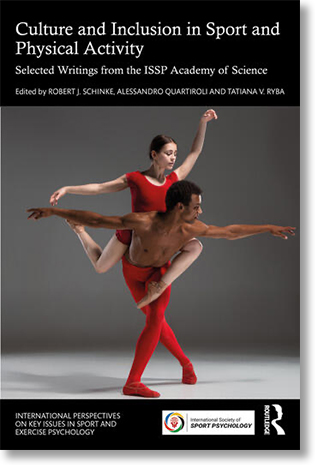
Culture and Inclusion in Sport and Physical Activity: Selected Writings from the ISSP Academy of Science
359 pages, paperback
Abingdon, Oxon: Routledge 2026 (International Perspectives on Key Issues in Sport and Exercise Psychology)
ISBN 978-1-032-93469-3
Culture and Inclusion in Sport and Physical Activity offers a journey through the broad field of cultural sport psychology (CSP). The book acknowledges leading pioneers in the field, including Leslee Fisher and Kerry McGannon among others, while also addressing important topics such as how culture influences career development, perceptions of inclusion regarding gender and sexual diversity, as well as behaviours and rituals, with contributions from authors across five continents. As the editors explain in the introduction, the book aims to connect scientists, practitioners, and professionals through the study of both differences and commonalities in sport and psychology.
Sport and exercise psychology then must become a medium through which to reach shared understanding within our global community. Athletes and sport, exercise, and performance professionals alike must seek to be understood in terms of their stories, the myriad identities each person holds, and how these inform our own and one another’s epistemological underpinnings. (p. 3)
The book is structured so that readers can move from more general and conceptual ideas in the first part to empirical contributions in the second. This structure gives audiences the opportunity to become familiar with CSP and related concepts, such as the ethics of difference, social justice, transnationalism, cross-cultural experiences, and alternative sport experiences, and then move towards more specific cases, for instance, gender differences in different contexts, superstitious behaviours among student-athletes, as well as migration and meaning.
That said, there were several aspects of the book that I found particularly interesting.
This is one of the strengths of approaching sport psychology from a cultural perspective: issues that may appear universal can also have very different meanings and consequences in different contexts.
First, I especially appreciated the attention given to intersectionality from the beginning of the book and the explanation of why intersectional research matters. Although the book focuses specifically on CSP, this approach can also help us better understand perspectives, behaviours, and experiences in other areas. It is therefore relevant not only to cultural and psychological research, but also to other fields such as education and sociology, particularly when the research involves human participants and communities:
The conceptual fallacy of implicitly locating the normative athlete as white, male, heterosexual, able-bodied, and often economically privileged, has been problematised by critical scholars in sport psychology and related fields, who highlight that non-intersectional inclusion efforts tend to privilege those least marginalised, leaving many members of the group excluded (…) Recognising the multiplicity of interconnected identities and systems of oppression, Crenshaw (1989) argued that intersectional analysis should be incorporated into feminist knowledge production. Similarly, because athlete subjectivity is fluid, an intersectional perspective allows for a more nuanced psychological analysis and critique of power relations, recognising how different axes of identity such as race, gender, sexuality, and social class, intersect to create unique lived experiences. (p. 10)
This perspective is particularly valuable because it reminds readers that there is no single or universal experience of being an athlete. Identity is shaped by several factors at the same time, and these factors can influence people’s opportunities, experiences, and relationships with, and within, sport.
Second, I would like to highlight the book’s contribution to the discussion of gender and sexual diversity. Several chapters focus on these topics, discussing gender differences in relation to HIV-related psychological variables, women student-athletes’ dual-career struggles, sexist and homophobic attitudes towards men, and the emotional and behavioural experiences of elite women footballers dealing with injuries. At this point, it is interesting to reflect on how ideas of relevance, problems, and concerns can differ across national and cultural contexts. Gender-related challenges can be found across countries, but their forms and visibility may vary depending on the social and cultural context. This is one of the strengths of approaching sport psychology from a cultural perspective: issues that may appear universal can also have very different meanings and consequences in different contexts.

Third, another idea that I found interesting is that the ways athletes deal with psychological experiences, such as stress and anxiety, can also vary depending on culture. Superstitions and coping in sport are something I have never considered before reading Chapter 11. I therefore found this section particularly interesting.
Athletes use superstitions to maintain emotional stability and perform optimally in stressful situations. Malinowski (1948) proposed that superstitions help people cope with uncertain and uncontrollable conditions by providing a sense of control, which reduces anxiety. (p. 194)
This also raises questions about psychological support in sport. Providing appropriate psychological support could help athletes develop emotional-management skills and other strategies for dealing with stress and anxiety. In turn, this could potentially reduce the need to rely on superstitious behaviours as a way of managing difficult situations. Of course, this does not mean that superstitions should necessarily be understood as negative behaviours. Rather, understanding their psychological and cultural function may help practitioners better understand athletes and the strategies they use to cope with pressure.
In general, the book offers an interesting collection of studies and reflections on culture, inclusion, and sport psychology. The different chapters provide a good variety of topics, perspectives, and research approaches. Regarding the writing style, the book is generally well written and follows an academic style while remaining relatively concise and understandable. The same applies to the methodologies. The chapters use different methodological approaches, which reflects the diversity of research questions within CSP. In general, the methods are explained clearly enough for readers to understand how the studies were conducted and why particular approaches were selected. At the same time, the level of methodological detail varies between chapters, which is understandable given the different types of contributions included in the book.
That said, some critical points should also be mentioned. First, I found a possible inconsistency between the description offered in the introductory pages and the structure of the book. On page 3, the editors state that the book is divided into three sections, an opening section devoted to elite amateur and professional sport, a second section integrating scientific contributions focused on development and sport, and a third section focused on exercise and physical activity. However, as shown in the table of contents (see below) and throughout the book, there are two main parts: I. Conceptual Contributions and II. Empirical Contributions. Although this is a relatively minor issue, it was not completely clear to me what the reference to the three sections means. Second, I think Chapter 9, which focuses on the dual careers of women student-athletes, could have been further developed by including the issue of motherhood. Women who participate in sport and study may also work and have responsibilities related to motherhood. This invites reflection on how these different roles interact and how sport organisations and educational institutions can support athletes in this situation. What happens when an athlete combines sport, education, employment, and motherhood? How can we facilitate the emotional well-being of athletes who experience these multiple demands? Including this perspective could have further strengthened the chapter’s discussion of gender, dual careers, and inclusion.
To sum up, Culture and Inclusion in Sport and Physical Activity is an interesting collection of writings that encourages readers to consider how the different aspects of sport, from career opportunities to equity and inclusion, can be shaped by the cultural and social context in which we live. One of the main strengths of the book is its ability to show that what may appear to be universal experiences in sport can be understood differently depending on culture, identity, and social position. At the same time, the book highlights the possibility of finding common ground through an understanding of difference.
The book would be particularly valuable for scholars and students interested not only in cultural sport psychology, but also for researchers and practitioners working with diversity, inclusion, gender, identity, social justice, and cross-cultural issues in sport and physical activity. It may also be useful for readers who are not specialists in CSP but want to understand how cultural perspectives can contribute to a more inclusive approach to sport and exercise psychology.
Copyright © Mayte Ortiz-Romero 2026