Duncan R. Jamieson
Emeritus Professor, Ashland University
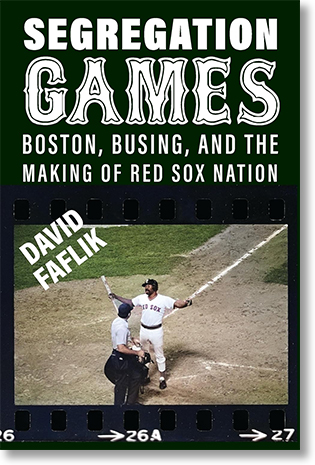
Segregation Games: Boston, Busing, and the Making of Red Sox Nation
192 pages, paperback, ill
Amherst, MA: University of Massachusetts Press 2026 (Sport for Social Change)
ISBN 978-1-62534-928-6
Any book that expands a reader’s knowledge and raises questions is, in my opinion, a good book. By this definition, Segregation Games, by David Faflik, Professor of English at the University of Rhode Island, is a very good book. He examines Boston, Massachusetts, in the mid-1970s when the city struggled with both de facto segregation in its public schools and the collapse of the Boston Red Sox’s hopes for a World Series victory. They won the first World Series, played in 1903 when their name was the Boston Americans, followed by eight more championships, offset by four losses, including one in 1975, which coincided with the federally mandated busing plan. With nine titles, Boston (American League, AL) is tied for third place with the Oakland Athletics (National League, NL) and the Los Angeles Dodgers (AL) for the most World Series wins.
Throughout the book, Faflik examines the meanings of the words “game” and “play,” as the two of them relate to the two crises in Boston regarding baseball and school busing. Before reading this I never thought of mandatory busing to reduce school segregation as either a game or play; to me this represents a classic oxymoron. As Faflik writes, “this book should be both an engaging and an uncomfortable read, since as a revisionist history, it reconceives the relationship between society, popular culture, and sport in disruptive ways” (126). Both the White city schools’ administration and the White front office of the Boston Red Sox sidestepped the issue of racism. “The idea of baseball’s being so closely tied to busing never really took hold in these years despite the many signs that this was the case” (9).
Two centuries later, during the potato famine in Ireland, Irish immigrants flocked to Boston looking to build new lives for themselves. Instead, they found NINA (no Irish need apply) signs hanging in store windows.
During the late 19th century, technology shortened the work week for many, creating more free- time for men to play baseball and fans to watch the games. As racism took increasing control in the United States, an 1887 “gentleman’s agreement” between team owners barred Black players. In response, Blacks established their own teams, forming the Negro Leagues. The segregation continued until 1947 when Jackie Robinson (1919-1972) joined the Brookly Dodgers. The Red Sox have the distinction to be the last major league team to have a Black player; it took twelve years before the Red Sox finally acquiesced when Pumpsie Green (1933-2019) joined the infield roster in 1959, playing for the team until 1962. Next to join, outfielder Reggie Smith (1945-) played for Red Sox from 1966 to 1973, followed by Tommy Harper (1940-) who played for the Red Sox from 1972 through 1974. The discrimination extended beyond the home field. When the players went to Winter Haven, Florida for spring training, the local Elks club put vouchers for free dinners at their lodge, only for the White players. When Harper asked Smith about the practice, well known to the Red Sox organization, “Smith responded to his inquiry with a smirk, pointing at the skin on his forearm” (48-49). After Harper’s playing days he returned to the Red Sox to help front office management diversify.
While Boston’s Black residents approach twenty percent of the city’s population, de facto segregation forced ninety percent of them into Roxbury, North Dorchester, the South End and Mattapan neighborhoods, all close to Fenway Park, the Red Sox home field. Though avid baseball fans, in the mid-1970s few Black Bostonians followed the Red Sox, neither attending the games in person nor watching them on television. Boston’s major newspapers are the Globe and the Herald, both with robust sports sections following the Red Sox. Founded in 1965, Boston’s Black newspaper, the weeklyBay State Banner, also has a sports section that covered baseball, but notably not the Red Sox. Perhaps an indication of the perverseness of racism in American society, Larry Whiteside (1937-2007) became the first African American sports columnist for a major newspaper when he joined the Boston Globe in 1973.
Racism, as we know it today, began in the 15th and 16th centuries during the Age of Exploration. Europeans bought or kidnaped Africans, taking them as slaves to the new world to work on the plantations created in North and South America. In 1619, twenty Africans were sold in Jamestown, Virginia colony, establishing slavery throughout the American colonies and later most of what became the United States until it “ended” after 246 years with the passage of the 13th amendment in 1865. Racism, however, continues to be endemic in American society, first with the establishment of de jure segregation (by force of law) in the South and de facto segregation (by custom) in the North. Though the modern civil rights movements in the 20th century dismantled much of the strictures of segregation, it maintains its hold throughout the United States, including Boston. As Faflik rightly points out, Black Red Sox players tend to live in the suburbs surrounding Boston which are not as bound by tradition.
Though founded in 1629 as a haven for Puritans persecuted in England, the city did not extend much of a welcome to others. When Quakers arrived in the 1640s and 1650s, they were banished. When some returned, they were hanged. Two centuries later, during the potato famine in Ireland, Irish immigrants flocked to Boston looking to build new lives for themselves. Instead, they found NINA (no Irish need apply) signs hanging in store windows. Being Catholic, to avoid discrimination in the public schools, overseen by Protestant school boards, they established their own parochial schools. Even though Boston was the eastern center for the abolitionist movement in the 19th century, not all Bostonians welcomed Blacks.
An early victory aimed at dismantling de jure segregation in the South came in the unanimous Brown v Board of Education Supreme Court decision in 1954, which struck down segregated schools. Though aimed at the South’s dual education system, Northern schools were no less segregated. I grew up in Hollis, in the borough of Queens, New York City. In the 1950s, Hollis was lily white, as was my elementary school. I attended Andrew Jackson High School which drew from a much larger geographic area; some students, mostly Black, lived far enough away to come by bus. Perhaps not segregated, most of them took the general rather than the academic track as I and my White friends, resulting in limited interaction between Whites and Blacks. With about four thousand students in attendance, Jackson had multiple entrances, with the Black students using one on the building’s southwest corner. Without much knowledge of race relations at that age, I left school using that set of doors, having to run the gauntlet of Blacks waiting for the buses to arrive. It was unpleasant enough that I remember it to this day, never using that door again.
Twenty years after the Brown decision, federal judge W. Arthur Garrity (1920-1999), ordered Boston’s public schools to desegregate, using busing to create racial balance. Faflik sees three parallels between busing and sports. First, how mandatory busing to force integration in the Boston city school system “influenced the ways people played and partook of baseball in 1970s Boston.” Second, “it redefines the very meaning of sports in relation to the weirdly ‘playful’ behaviors that locals engaged in throughout the busing crisis beyond the boundaries of Boston’s playgrounds and athletic facilities.” Playgrounds catered to either White of Black, with both knowing which ones to use. Third, Faflik examines “how baseball and busing together informed what it meant to be ’White’ or ‘Black’” in Boston (3). So, rather than a book about Boston’s busing crisis and the Red Sox, “It’s a story about how the cultures and place sustained the uneasy relationship between society and sport in Boston” (5).
Faflik has broadened the meaning of both “play” and “game” to describe the tumultuous mid-1970s fracas. While he has introduced an idea I’ve never thought of, I am not convinced that throwing rocks and other projectiles at school buses ferrying Black children to schools in White neighborhoods where they were not welcomed, or using baseball bats in fights to resist desegregation constitute either “play” or a “game.” In the 1995-1996 British sitcom, “The Thin Blue Line,” the police arrested a teenager for “tworking” (taking without consent).” Inspector Fowler reprimanded the constable for using the term, saying it is inappropriate to minimize the seriousness of the crime. He asked the question, “would you refer to grievous bodily harm as ‘fun punching?’”
It is fifty years since the busing crisis and many city schools remain “intensely segregated” with little racial mixing. Furthermore, the schools in White neighborhoods have more educational resources than those with a majority Black student body, a situation not unique to Boston. Faflik concludes “that reformers deployed a repurposed understanding of sports and ‘play’ not only to combat the tactics of popular protest adopted by antibusers, but also to promote desegregation through creative invention in nearly every aspect of social life in the Massachusetts capital” (132). The Red Sox franchise and its fans have come a long way, but like the nation as a whole, at this moment we seem to be moving in the wrong direction, based on the ideas presented in the Declaration of Independence. The “unalienable rights of life, liberty and the pursuit of happiness” are certainly not extended to all Americans. Read carefully, this is an interesting study of racism in the United States as it manifested itself in the mid-1970s Boston.
Copyright © Duncan R. Jamieson 2026