Gonzalo Serrano & Toby Miller
Instituto Tecnológico de Monterrey, Mexico
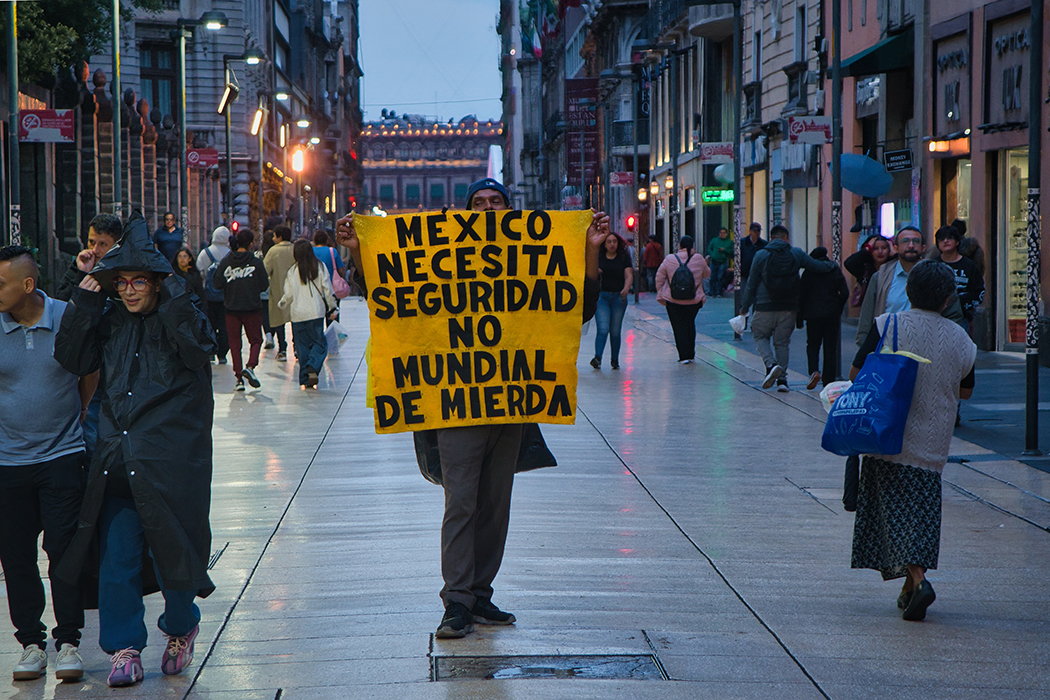
The 2026 men’s World Cup Finals are upon us, across the US, Mexico, and Canada. As the first nation to host three World Cups, (1970, 1986, and now) Mexicans have reason to feel happy and proud. Or do they?
FIFA selects host countries in exchange for guarantees they will provide “the best World Cup in history.” Far from coincidentally, that means extracting vast subvention from taxpayers. In the case of Mexico, the government announced it would remodel airports to qualify as ‘Aeropuertos FIFA.’ The capital has seen US$348 million invested in mass transit, an increase of 186% that is 12.5% beyond the norm for public works, at a time when infrastructural investment beyond fossil fuels is collapsing and public-sector interest payments soaring.
Along with the costs come numerous negative externalities in the three Cup sites. Guadalajara’s Primavera reserve is close to its Akron stadium and home to pumas, an almost extinct species, golden eagles, migratory birds, and deer. Wildlife and plant conservation and water resources are at severe risk due to Cup development and the presence of fifty thousand spectators and four thousand cars. Mexico City and Monterrey (also next to a key biological corridor) are subject to similar strains, notably the Azteca stadium’s misuse of water.
Massive public subvention and environmental destruction might seem worthwhile to everyday folk if tickets for matches were financially accessible to them, per 1970 and 1986. The reality is very different. One of the cheapest seats for the opening game between Mexico and South Africa on June 11 costs over US$6,500, according to prices published by FIFA’s hospitality operator, On Location. That’s about a third of the average annual income.
The numerical contrast is brutal: in 1970, workers on minimum wage could see Pelé lift the World Cup at the price of less than a day’s work: 30 pesos, equivalent to about 2 dollars at the time. In 1986, Mexican President Miguel de la Madrid successfully demanded popular prices for entry to the Azteca. Francisco Javier González’ El 86 explains that ‘the most expensive ticket was 50 dollars, and the other prices were 30 and 20 for most stadia. The Azteca offered entry for three to ten dollars, the latter only for national consumption.’
Current President Claudia Sheinbaum’s token act has been to hand over her entry pass on June 11 to an indigenous woman. She says the Cup should ‘serve to promote sport and open up opportunities for young people’; but they won’t have much opportunity to attend games, with Mexico holding just 13 of the tournament’s 104 matches, and at such high prices.
FIFA wants a VIP World Cup. Sponsors and other corporations are permitted to purchase blocks of tickets for clients and executive lizards, whose successes in governing the labor process will be rewarded by package deals with tour organizers—at the expense of ordinary people. If we adjust for inflation, tickets in general cost more than twice 2022 prices alone, and resale sites see seats at the Final going for as much as two million dollars.
Juan Villoro quotes an anonymous journalist saying: ‘The party is really organized by the United States. Canada brings the potatoes and Mexico the soft drinks.’ His judgment? Mexico is not ‘the host, but the bartender who offers a welcome Margarita cocktail.’
Copyright © Gonzalo Serrano & Toby Miller 2026