Jack Black
Loughborough University
 Every weekend, English football appears to die again. A goal is delayed by a VAR check, or a transfer fee passes another dizzying threshold. The verdict follows quickly from terraces, phone-ins, group chats, and social media… “The game’s gone!”
In fact, the phrase has become one of football’s most adaptable complaints. It can be delivered in earnest and then repeated as a joke a moment later. It accompanies frustration with ticket prices, inconvenient kick-off times, data-led punditry, sanitised stadium atmospheres, club ownership, and the administrative rituals of VAR (notably, in the case of VAR, there is often the sense that the replacement of human judgement with technology has diminished the spontaneity of error that once gave the game much of its character). Indeed, the flexibility of the phrase partly explains why it travels so easily. Insofar as every fresh irritation can be offered as proof of a much larger decline, we are left with a catalogue of irritations and frustrations about modern football, which, unfortunately, continues to grow. Such complains, however, condense a larger story.
That is, while VAR has changed how goals are awarded, just as broadcast scheduling and rising costs have changed the conditions under which supporters encounter their clubs, these transformations remain material. Where complaining continues to be a formative feature of watching football, one in which our dissatisfactions acquire their own form of enjoyment, it is often nostalgia which gathers these concerns into the relatively ambitious assertion that a whole way of life has disappeared. For many, this combination of criticism and attachment gives “the game’s gone” its affective force.
The past that modern football invented
In England, “modern football” usually names a cluster of changes associated with the early 1990s. With the Premier League separating from the Football League, and, in doing so, establishing a broadcast-led revenue model, stadiums were also reconstructed after the Taylor Report, and clubs expanded their sponsorship and hospitality as part of a global market. Whereas these developments improved safety and facilities, they also altered who could attend regularly and how clubs understood their supporters.
At moments of crisis, nostalgic loss can take on a paranoid form. If enjoyment has disappeared, someone must have taken it. Stolen, in the case of football, by owners, governing bodies, technology companies, or geopolitical actors.
As a result, supporters have repeatedly contested these changes. Campaigns against ownership decisions and commercial priorities travel through fanzines, supporter trusts, stadium protests, and digital platforms, with social media carrying shared grievances across established club rivalries. “The game’s gone” refrain works as a vernacular version of this critique. Helpfully short enough to circulate online but also emotionally capable of resisting any persuasion which seeks to offer evidence to counter its claims.
Though the imagined point before football’s corruption is difficult to locate, the “golden age” moves as each generation acquires its own story of decline. In doing so, the Premier League occupies a peculiar position, as it is simultaneously blamed for accelerating the commercial transformation of English football, while also remembered as a nostalgic object in its own right. The contradiction is visible in retro shirts and television packages built around heritage branding, which turn earlier forms of football culture into saleable images. Whereas the commercial game sells supporters a carefully edited memory of the world that such commercialisation is said to have destroyed, the meme-like circulation of the “game’s gone” phrase also makes it part of the entertainment culture it criticises. Readily repeated by broadcasters, brands, and content creators, a protest against football’s commodification subsequently becomes fresh material for football’s media economy.
What is often ignored is that pre-Premier League football contained its own forms of exclusion and exploitation. Stadium infrastructures were often poor, players lived under restrictive employment arrangements, racism shaped both participation and spectatorship, and disputes over money and ownership had accompanied the professional game from its beginnings. Despite the fact that, today, many supporters have indeed been priced out of the game, with clubs now operating as assets within international investment portfolios, unfortunately, English football has never offered the uninterrupted communal intimacy that the nostalgia of the “game’s gone” phrase affords it.
A past made whole by dissatisfaction
Jacques Lacan’s account of desire can help us to explain why an irrecoverable past can exert such a strong pull. In Lacanian psychoanalysis, the subject is organised around a constitutive lack; a gap that cannot be filled by obtaining the “right” object. Where the experience of lack encourages us to imagine a prior state of wholeness, such completion is always produced retrospectively, after the loss has been felt. Nostalgia gives this loss a place and a date, indeed, a footballbefore VAR, before the Premier League, or before clubs became global brands.
Consequently, nostalgic fantasies prove persuasive because they attach structural dissatisfaction to recognisable changes. In effect, VAR becomes the obstacle separating present-day spectators from their spontaneous enjoyment. If VAR was banned tomorrow, contentious refereeing would still continue, and the footballing world, pre-VAR, would remain irrecoverable. Instead, it is the assumed coherence of that world which is assembled through a dissatisfaction with the present. As a result, nostalgia persists because its object remains always out of reach, its persistence lying in the repeated act of longing, including the small enjoyment obtained from diagnosing each new offence against the game.
When loss becomes theft
At moments of crisis, nostalgic loss can take on a paranoid form. If enjoyment has disappeared, someone must have taken it. Stolen, in the case of football, by owners, governing bodies, technology companies, or geopolitical actors. In this regard, lack becomes organised around an external agent believed to possess or obstruct the enjoyment that properly belongs to us.
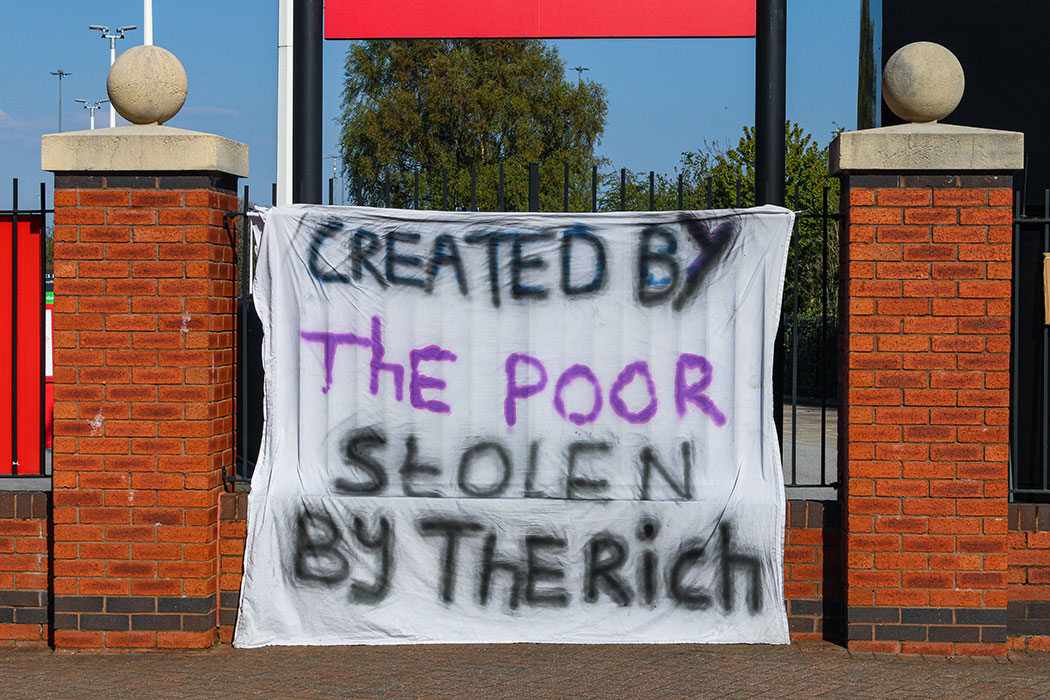
The proposed European Super League in 2021 provided an unusually clear object for this anger. Twelve wealthy clubs planned a competition that would protect its founders from ordinary sporting risk. Supporters responded with demonstrations and the widely shared slogan “created by the poor, stolen by the rich”. Yet, while the proposal posed a genuine threat to the principle of open competition, and coordinated opposition helped to force its rapid collapse, the episode also converted long-standing unease about commodification into collective action. Here, the language of theft provided such unease a certain ideological justification. Projecting meritocracy and a sense of local ownership onto an earlier football culture, which was already unequal and profit-oriented, diffuse historical tensions could acquire identifiable culprits and a recoverable object, “our game”. This simplification helped the protest gather force, even though defeating the Super League left the economic structure of elite football largely intact.
Whereas the fan-led review which followed recommended statutory oversight, and the Football Governance Act 2025 established an Independent Football Regulator, such regulatorily change can only ever address ownership practices and greater accountability. They cannot overcome the contradictions that shape the modern game.
Football’s contradictions
Today, for many supporters, most routes into elite football run through the commercial system they resent. Subscription television, branded merchandise, platform media, and stadium markets collectively shape a modern game which is both loved and hated in equal measure (and it is in this measure that our enjoyment for the game resides). Calling this simple hypocrisy overlooks the narrow terms on which participation is offered insofar as supporters can recognise their implication in the spectacle and continue to criticise it.
It is for this reason that the task remains for us to read “the game’s gone” refrain critically. Whereas the lost game promised by nostalgia cannot be recovered, its significance nonetheless belongs to the present act of remembering. What actual loss is being named and what demand follows from it? Though the grievances gathered by the phrase remain real, once separated from the promise of nostalgic restoration, they may also serve to support a more exacting politics of football ownership and supporter power. In this respect, the enduring force of “game’s gone” lies in the many ways it turns present dissatisfaction into a demand over what the game can become.
Copyright © Jack Black 2026