Angela Stănescu
Sport Research Institute, Universitat Autònoma de Barcelona
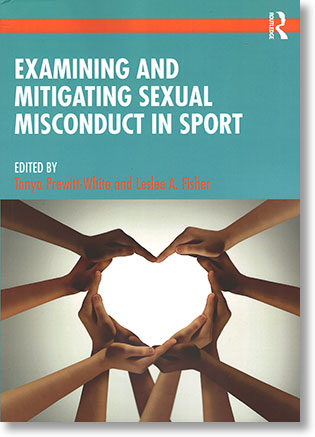
Examining and Mitigating Sexual Misconduct in Sport
222 pages, paperback
Abingdon, Oxon: Routledge 2022
ISBN 978-0-367-64703-2
In a context of increasing awareness of sexual abuse in our societies and sports in particular, this book is a significant contribution to researchers and safeguarding practitioners. Contributing to the increasing body of knowledge on sexual misconduct, this volume addresses safeguarding, ethical governance of sport, and athletes’ welfare. Edited by Tanya Prewitt-White and Leslee A. Fisher, this volume is presented as an invitation to sport stakeholders for an honest discussion of a topic that is often minimized or ignored. The purpose of the collection, as stated in the preface, is to inform and support sports stakeholders and organizations in their investment not only in examining and mitigating sexual misconduct, but also in healing any harm.
One of the major strengths of the book is the approach that considers sexual misconduct as embedded in broader sports cultures and specific structures of power. The editors highlight that sexual misconduct in sport is not the result of just the perpetrator’s wrongdoing, but a combination of power inequalities and cultures that create conditions where abuse can occur and remain hidden. Drawing on well-known incidents, such as the Larry Nassar case, the authors illustrate how abuse occurs at various levels of sports and demonstrate the devastating impact of sexual misconduct on not just the victims but also the sporting communities. The case studies reveal patterns such as institutional failure to respond appropriately to complaints and to protect the victim’s welfare. For instance, in the globally known case of Larry Nassar, who sexually abused more than 150 young gymnasts, “it came to light that Michigan State University was aware of reports alleging Nassar’s sexual misconduct as early as the 1990s” (p. 7).
This book employs a multidisciplinary approach to explain from a sociological and systemic perspective why sport becomes a site of sexual misconduct. Therefore, the volume integrates explanations from sociology, psychology, law, sports ethics, and sports management. Moreover, it provides not only a theoretical understanding of sexual misconduct in sports but also practical recommendations for sports organizations to create safer environments.
Examining and mitigating sexual misconduct in sport requires a continuous reflexive process of critically interrogating the beliefs and assumptions that shape behaviour and decision-making.
As stated before, the volume is aimed at researchers and all sports stakeholders, but particularly to safeguarding practitioners. This focus on a non-academic audience is also reflected in the book’s style, which often provides insightful examples and discussion questions at the end of each chapter. These sets of questions help the reader to extract the meaningful ideas and reflect on the content presented in the respective chapters. For any person who wants to understand sexual misconduct better, these reflexive questions become essential as instruments that help one decode a complex phenomenon. The questions also evidence the editors’ intention to open discussions on a topic that is often minimized and requires careful language and an appropriate approach. The way questions are constructed reflects care and empathy but also raises important reflexive processes. For example, answering questions such as “what ways of reporting misconduct are available to you and/or your children?” (p. 13), or “how encouraged would you feel to report sexual misconduct?” (p. 63) requires revolving around the theoretical concepts explained in the volume, understanding and showing empathy of the lived experiences described, but also an ongoing self-reflection and critical introspection. Examining and mitigating sexual misconduct in sport requires a continuous reflexive process of critically interrogating the beliefs and assumptions that shape behaviour and decision-making.
The book is structured in three sections: cultural realities and considerations, personal narratives, and recommendations. The proposed structure is very interesting for readers, as it initially provides definitions and appropriate terminology for sexual misconduct, then moves to the lived experiences of survivors, and, in the end, combines the insights from the first sections by providing practical recommendations for sports organizations. Progressing from a theoretical understanding of the topic to evidence-based recommendations is one of the book’s strengths. This structure makes the volume accessible to researchers, safeguarding practitioners, and other audiences interested in understanding how to address sexual misconduct in sport.
The first section of the volume, “Cultural realities and considerations”, includes five chapters that set the theoretical foundation. It includes key theoretical perspectives on sexual misconduct in sport and sets the essential reference points for the other two sections. Readers first learn about the definition of sexual misconduct and how it differs from other forms of abuse. This foundational section is also important for providing a clear terminology. The authors provide clear academic definitions supported by contemporary research. The complexity of sexual misconduct is reflected in an inconsistent use of appropriate terms, and the first section of the volume clarifies some conceptual ambiguities.

In the first chapter of the section, Leslee A. Fisher and Allison D. Anders explain the power relations that could potentially lead to sexual misconduct in sport. In using a broader sociological and systemic perspective, contributors to the first section clarify concepts like bystander, common knowledge of sexual misconduct in sport, institutional betrayal, restorative justice, cisheteronormativity, and epistemic injustice. Chapter 4 by Stiliani “Ani” Chroni and Anna Kavoura discusses the compelling process of grooming. The authors explain how perpetrators often cultivate trust with athletes, parents, and the sporting community before engaging in abusive behavior. By closely examining grooming, this volume challenges the misconception that abuse is sudden and easily recognizable, as the “retrospective identification of grooming is easier than prospective identification” (p. 42).
The personal narratives in the second section illustrate the lived experiences of survivors and witnesses of sexual misconduct in sport. The editors advise from the beginning that this volume, and specifically this section, should be read with care and understanding for oneself, particularly for sexual misconduct survivors and their loved ones. However, the survivor stories “are central to humanizing the issues and evoking change in sport systems” (preface, p. xx). Rather than focusing exclusively on theoretical aspects, policies, and procedures, the editors devote significant attention to survivors’ lived experiences. Mitigating sexual misconduct can occur only by understanding the devastating consequences on survivors’ lives, including trauma, depression, anxiety, loss of trust, loss of identity, and withdrawal from sports, which could also mean withdrawal from one’s profession. The section includes 7 stories from contributors who survived sexual misconduct in sports. Some of these contributors became researchers or survivor advocates. I consider it a strength that survivors-researchers link their personal narratives to academic literature and provide a critical understanding of their lived experiences. This is a powerful contribution in a sports context that should address sexual misconduct with zero tolerance.
The contributors narrate their stories within various narrative frameworks, such as autoethnographic narratives or composite letters. The narratives include multiple angles of sexual misconduct, including bystanders’ perspectives, impact of grooming, survival through homophobia, impact of gender hierarchies and stereotyping for women working in sports environments, experiences of same-gender and trans violence, and rape. These many angles bring an understanding that sexual misconduct does not only occur in the form of non-consensual sexual contact, but it is shaped across many forms and layers of complexity.
Safeguarding policies alone are insufficient in the absence of a strong institutional commitment and a culture of zero tolerance for sexual misconduct.
The third section of the volume emphasizes translating knowledge into action by providing practical recommendations for sports organizations. Sexual misconduct is approached as a systemic issue that requires institutional solutions such as adequate mechanisms of reporting abuse. In the 5 chapters of this section, contributors evaluate existing safeguarding programs and acknowledge that many organizations have policies in place. However, the authors argue that the implementation of these policies remains inconsistent. The recommendations proposed in this chapter center on athletes’ and victims’ welfare. “Through a trauma-informed lens, we recognize that developing and implementing sexual misconduct prevention programming within sport institutions cannot be done without truly valuing and listening to the stories of survivors, as gruesome as they may be” (p. 142). Safeguarding policies alone are insufficient in the absence of a strong institutional commitment and a culture of zero tolerance for sexual misconduct. In chapter 15, Heather Imrie details some gruesome statistics about the number of sexual violence victims (both women and men) and explains how to interact with and support survivors of sexual violence. A very strong idea explained in this chapter is that contrary to people’s beliefs, sexual violence is not “a random act committed in isolation,” […] but “an interplay of societal conventions, personal beliefs, and community response” (p. 175). Therefore, the “sex talk” as a vital instrument to change cultures should be a continuous conversation and should include deep discussions about consent. Finally, the volume concludes with a discussion about restorative justice as a means to repair and heal the harm produced by sexual misconduct.
Despite its many strengths, the book has a few limitations. At times, the academic tone and theoretical density of the first section might be challenging for a general audience. While researchers can navigate through multiple definitions and theoretical models, a safeguarding practitioner may find it confusing at times. However, the editors propose discussion questions at the end of each chapter, which can be viewed as tools for decoding dense theoretical language. Also, the contributors often illustrate the theoretical concepts with real-world cases to ensure clarity.
Additionally, while the volume provides some international examples, the discussions are rooted in United States sporting contexts, particularly intercollegiate sports, which have particular characteristics. This focus on the United States is also reflected in the practical recommendations, which become difficult to implement in other international sporting contexts. The authors briefly discuss a comparison with European public education, where the “sex talk” is approached with consideration and more openly.
Nevertheless, these limitations do not diminish the impact and relevance of this book, which uniquely combines rigorous scholarship and practical relevance. I find it extremely important that this volume reaches a broader audience rather than focusing on researchers. Even so, the book provides rigorous scholarly references and opens evidence-based discussions on a highly relevant topic.
Overall, this volume is an important contribution for students and researchers, and a practical guide for safeguarding practitioners. Combining scholarly literature that provides useful terminology with survivors’ personal narratives and practical recommendations makes this book particularly impactful.
For me, the book was particularly powerful, as processing the readings through personal narratives can be gruesome and requires emotional resources. However, mitigating sexual misconduct can only occur properly when one understands the harmful consequences of this behaviour. Audiences, and especially safeguarding practitioners, need to confront these difficult realities in meaningful ways. Another aspect that had a profound impact on me was the statistics on the number of victims of sexual violence or attempted sexual violence. Even if the statistics are limited to the United States context, they demonstrate the pervasive nature of the phenomenon, and they underscore the relevance and impact of this book. For anyone interested in athletes’ welfare and safeguarding, this volume is an essential read.
Copyright © Angela Stănescu 2026