Alan Bairner
Loughborough University
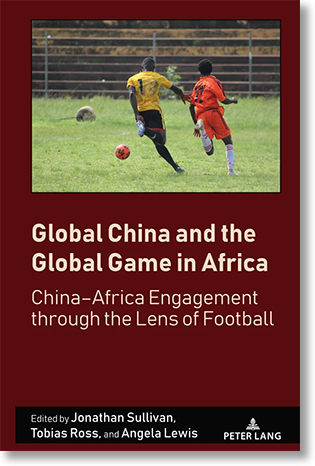
Global China and the Global Game in Africa: China–Africa Engagement through the Lens of Football
230 pages, hardcover
Oxford, Oxon: Peter Lang Publishing 2025 (Sport in East and Southeast Asian Societies)
ISBN 978-1-63667-649-4
This collection of twelve chapters is a contribution to A.J. (Tony) Mangan’s series, Sport in East and Southeast Asian Societies. Geopolitical, Political, Cultural and Social Perspectives, its main focus being on a highly significant geopolitical issue, namely Chinas relationship with Africa, especially sub-Saharan Africa. My first observation is that it is gratifying to read studies on football in China that do not focus exclusively or at all in the case of most of the chapters, on why the men’s national team is so unsuccessful. That is a question that has been addressed by numerous scholars, albeit with only minimal agreement on the answer.
The first three chapters consider the overarching theme of the book. The first is written by Jonathan Sullivan, one of the editors and a highly respected commentator on football in China. The second chapter is co-authored by Sullivan and Simon Chadwick, another influential expert of China’s football industry. Here they take geopolitical economy of football approach to China-Africa engagement in football. In Chapter 3, Xiufang (Leah) Li and Zhao Alexandre Huang examine the aims and aspirations that lie behind the China-Africa football relationship.
Some of the most interesting insights are provided in discussions about the use of what has become known as ‘stadium diplomacy’.
In the opening chapter, Sullivan notes that ‘Over the past two decades, China’s presence and purported ambitions in Africa have attracted considerable attention, scepticism and criticism, especially in western nations’ (p. 1). Importantly, however, he immediately adds that there is ‘no evidence that China is seeking colonies, using prisoners as cheap labor or any of the other lurid accusations made against “the Chinese” in Africa’ (Taylor, 2014, 121) (pp.1-2). Much of that criticism comes from countries such as the United Kingdom where Conservative politicians appear psychologically incapable of coming to terms with the fact that China is today a superpower which Britain once was largely on the back of imperialist expansion and colonialism. Without knowing it, such critics are projecting on to China their own lamentable dealings that affected large parts of sub-Saharan Africa and beyond. This conveniently ignores the ideological foundations of New China which have led the PRC to see itself, as Sullivan notes, ‘as an actor in solidarity with other developing nations in the struggle against western imperialism’ (p. 5). Of course, the relationship between China and Africa is not one of equals but it is complex. Therefore, according to Sullivan ‘the desire to contribute a more holistic and balanced understanding of engagement underpins the motivation for this book’ (p. 3). To what extent is this desire fulfilled?
Some of the most interesting insights are provided in discussions about the use of what has become known as ‘stadium diplomacy’. Sullivan refers to this phenomenon in his introductory chapter, reporting that, at the time of writing, China has been the main driving force behind the construction of sports stadia in 36 different countries. He argues that this involves a power differential that ‘cannot be masked by invoking legacies of solidarity or rhetorical commitments to “win-win” economic cooperation ‘(p. 5). He then invokes China’s appetite for African natural resources. This need not mean, of course, that solidarity is no longer meaningful although, in a chapter devoted entirely to stadium diplomacy, Charlie Qiuli Xue and Guanghui Ding prefer the term ‘socialist cosmopolitanism’ which embraces recognition and appreciation of ‘local cultural, economic and geographical distinctions’ (p.207). In providing a valuable account of the stadium diplomacy process, they note the importance of stadiums in the urban landscape, ‘a realm that intertwines sporting, political and cultural events ‘(p. 188).

Other particularly insightful chapters in the book include Angela Lewis’ and Tokumbo Ojo’s separate studies of StarTimesas an example of China’s engagement with sports media in Africa, Elsewhere in the collection, however, there is perhaps too much analysis of specifically African issues, above all, athlete migration, in relation to which the role of China is, to some extent, tangential. It is also a theme that has been explored extensively in other publications. The exceptions in this regard are chapters by Tobias Ross on Dalian Shide FC’s Lion Cub program and Peizi Han on female African footballers who have played professionally in China. Ross offers a sad but informative and well researched examination of a program which began in 2001 when 24 teenage players from Cameroon arrived in ‘football-mad Dalian’, none of whom subsequently contributed to the club’s finances through transfer fees or met the qualifications needed to represent Chinese national teams (p. 169).
As with male athlete migration, Han’s chapter has as much to do with Africa as it does about China but it is refreshing to get insights into the women’s game in a country where it is often ignored amongst the plethora of work on the weakness of the men’s national team. In addition, Han’s account is also more uplifting than Ross’ chapter and the other four which examine, from various perspectives, the movement of male African players to China. Not only does Han provide valuable information about African migration in China in general and, more specifically, the history of African women footballers in China, he also uses case studies of two particularly influential players, Asisat Oshoala from Nigeria and Tabitha Chawinga from Malawi, to recognise beneficial outcomes of player migration. He argues that ‘Oshoala’s success in China (with Dalian Quanjian) was a turning point in her career, which culminated in a transfer to Barcelona FC and the subsequent distinction of becoming the first African woman to win the UEFA Women’s Champions League’ (p. 81). Chawinga’s journey which led her to China ‘paralleled Oshoala’s in terms of overcoming family objections and cultural resistance to women and girls playing football (p. 81). Her dedication and talent positioned her, in Han’s words, ‘as a bridge between China and Malawi’ (p. 82). Taken together, according to Han, ‘the stories of Oshoala and Chawinga underscore the transformative power of football for African women in China and in their home countries, not just as athletes but as cultural ambassadors’ (p.83). Such stories, one can only assume, are significantly fewer in relation to male players.
Despite my concern that there is too much attention paid in some of the chapters to the factors that influence athlete labour migration to China and, indeed, elsewhere, even they provide worthwhile information for any reader who is interested in the overarching theme of the collection The only chapter which I feel is largely redundant is the one that focuses on North Africa and the Middle East. The former has such a different history from that of sub-Saharan Africa and, as for the latter, sport policy literature is already saturated with studies of the Gulf States. That minor criticism aside, this is a thought-provoking collection of essays that deserves to be read not only by people with a specific interest in football in China and Africa but also by anyone who simply wants to learn more about the important relationship between these two parts of the world in an era in which the global order is being reconfigured even as I write.
Copyright © Alan Bairner 2026