Christian Tolstrup Jensen
Dept. of Sport Sciences, Malmö University
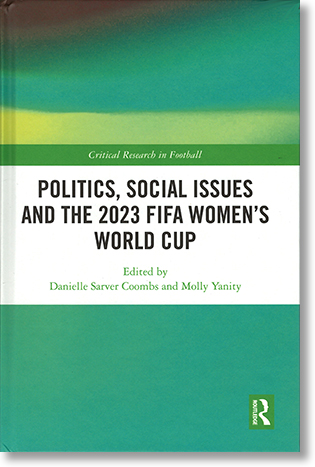
Politics, Social Issues and the 2023 FIFA Women’s World Cup
308 pages, hardcover
Abingdon, Oxon: Routledge 2025 (Critical Research in Football)
ISBN 978-1-032-83112-1
The increased interest in women’s football not only shows in the attendance of the tournaments. It also shows in research, and the 2023 FIFA World Cup has been subject to at least three anthologies. One of them looks at politics, representation, and management (reviewed here) another at the role of media at the tournament (reviewed here) and a third, subject of the present review, explores “important issues and emerging themes that were foregrounded during the 2023 Women’s World Cup” (p. 2). Such a statement opens for a broad view on women’s football, and the book fulfills this expectation well. Covering everything from the conditions for women’s football in Burkina Faso to right-wing coverage of the US women’s national team at the World Cup and the potential impacts of the tournament on women’s football in the Philippines, this volume takes the reader around the globe. The diversity in topics is also reflected in the composition of the authors with space for both established researchers and emerging new scholars coming from sociology, economics, sport management and other relevant subjects.
Having read the book, it however struck me how small a role the World Cup itself plays in many of the chapters. In Chapter 3, Emmanouil (Manos) Karousos uses it as a springboard for a rather general account of gender discrimination in football with regard to inter alia pay, access to leadership positions and media attention. And even more common is the use of the international tournament to describe and analyze a national development, in which the World Cup indeed played a role but more as a contributing than a crucial factor.
Similar to Spain, the challenges and politicization of women’s football in the US did not only happen with the 2023 World Cup, although it indeed intensified the criticism.
Chapter 5 and 6 by Jim McKay and Carlos Gómez Gonzáles and José Luis Pérez Triviño respectively covers the case of the then President of the Spanish Football Federation Luis Rubiales kissing the player Jennifer Hermose without her consent and the international outcry that followed. Although the kissing took place at the World Cup, it did not emerge out of nowhere. In chapter 5, McKay thus shows, from a “conjunctural perspective”, how the scandal was the result of a mix of long-standing issues in Spanish and international football including patriarchy, neoliberalism and clientelism.
Similar to Spain, the challenges and politicization of women’s football in the US did not only happen with the 2023 World Cup, although it indeed intensified the criticism. In chapter 10, Taylor Henry shows how the World Cup was a culmination of at least two years of critique in the right-wing sport media outlet Outkick. Similarly, Molly Yanity in chapter 7 shows how such a discourse also developed around former member of the US national team Carli Lloyd. By not least insisting on keeping sport as separate from politics and seeing sport as simply a matter of being the best, Lloyd also came to discard sport as a feminist issue, which right-wing sport media outlets such as Outkick in turn would use in their coverage.
Finally, chapters 8, 10 and 4 present cases from Colombia, the Philippines and Burkina Faso and show how the World Cup in the first two cases augmented the ongoing improvement of the position of women’s national teams. In Colombia (chapter 8 by Karen Ariza Carranza and Peter J. Watson) the 2023 World Cup for instance was a “critical visibility moment” but also a moment that was linked to the team’s past performance (and protests) at the 2019 World Cup and 2022 Copa América. Likewise Satwinder Rehal in chapter 9 analyses the step of the women’s national team towards national legitimacy in the Philippines when beating the host New Zealand 0–1 and how the process – like in Colombia – among other things was helped by a concurrent set-back for their male counterparts. Eventually, Sylvain Zingue in chapter 4 showcases the difficult conditions for women’s football in Burkina Faso. Despite the very limited link to the World Cup and the lack of an explicit research design, it is an interesting read for its insights on the structural hinders (not least the obligations for women in the family).
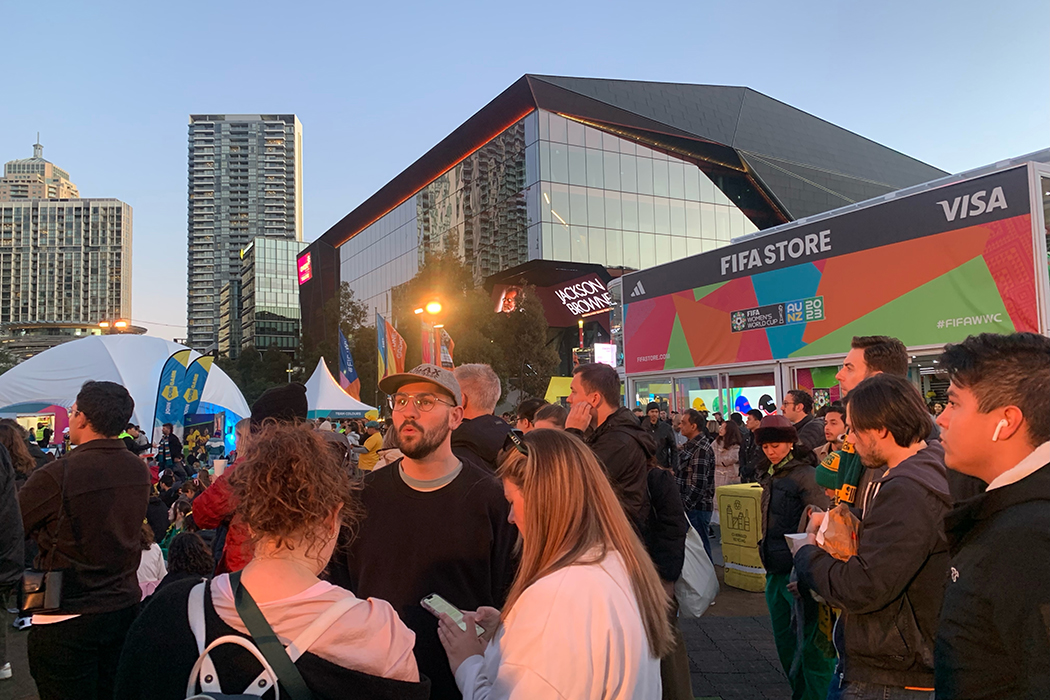
That said, there are chapters which tell us something about the World Cup as such. Chapter 2 by Andrew Grainger and Hillary J. Haldane offers a critical study of the organization of the World Cup and the sincerity in FIFA’s efforts to support indigenous involvement in the tournament. The main bulk of news on the World Cup then follows in the final four chapters on fandom at the World Cup. Here data is based on and explicitly linked to the 2023 edition. Niamh Kitching in chapter 11 shows how children’s interest in the tournament in Ireland among other things was dependent on their gender, their place of residence (rural/urban) and background (migrant/non-migrant). Chapter 14’s analysis of the impressions of the stadia among Australian and German fans by Jessica Kunert, Lina-Doreen Rose and Christiana Schallhorn show a similar cultural dependence when it comes to understanding football. While both groups perceived the stadiums as having a friendly atmosphere and being a safe space, the Australian fans always did this to a higher degree than their German counterparts; possibly due to the longer experience with male football in Germany and the role football plays there. Chapter 12 (by Jessica Richards, Andrew Grainger and Edward Mariyani-Squire) in turn focuses on the premises of the World Cup analyzing two cases of fan zones within and beyond the control of FIFA and how the latter was much less marked by commercial offers and had a higher focus on the sport itself and local involvement. The chapter is neatly followed by a study on the behavior of fan groups in the fan zones. There, based mainly on Australian media coverage and a clear design, Kasey Symons shows how the fan zones and communities for the women’s World Cup were fun, noisy and inclusive (a place to find friends – more than sport) in somewhat of a contrast to men’s fan groupings. This contrast was also recognized by the fans, who made their fandom into a political statement in all their creative, serious unseriousness.
By reading Politics, Social Issues and the 2023 FIFA Women’s World Cup, I have learned a lot about the current state of women’s football. But I am cautious regarding the central role attributed to the 2023 World Cup in the title and introduction, where the Cup is declared a “tipping point” (p. 1) and even a “cornerstone” (p. 4). For one, the last remark is taken from a report published by FIFA and the World Trade Organization and should be read with caution. But furthermore, this is a book on the 2023 World Cup published 2025. Any talk in the studies on the impact of the World Cup in e.g. Colombia, the Philippines and on the fandom are necessarily speculations. The speculations are qualified and of course the growth of the Women’s World Cups is important for understanding the development of women’s football. The book shows this already in chapter 1 where Alanna Harman and Tim Elcombe analyze the growth of attendance and interest from an increased number of stakeholders in FIFA Women’s World Cup; findings which also serve as a good overview of the international history of women’s football. It is however telling that this study takes a historical perspective starting in the 1990s. And although chapter 1 lists global issues brought forward by the 2023 edition (including ACL injuries, pay equity and athlete activism), my takeaway from the book is that the development women’s football cannot depart from – nor be understood by – single editions of the World Cup. A sustained and thorough development, as well as gaining understanding iof such a development, requires taking a long view on the national basis. Along with the talk of the World Cup as a tipping point, it is also stated that the “results are promising” (p. 1), a more modest claim with which I would tend to agree.
Copyright © Christian Tolstrup Jensen