Łukasz Muniowski
University of Szczecin, Poland
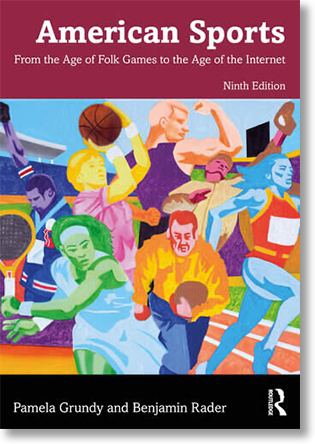
448 pages, paperback, ill
Abingdon, Oxon: Routledge 2026
ISBN 978-1-032-34774-5
Pamela Grundy’s and Benjamin Rader’s American Sports: From the Age of Folk Games to the Age of the Internet has just undergone its eighth revision, and its ninth edition is a testament to the quality and comprehensibility of the book. The updated text is 130 pages longer than the previous edition, published in 2019, and the authors point out in the preface that “a great deal has happened” since that time, most notably NIL, legal sports gambling and Covid-19 (p. xiii). The global and local developments changed the way we consume and study sports, as the availability of spectatorship increased, while sports have become more commercialized than ever, leading to oversaturation and numbness to otherwise impressive physical achievements. However, the hypocrisy of the ruling institutions and the hold that they had on athletes loosened, which is a welcome change, one that fans and scholars can stand behind in unison.
The book is not solely about sports but about the social, political and cultural changes that impacted America, and only in turn the world of sports, allowing it to blossom into one of the pillars of everyday life. The origins of sports in United States signify their dualistic nature, painting them as something both ceremonial and entertaining. Native American competitions were full of passion, and various important events punctuated the year, while the contests organized by the colonizers vastly contributed to the commodification of various disciplines. For the Indigenous peoples sport was about local pride, ditto for the Europeans, however they also considered it a symbol of status, strongly connected with the notion of amateurism. Similarly to the way they were perceived on the Old Continent, professionals were looked down upon, as sport was about leisure and pleasure since perfecting one’s craft required time, available only to those who could afford to spend it on sports. The thing that connected both approaches was the adoration for the best athletes, which has been the staple of sports fandom ever since its inception.
Despite suffering various crises, exposing the hypocrisy of institutions responsible for upholding the rules and fair play, sports persevered through point-shaving scandals, corruption and life-threatening injuries to some of its main actors, and remains a global force.
Considered trivial by some, physical activity was also heavily divided, with hunting originally considered better than, say, anetso (which would later become known as “lacrosse”) or (what would later become known as) American football. Then there was the gender divide, which plagued American sports for over a half of century, and while the gap between the funding and support of men’s and women’s sports is still substantial, there is no denying the fact that women finally get a chance to play.
Grundy and Rader highlight the role of pioneers who paved the way for today’s generation of athletes, providing biographical information crucial to understanding the circumstances they had to face to just get that chance. The authors also focus on the role of media in the changing perception of sports, regardless of whether we are talking about telegraphs and newspaper offices inviting crowds to gather and learn about sporting outcomes, to people constantly checking their phones while on family functions or vacations to do the exact same thing.
Apart from being a historical account of the development of sports in the United States, the book is also an invaluable tool for understanding the importance of morals for sport and its development, as without the early connections with religion, rules and discipline, it would not be possible for it to gain so much popularity. Despite suffering various crises, exposing the hypocrisy of institutions responsible for upholding the rules and fair play, sports persevered through point-shaving scandals, corruption and life-threatening injuries to some of its main actors, and remains a global force. Nowadays the business aspects oftentimes overshadow the purity of the competition, but it is still there, albeit requiring a look beyond sponsorships and (sometimes overpaid) superstars.
The 23 chapters of the book are structured like individual classes. Most open with a short narrative describing a sporting competition which is then followed by a discussion of historically and thematically divided issues, developments and individuals. They end with a conclusion, critical thinking questions and exercises. This structure-reliant approach makes for a wonderful textbook, one which I also relied on when preparing my classes on American sports a couple of years ago. Sticking to that approach and – expanding it for the eighth time! – opened up Grundy and Rader’s work to a new generation of scholars who can build upon their structure and extend the topics which they touch upon. Factually accurate, simple and organized, American Sports, is a book every sports historian needs to read and study. This applies to its contents but also its structure.
Copyright © Łukasz Muniowski 2026