Hans Bolling
PhD in History, Independent scholar
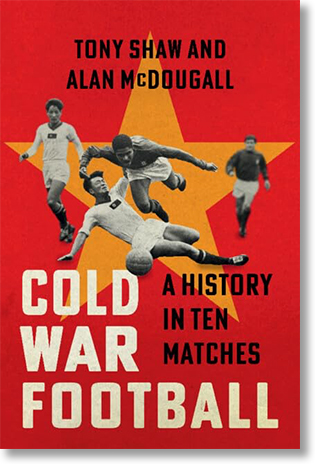
Cold War Football: A History in Ten Matches
276 pages, hardcover, ill
Cambridge, Cambs: Cambridge University Press 2026
ISBN 978-1-009-45612-8
One of the first publications about sport I remember reading, looking at the pictures in, was Världsmästarna 1974: De stora mästerskapen i bild [World Champions 1974: The major championships in pictures], which covered that year’s world championships in football, ice hockey, handball, skiing and more. I still remember photographs from it, not only the one of Jan Tomaszewski saving Staffan Tapper’s penalty in the second round of the 1974 World Cup, but also a picture of a footballer from Zaire (the Democratic Republic of Congo) being sent flying by Scotland’s Billy Bremner in the country’s debut at the tournament. It all came back to me when I read Tony Shaw’s and Alan McDougall’s book Cold War Football: A History in Ten Matches, which devotes a large part to the 1974 World Cup, the first World Cup I have my own memories of.
Cold War Football is what the title suggests, a book about the Cold War’s influence on football and vice versa. The aim with it is to unveil football’s role during one of the conflicts that shaped the twentieth century. The ten matches Shaw and McDougall have selected are the ’friendly’ game between Arsenal and Dynamo Moscow in London in November 1945; the final of the 1954 World Cup between West Germany and Hungary in Bern; the ’friendly’ game between Ireland and Yugoslavia in Dublin in October 1955; the final of the 1964 European Championships between Spain and the Soviet Union in Madrid; the 1966 World Cup quarter final between North Korea and Portugal in Liverpool; the second and decisive World Cup qualifying match in Santiago between Chile and the Soviet Union in November 1973, which was never played; the 1974 World Cup game between West Germany and East Germany in Hamburg; the game between Zaire and Yugoslavia in the same World Cup; the 1988 Romanian cup final between Steaua Bucharest and Dinamo Bucharest; and finally the first game of the first Women’s World Cup in 1991 between China and Norway in Guangzhou. The book thus concludes with the incorporation of women’s football into the remit of FIFA.
From the first perspective the authors have succeeded in choosing matches that are not only interesting in their own right but are also well-suited when it comes to explore different themes relating to the Cold War.
In a book about history, there is always room to discuss the source material – in this case that can be done from two perspectives: the football matches chosen and the material used. From the first perspective the authors have succeeded in choosing matches that are not only interesting in their own right but are also well-suited when it comes to explore different themes relating to the Cold War. One could perhaps argue for the inclusion of a game from the decade and a half between the 1974 World Cup and the cup final in Bucharest in 1988. The same thing can be said about the second perspective; the book is based on thorough research in archives and in literature, magazines and newspapers.
Taken together this means that Cold War Football is a book that explores themes from mistrust between former allies and the Catholic Church’s stance on, mistrust towards, the communist countries in Eastern Europe via the new Germanys that were created after the Second World War, to the USA’s and the Soviet Union’s interference in local politics in South America and Africa and much, much more. But, much attention is also directed toward the football that was actually played, from detailed descriptions of the Arsenal vs. Dynamo game played in the fog at Tottenham Hotspur’s stadium White Hart Lane, via the game between Chile and the Soviet Union at the Estadio Nacional in Santiago, which had been used as an internment camp following the military coup in September 1973, in November the same year that kicked off but wasn’t played since the Soviet players never took to the field, to chaos and coercion in local football in Rumania in the late 1980’s.
As Cold War Football is a well written and easy to read book, it ought to interest anyone with an interest in football and the history of the second half of the twentieth century. In this thoroughly entertaining book, the most interesting chapters are the two that focus on club football, which reinforces the view that local and national sport not only is the most important sport in people’s lives, it also has the most to say about the societies in which it is played. It is what matters when the media spotlights are directed elsewhere.

To use football matches to say something, a lot, about the world seems to be in vogue. In May 2026 the Italian sport journalist Stefano Bizzotto’s book Storia del mondo in 12 partite di calico was published in English as The History of the World in 12 Soccer Matches. Given that the approach works well, this is hardly surprising.
However, one thing worth discussing is if football is the most suitable sport to use as a lens thorough which to study and understand sport and politics during the Cold War. As it is the world’s most popular sport a yes might be the obvious answer. But arguments against football as a political tool during the Cold War can be that it is a sport that compared to most others has been able to live and thrive without much support from authorities and therefore capable of asserting a degree of independence vis-à-vis them. Also, it is a sport with boisterous and often headstrong supporters who are difficult to control. Further, investing political capital in the game possesses a risk, and as a low scoring game in which the outcome is difficult to influence and the underdog has a real chance of winning, there is a probability that the result in matches will not satisfy those in power. The true arena to assert the benefits of a political system, or protest against them, through sport during the Cold War would probably be the Olympic Games or, in the case of Sweden, the tennis courts.
Finally, my fond memories of the 1974 World Cup mean that I must point out a minor error in Cold War Football. On page 167 we are told: ‘All four teams from Eastern Europe competing in West Germany – Poland, Bulgaria, East Germany and Yugoslavia – would make it through to the second round.’ Bulgaria were drawn in the same group as the Netherlands, Uruguay and Sweden, and it was Sweden who, alongside the Netherlands, progressed to the second group stage. There, as mentioned on page 148, Sweden played against West Germany in the rain at the Rheinstadion in Düsseldorf, and Ralf Edström’s opening goal made the Swedish television audience dream of witnessing a repeat of 1958 and the commentator Bengt Grive to utter the classic words: ‘där kommer Edström, volley, åh vilket skott, samma kalasskott som ni minns från första målet mot Uruguay och precis från samma läge, med samma ben och samma höjd och jag tror nästan lika bra fart på bollen… vad är klockan?’ [here comes Edström, volley, oh what a shot, the same great shot that you remember from the first goal against Uruguay and from exactly the same position, with the same leg and the same height and I think almost as good a speed on the ball… what time is it?]. On the other hand, Shaw and McDougall declare the match between West Germany and Sweden to be ‘the game of the tournament’.
Copyright © Hans Bolling 2026