
Home » Aage Radmann
Category Archives: Aage Radmann
ECSS Malmö 2015: 2,000 abstracts in more than 200 sessions

Post by Aage Radmann and Susanna Hedenborg
As presidents for the ECSS Malmö 2015 Congress, we have spent a few days down at the ECSS central office in Cologne together with the staff members, Hans Hoppeler (former president of the ECSS, 2009–2011) and Flemming Dela (co-chair of the ECSS Scientific Board). The purpose of this high-level get-together was to build the program, based on accepted abstract. The program will be announced to all participants on April 1, 2015.
The ECSS office is located close to the German Sport University Cologne (Deutsche Sporthochschule Köln, https://www.dshs-koeln.de/english). This is the biggest sport university in Europe with its 21 faculties with high quality education and research.

Deutsche Sporthochschule Köln
Some 6,000 students from 72 countries are enrolled in courses and programs within a diverse array of teacher education, humanities and social sciences, and world leading biomedicine. It is an enormous university campus, with lecture rooms, sport facilities and student accommodation. It is situated close to recreational parks, and there is even a horse stable so that the future PE teachers will be well prepared!

Flemming Dela, co-chair Scientific board, Copenhagen university, and Hans Hopppeler, former president, in the initial stages of program building – utilizing post-it notes.
For the Malmö ECSS congress about 2,000 abstracts have now been placed in different sessions, and it’s amazing what an interdisciplinary scholarly meeting this really is. ECSS is actually one of the largest interdisciplinary sport science conferences in the world, and in Malmö yore congress is made up of 200 sessions! In addition, satellite sessions, interest group meetings and workshops are planned in connection to the scientific program.

Time for a dinner break after a long day building the program. Elias Tsolakidis, ECSS Technical Director, Hans Hoppeler, former president, and Thomas Delaveaux, Executive Director of the ECSS, at the Anno Pomm Kartoffelhaus.
Participants will arrive from about 75 countries across the globe. Even though this is a European conference, big groups of researchers come from Japan, Brazil and other countries well outside of Europe.
This year the number of abstracts from the fields of social science and the humanities have increased, and this summer more than 25 per cent of the presentations fall within these fields. ECSS 2015 is possibly the scientific sport conference that has attracted the highest number of participants within the field of social science and humanities ever!

The ECSS Malmö 2015 Congress presidents, Aage Radmann and Susanna Hedenborg, in Cologne.
We really look forward to meeting you all in Malmö!
Welcome!
Why Malmö is Scandinavia’s Hippest Travel Destination
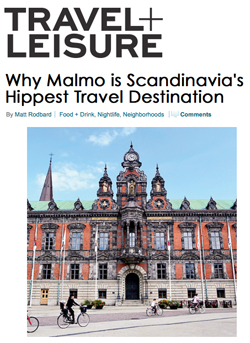 We are not bragging about Malmö ourselves this time, its actually the New York magazine Travel + Leisure who put Malmö on the list as one of the best places in the world (phew) to visit. Travel + Leisure highlights some of the best things about Malmö:
- Because it has one of Scandinavia’s most progressively designed neighborhoods. The once-gritty Western Harbor is now Europe’s first carbon-neutral district. As part of a government-funded competition, architects were tasked with creating statement-making structures that use renewable sources of energy.
- Because some of the region’s best chefs are setting up shop. Cheap rents and a food-obsessed public have lured bright culinary talents.
- Because coffee is considered a high art. Single-estate beans, on-site roasting, cups brewed with high-tech gadgets: Malmö, like much of Sweden, takes its coffee seriously.
- Because there’s a really good nightlife scene. A cocktail renaissance is taking over southern Sweden.
So, as you can see, some of these good things about Malmö is connected to the sustainable theme for ECSS 2015.
And soon you will have the possibility to discover all this by yourself. Welcome to Malmö.
Please visit Travel + Leisure to find out more about the 2015 ECSS city!
Prominent guests from University of Southern Denmark and Michigan State University, in Malmö
Post by Aage Radmann and Susanna Hedenborg.
Yesterday, prominent guest speakers visited the the Research Seminar Series in Sport Sciences at the Dept. of Sport Sciences, Malmö University – which, in case you’ve missed it, is hosting next year’s ECSS Congress.
 Karen A Pfeiffer’s (from Michigan State University) first area of research is measurement of physical activity; the second area is interventions to increase physical activity. These two research interests were nicely combined in the work she has been doing together with others in order to publish guidelines and an overview (review-review) of what research has to say about interventions with the aim to increase physical activity among children and youth that actually work. An important result was that enhanced PE seems to be the way to go. So what is enhanced PE? Well, it is not enough to increase hours of PA – PA has to have a certain quality too. It is important to learn skills – not only to be physically active. This is interesting and raises questions of how to make sure that children meet educated PE teachers! Pfeiffer also pointed to new research on the importance of building environments that people like to be physically active in. In conclusion, she talked about future research and the needs to concentrate on optimal age range for specific approaches, long-term follow-up, and that we need to compare effects across race, ethnicity and socio-ecnomic groups.
Check out the report that laid the basis for Karen Pfeiffer’s talk.
 Lars Bo Andersen (University of Southern Denmark) took over the lectern after Karen Pfeiffer. Denmark has introduced 45 minutes PA per day during school hours. Except for presenting convincing research on the importance of increased PA, Anderson presented a few different studies on intervention projects. It should be easy to use the results from these studies to convince politicians in other countries! Even so, it is difficult to change people’s minds – we know PA is good for you, and how PA can improve health – this is still not enough to make people change their habits. Andersen will chair one of the sessions at the ECSS congress in Malmö – so, the discussion will surely continue! We look forward to it!!
Susanna Hedenborg & Aage Radmann
Congress Presidents

Karen Pfeiffer in action in Malmö.

Lars Bo Andersen reviewing the Danish situation.
The Football Capital of Scandinavia
Post by Aage Radmann and Susanna Hedenborg
For the second year running the two Malmö football teams, Malmö FF (the men’s team) and Rosengård FC (the women’s team), won their respective Swedish top leagues for association football clubs. Both teams play in this year’s Champions League. Football is the most popular sport for children and young people in Sweden – both boys and girls play football. Some of you may have heard of Zlatan Ibrahimovic – Malmö FF used to be his team. Maybe you have heard of his book too, it has been translated into several languages – in Sweden it actually gave rise to a sort of “Harry Potter effect” when it comes to reading and boys. Sport can really play many different roles!
Other popular sports that you may encounter on your visit to Malmö are floor ball, golf and horse riding – they are very popular sports here as well. Floor ball was developed in Sweden in the 1970’s and is a kind of floor hockey. At the Department of Sport Sciences at Malmö University it is played every Friday between 12 and 1 PM – make sure you try it while visiting the ECSS Congress next year!
There are several golf courses in the region and golf players from northern Sweden envy the opportunities to (almost) all year golf in this southernmost part of the country.
Guests from abroad are often surprised that horse riding is one of the most popular sports for girls and women. Horse riding has really changed since the beginning of the 20th century. A hundred years ago, horses were used in agriculture, forestry and the transport sector as well as in the army. Most horses were draught horses and working with horses was connected to masculinity. Today young girls and women occupy the horse riding clubs and compared to many other countries, horse riding in Sweden is not an exclusive occupation for the upper classes. Why not try a ride on an Icelandic horse in one of the small forests not far from Malmö while visiting the conference!
In addition, there are good jogging opportunities close to the conference venue – not least along the beautiful beach at Ribersborg. That’s where we’ll host a Conference Run in honour of Bengt Saltin – come join us!
Susanna Hedenborg & Aage Radmann
Congress presidents
